Physics (Grade 10, Lebanon) · Chapter 5 · Tutorial exercise
Experimental study of an electrolyzer and operating threshold
Generators and receivers · B. Linear active receivers · level 2
Statement
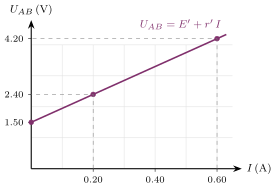
We carry out the experimental study of an electrolyzer with platinum electrodes containing an aqueous solution of sulfuric acid. By varying the voltage applied across it, we record the current through it:
- As long as , the ammeter reads and no gas is released at the electrodes.
- For , we measure .
- For , we measure .
- Why does no current flow as long as ? How does this behavior immediately distinguish an active receiver from an ohmic conductor?
- In the linear domain (), determine the internal resistance and the counter-electromotive force of the electrolyzer.
- This electrolyzer is operated with a constant current for a time . a) Calculate the voltage across it. b) Calculate the total electrical energy received , the chemical energy used to decompose water into dihydrogen and dioxygen, and the thermal energy dissipated by the Joule effect in the solution. c) Calculate the energy efficiency of this electrolysis.
Solution
- An electrolyzer carries out a non-spontaneous chemical transformation (here the electrolysis of water) which requires a minimum supply of energy per electric charge, characterized by its threshold voltage (close to ). Unlike an ohmic conductor (), which lets current through at the slightest nonzero voltage, an active receiver remains blocked () as long as the applied voltage is less than its counter-electromotive force.
- On the straight portion of equation , the slope gives the internal resistance : The vertical intercept gives the counter-electromotive force : Ohm's law for the electrolyzer is therefore written .
- a) For : b) For a time :
- Electrical energy received:
- Useful chemical energy:
- Energy dissipated by the Joule effect: (Check: ). c) The efficiency of the electrolyzer is:
What the exercise establishes: Interpret physically the counter-electromotive force of an electrolyzer as the minimum voltage required for the electrochemical reaction and carry out a complete energy balance.
Similar exercises
- Series combination of generators and effect of a worn-out battery solved
- Electric motor of a goods lift: locked-rotor and running-rotor tests solved
- Determining the efficiency of an active receiver from the powers solved
- Comparison of a voltage generator and a storage battery over a cycle solved
- Supplying a motor and a heating resistor from a battery of generators solved
The course of the chapter · All the exercises of the chapter