Physics (Grade 10, Lebanon) · Chapter 5 · Tutorial exercise
Supplying a motor and a heating resistor from a battery of generators
Generators and receivers · B. Linear active receivers · level 3 (hard)
Statement
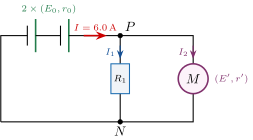
On the test bench of a small experimental electric vehicle, the power source is made up of two identical battery modules connected in series with the same polarity. Each module has an electromotive force and an internal resistance . This equivalent source delivers a main current which supplies two branches connected in parallel between its output terminals and :
- Branch 1: a defrosting resistor of resistance carrying a current .
- Branch 2: the electric propulsion motor of internal resistance , carrying a current .
- Study of the source: a) Calculate the emf and the internal resistance of the combination of the two modules in series. b) Calculate the voltage available at the output terminals of the battery when it delivers , as well as the efficiency of the battery.
- Study of the two receiving branches: a) What is the voltage across the resistor and that across the motor? Deduce the value of the resistance . b) By applying the junction law, calculate the current through the motor, then determine the counter-electromotive force of the motor and its efficiency .
- Overall power balance: Calculate:
- the total power generated by the battery;
- the useful mechanical power of the motor;
- the thermal power of the defrosting resistor;
- the sum of the powers lost by the Joule effect in the battery () and in the motor (). Check the overall conservation of power in the complete system.
Solution
- a) For the two identical modules combined in series with the same polarity: b) For a delivered current : The efficiency of the battery is:
- a) Since the two branches are connected in parallel directly between and , they are subjected to the same voltage . According to Ohm's law for the resistor carrying : b) According to the junction law (), the current in the motor is: According to Ohm's law for the motor () with : The efficiency of the motor is then:
- Overall power balance:
- Total power generated by the battery:
- Useful mechanical power of the motor:
- Thermal power of the defrosting resistor:
- Internal Joule-effect losses: that is, total internal losses .
- Check of the conservation: The total power generated by the battery is found entirely in the sum of the powers converted (mechanical and thermal) throughout the circuit.
What the exercise establishes: Prepare the study of the complete circuits of chapter 6 by coordinating Ohm's law for the generator, the junction law, Ohm's law for the motor and the overall conservation of power.
Similar exercises
- Series combination of generators and effect of a worn-out battery solved
- Experimental study of an electrolyzer and operating threshold solved
- Electric motor of a goods lift: locked-rotor and running-rotor tests solved
- Determining the efficiency of an active receiver from the powers solved
- Comparison of a voltage generator and a storage battery over a cycle solved
The course of the chapter · All the exercises of the chapter