Physics (Grade 10, Lebanon) · Chapter 6 · Tutorial exercise
Operating point of a generator facing a passive then an active receiver
Electric circuits · A. Operating point and Pouillet's law · level 1 (application)
Statement
In the laboratory we have a linear DC voltage generator whose characteristic passes through the points and .
- Determine the electromotive force and the internal resistance of this generator, and write the numerical equation of its characteristic.
- First experiment: An ohmic conductor of resistance is connected across the terminals of this generator. a) Determine the coordinates of the operating point of this circuit. b) Calculate the electrical power received by the resistor and the efficiency of the generator.
- Second experiment: The ohmic conductor is replaced by a DC electric motor of counter-electromotive force and internal resistance . a) Determine the coordinates of the new operating point. b) Calculate the useful mechanical power developed by the motor, the efficiency of the generator, the efficiency of the motor and the overall efficiency of the circuit. Check that .
Solution
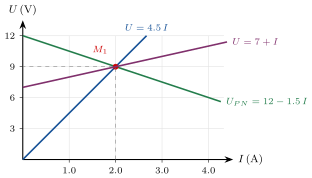
1.
- For , the no-load voltage is .
- The internal resistance is the opposite of the slope of the line :
- Equation of the characteristic of the generator: .
- With the ohmic conductor (): a) The equality at the operating point is written: The common voltage is then: b) Power received by and efficiency of the generator:
- With the motor : a) The equality at the operating point gives: The common voltage across the generator and the motor is: b)
- Useful mechanical power of the motor: .
- Total power generated by the generator: .
- Efficiency of the generator: .
- Efficiency of the motor: .
- Overall efficiency of the circuit: We do check that .
What the exercise establishes: Determine the operating point of a simple circuit and notice that two receivers of different natures (a resistor and a motor) can impose exactly the same operating point while having different internal energy balances.
Similar exercises
- Pouillet's law in a series loop with several generators and receivers solved
- Effect of the rotation or stalling of a motor in a series circuit solved
- Mixed circuit comprising an electrolyzer and a bridge of resistors solved
- Solving a network with three active branches in parallel between two junctions solved
- Resistance matching and maximum power transfer to a load solved
The course of the chapter · All the exercises of the chapter