Physics (Grade 10, Lebanon) · Chapter 6 · Tutorial exercise
Pouillet's law in a series loop with several generators and receivers
Electric circuits · A. Operating point and Pouillet's law · level 2
Statement
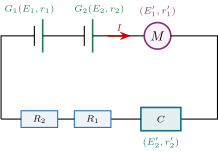
A single series loop is built comprising in succession:
- a generator of emf and internal resistance ;
- a generator of emf and internal resistance , connected in series with the same polarity as ;
- a DC motor of back emf and internal resistance ;
- an electrolysis cell of back emf and internal resistance ;
- two ohmic conductors of resistances and .
- Calculate the direct current flowing in this series circuit, specifying the law used.
- Calculate the voltage across each of the dipoles: , , , and the overall voltage across the set . Check the loop law.
- Carry out the complete power balance (total power generated by the generators, useful mechanical and chemical powers, total power dissipated by the Joule effect) and check the conservation of power.
Solution
- Since the circuit has only a single loop without branches, we apply Pouillet's law:
- Sum of the electromotive forces: .
- Sum of the counter-electromotive forces: .
- Sum of all the resistances of the circuit: The current is therefore:
- For , Ohm's laws give:
- ;
- ;
- ;
- ;
- . Check by the loop law:
- Power balance:
- Total power generated by the two generators:
- Total useful power (mechanical in + chemical in ):
- Total power dissipated by the Joule effect in all the resistances: We do check the conservation of power: .
What the exercise establishes: Apply Pouillet's law without hesitation to a complete chain of dipoles in series and check the consistency of the results by the loop law and the power balance.
Similar exercises
- Operating point of a generator facing a passive then an active receiver solved
- Effect of the rotation or stalling of a motor in a series circuit solved
- Mixed circuit comprising an electrolyzer and a bridge of resistors solved
- Solving a network with three active branches in parallel between two junctions solved
- Resistance matching and maximum power transfer to a load solved
The course of the chapter · All the exercises of the chapter