Physics (Grade 10, Lebanon) · Chapter 6 · Tutorial exercise
Solving a network with three active branches in parallel between two junctions
Electric circuits · B. Mixed circuits and networks with several loops · level 2
Statement
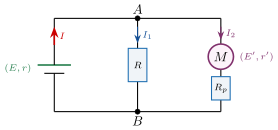
Between two junctions and of an electric circuit, three branches are connected in parallel:
- Branch 1 (generating): a generator of electromotive force and internal resistance (positive terminal on the side of ), which delivers the main current toward junction .
- Branch 2 (passive receiving): an ohmic conductor of resistance , carrying from to a current .
- Branch 3 (active receiving): an electric motor connected in series with a protective resistor , the whole carrying from to a current .
- Write the expression of the voltage in each of the three branches as a function of , of and of respectively.
- Express , and as functions of the single unknown , then use the junction law at to calculate the exact value of the voltage .
- Deduce the numerical values of the currents , and .
- Calculate the voltage across the motor alone in branch 3, and check the complete balance of conservation of electrical power in the three branches of the network.
Solution
- Since the three branches are in parallel between and :
- Branch 1 (generator convention): .
- Branch 2 (receiver convention): .
- Branch 3 (motor + resistor in series, of total resistance ):
- Let us isolate each of the three currents as a function of : The junction law at junction is written , that is: Let us multiply both sides by : We get .
- We deduce the three currents:
- ;
- ;
- . We check that .
- Across the motor alone : Power balance:
- Power generated: .
- Useful power of the motor: .
- Total Joule losses: . The sum is exactly equal to .
What the exercise establishes: Master the node-potential method ( chosen as the main unknown), which makes it possible to solve with a single linear equation any network of branches in parallel.
Similar exercises
- Pouillet's law in a series loop with several generators and receivers solved
- Effect of the rotation or stalling of a motor in a series circuit solved
- Mixed circuit comprising an electrolyzer and a bridge of resistors solved
- Resistance matching and maximum power transfer to a load solved
- Workshop electrical network with switching of a motor and a furnace solved
The course of the chapter · All the exercises of the chapter