Physics (Grade 10, Lebanon) · Chapter 8 · Tutorial exercise
Using a piecewise position graph
Rectilinear motions · A. Uniform rectilinear motion (URM) · level 2
Statement
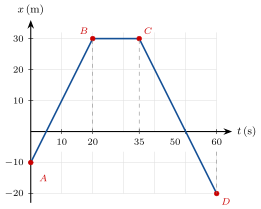
A pedestrian moves along a straight path provided with a reference . The graph representing the variations of his abscissa as a function of the time is made up of three successive line segments:
- from to , the segment joins the point to the point ;
- from to , the segment joins the point to the point ;
- from to , the segment joins the point to the point .
- Using the relation on each segment, determine the algebraic velocity of the pedestrian in each of the three phases, specify the nature of his motion and write the corresponding time equation .
- At what instants does the pedestrian pass through the origin () of the reference?
- Calculate the total distance traveled by the pedestrian between and , as well as his average speed over the whole .
Solution
- In each phase, the graph is a line segment: the ratio is constant, so each phase is a uniform rectilinear motion (or a state of rest).
- Phase 1 (): It is a URM in the positive direction with initial abscissa , hence .
- Phase 2 (): The pedestrian is at rest (motionless) at the constant abscissa .
- Phase 3 (): It is a URM in the negative direction with equation .
- The pedestrian passes through the origin when :
- on the way out (phase 1): ;
- on the way back (phase 3): .
- The total distance traveled is the sum of the distances traveled during the three stages: The average speed over the total duration is:
What the exercise establishes: Read the velocity of a URM as the slope of a graph and distinguish the final abscissa from the total distance traveled.
Similar exercises
- Time equation of a uniform rectilinear motion and meeting of two vehicles solved
- Experimental establishment of the time equations and on an inclined table solved
- Applications of the laws of uniformly accelerated rectilinear motion (inclined plane, free fall, airplane and electron) solved
- Chronophotograph of a ball in free fall reproduced at the scale 1/40 solved
- Study of a rectilinear motion by its velocity graph and the area method solved
The course of the chapter · All the exercises of the chapter