Physics (Grade 10, Lebanon) · Chapter 8 · Direct application of the course
Using a velocity graph and area under the curve
Rectilinear motions · level 2
Statement
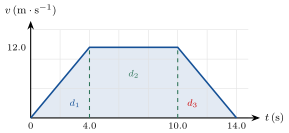
A cart moves in the positive direction of a straight rail , starting from the origin () at the instant . Its velocity graph has three phases:
- Phase 1 (): line segment going from to .
- Phase 2 (): horizontal segment of ordinate .
- Phase 3 (): line segment going from down to the stop .
- Determine the acceleration and the precise nature of the motion in each of the three phases.
- By calculating the area under the graph , determine the distance traveled during each phase as well as the total distance traveled by the cart between and .
Solution
- The acceleration in each phase is given by the slope of the corresponding segment:
- Phase 1 (): . The velocity increases: uniformly accelerated rectilinear motion.
- Phase 2 (): (): uniform rectilinear motion.
- Phase 3 (): . The velocity decreases: uniformly decelerated rectilinear motion.
- Let us calculate the area under the graph for each phase:
- Phase 1 (triangle of base and height ): .
- Phase 2 (rectangle of base and height ): .
- Phase 3 (triangle of base and height ): .
The total distance traveled is the sum of the three areas (equal to the area of the trapezoid of large base , small base and height ):
Similar exercises
- Synthesis problem: pursuit between a motorist in uniform motion and a motorcyclist in uniformly accelerated motion solved
- Starting and braking of an automobile solved
- Using a recording on an inclined air table solved
- Vertical free fall with initial velocity solved
- Pursuit between a motorcyclist in UARM and a truck in URM solved
The course of the chapter · All the exercises of the chapter