The English-speaking world beyond Britain and America
Cours · anglais LV A et LV B (prépas ECG et ECT), chapitre 14 · prépas ECG et ECT, 1re et 2e années · le début du chapitre, la suite sur Adloun
English is spoken as a first language by a minority of its speakers. Most people who use it learned it at school, at work or online, from Lagos to Bangalore and from Shanghai to Paris. The English-speaking world is therefore much larger than Britain and America: it includes former settler colonies (Canada, Australia, New Zealand), a neighbour with a painful history (Ireland), and former colonies where English became one language among many (India, South Africa, Nigeria). Most of them belong to the Commonwealth, a voluntary association that grew out of the British Empire.
This chapter gives you the essential landmarks for each of these countries, explains what the Commonwealth is and is not, and discusses English as a global language. These countries offer precious examples for an essay: a reference to Canada, India or South Africa shows that a candidate does not reduce the English-speaking world to London and Washington.
ELVi: essay subjects on globalisation, migration, identity, language, colonial memory or climate are often best treated with examples from several English-speaking countries. Ecricome: the civilisational subject may concern any English-speaking country, and the version can be a literary text from India, Ireland or Australia. In both: knowing that Canada is a constitutional monarchy or that India is a federal republic avoids errors that cost more than a grammatical mistake.
14.1 From Empire to Commonwealth
At its height, after the First World War, the British Empire covered about a quarter of the world's land surface. Its dissolution took two paths. The settler colonies, where British emigrants became the majority, gained self-government step by step and became dominions: Canada (1867), Australia (1901), New Zealand (1907), South Africa (1910). The Statute of Westminster (1931) recognised their full legislative independence. The colonies where the British ruled over non-European majorities gained independence after 1945, often after nationalist struggles: India and Pakistan in 1947, Ghana in 1957, Nigeria in 1960, Kenya in 1963.
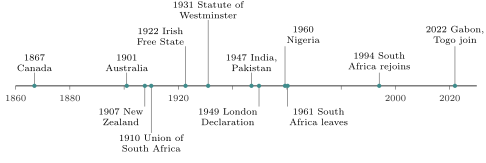
Figure 1. From Empire to Commonwealth, to scale (0.072 cm per year, 1860 to 2030). Self-government for the settler colonies came first, independence for the other colonies after 1945; the London Declaration of 1949 allowed republics such as India to remain members. South Africa left in 1961 under apartheid and returned in 1994. À retenir : deux décolonisations très différentes, l'une par étapes et négociée, l'autre souvent conquise.
A voluntary association of 56 independent and equal countries, home to about 2.7 billion people (thecommonwealth.org). Most are former British territories, but not all: Mozambique, Rwanda, Gabon and Togo joined without such a past. Since the London Declaration of 1949, members can be republics; the King is the symbolic Head of the Commonwealth, a role that is not hereditary and that the leaders of the member states choose. Its values are set out in the Commonwealth Charter (2013). It has no binding powers; its strength is a shared language, legal traditions and networks.
Ne confondez pas le Commonwealth et les Commonwealth realms. Les realms sont les quelques pays membres dont le roi Charles III est aussi le chef d'État, comme le Canada, l'Australie ou la Nouvelle-Zélande ; l'Inde, l'Afrique du Sud ou le Nigeria sont des républiques membres du Commonwealth. Écrire que « la reine était la souveraine de l'Inde » après 1950 est une faute.
Repère : Vocabulary: empire and decolonisation
| English | Français |
|---|---|
| a settler colony | une colonie de peuplement |
| a dominion | un dominion (colonie autonome) |
| self-government, home rule | l'autonomie |
| independence, to gain independence | l'indépendance, accéder à l'indépendance |
| partition | la partition |
| a realm | un royaume (dont le roi est le souverain) |
| indigenous peoples, First Nations | les peuples autochtones, les Premières Nations |
| reconciliation | la réconciliation |
14.2 Ireland: a European success story next door
Ireland's relationship with Britain is the oldest and most painful of all. The Great Famine of the 1840s killed about a million people and drove another million to emigrate. After the war of independence, the Irish Free State was created in 1922, while six counties of the North stayed in the United Kingdom. Ireland became a republic and left the Commonwealth in 1949, and joined the European Economic Community in 1973, together with the United Kingdom.
Its economy was transformed from the 1990s onwards (the Celtic Tiger''), thanks to EU membership, an English-speaking and educated workforce, and a low corporate tax rate that attracted American multinationals, especially in technology and pharmaceuticals. This success distorts the statistics: in 2024, Ireland's GDP per head was the highest of the countries in figure 3 (World Bank), largely because the profits of multinationals are booked there. The Irish statistical office publishes a
Exercices du chapitre
- Un thème de cinq phrases corrigé
- Une version : Mark Twain en Australie corrigé
- Repérer les fautes corrigé
- Réécrire en C1 corrigé
- Un résumé comparatif en format réduit corrigé
- Un plan d'essai et son introduction corrigé