Science, environment and possible futures
Cours complet · anglais (seconde), chapitre 10 · seconde générale, langue vivante
Travailler ce chapitre sur Adloun Exercices corrigés de ce chapitre
10.1 Introduction
Ce chapitre culturel explore un axe majeur du programme de Seconde : les rapports entre la science, l'environnement et les futurs possibles dans le monde anglophone. Depuis le XIXe siècle, les pays de langue anglaise ont été le théâtre d'immenses avancées scientifiques et techniques : la théorie de l'évolution, la découverte de la pénicilline, la structure de l'ADN, l'invention du World Wide Web. Mais chaque progrès soulève aussi des questions éthiques (ethical questions) : jusqu'où la science peut-elle aller ? qui en est responsable ? Parallèlement, la prise de conscience écologique est née en grande partie dans le monde anglophone (États-Unis, Royaume-Uni). Enfin, la littérature de science-fiction de langue anglaise imagine depuis deux siècles les mondes de demain. Les explications sont en français ; les repères culturels, textes et citations sont en anglais.
10.2 Scientific innovations and responsibility
Le monde anglophone a joué un rôle de premier plan dans l'histoire des sciences modernes. Les repères ci-dessous rassemblent quelques figures et découvertes réelles.
Repère : Charles Darwin and the theory of evolution
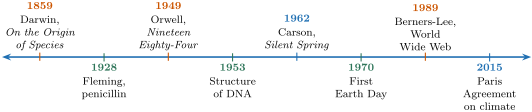
Charles Darwin (1809--1882) was a British naturalist. After a five-year voyage around the world aboard HMS Beagle, he published On the Origin of Species in 1859. In this book he explained the diversity of living species through natural selection: organisms that are better adapted to their environment tend to survive and reproduce. His theory transformed biology and remains a foundation of modern science.
Repère : Alexander Fleming and penicillin
Alexander Fleming (1881--1955) was a Scottish bacteriologist. In 1928, he noticed by chance that a mould growing on one of his laboratory dishes killed the surrounding bacteria. This observation led to the discovery of penicillin, the first widely used antibiotic. Later developed by other researchers, penicillin has saved millions of lives. Fleming shared the Nobel Prize in Medicine in 1945.
Repère : The structure of DNA (1953)
In 1953, at the University of Cambridge, James Watson (American) and Francis Crick (British) described the double-helix structure of DNA, the molecule that carries genetic information. Their work relied in part on the X-ray images produced by the British chemist Rosalind Franklin (1920--1958), whose essential contribution was long overlooked. This discovery opened the way to modern genetics.
Quelques mots essentiels du champ scientifique :
- a discovery : une découverte — to discover : découvrir
- an invention : une invention — a breakthrough : une avancée majeure
- research (indénombrable) : la recherche — a scientist : un(e) scientifique
- an experiment : une expérience — evidence : des preuves
- ethics : l'éthique — responsibility : la responsabilité
Un progrès scientifique n'est jamais neutre : il pose la question de son usage et de la responsabilité des chercheurs. C'est le cœur du débat éthique.
Repère : Alan Turing and the birth of computer science
Alan Turing (1912--1954) was a British mathematician, considered one of the founders of computer science and artificial intelligence. During the Second World War he helped to break the German Enigma code. In 1950 he proposed the famous Turing test, a way of asking whether a machine can be said to ``think''. His question is still discussed today, in the age of AI.
The novel Frankenstein (1818) by the British writer Mary Shelley tells the story of a scientist, Victor Frankenstein, who creates a living creature and then abandons it. It is often described as one of the first works of science fiction. The book raises a question that is still relevant: ``Should we do everything that science makes possible?'' It reminds readers that scientific power comes with responsibility.
Le monde anglophone a produit des découvertes scientifiques majeures : l'évolution (Darwin, 1859), la pénicilline (Fleming, 1928), la structure de l'ADN (Watson, Crick, Franklin, 1953), l'informatique (Turing). Chaque avancée pose la question de la responsabilité éthique : Just because we can, does it mean we should?
10.3 Environment and sustainable development
La conscience écologique moderne est née en grande partie dans les pays anglophones, portée par des scientifiques, des écrivains et des mouvements citoyens.
Repère : Rachel Carson and Silent Spring (1962)
Rachel Carson (1907--1964) was an American marine biologist and writer. In her book Silent Spring (1962), she showed the harmful effects of chemical pesticides such as DDT on birds, the food chain and human health. The book had a huge impact on public opinion in the United States and is often seen as the starting point of the modern environmental movement.
Repère : Earth Day and the environmental movement
The first Earth Day took place in the United States on 22 April 1970, bringing together millions of people to demand the protection of nature. It is now celebrated worldwide every year. In the same period, the organisation Greenpeace was founded in 1971 in Vancouver (Canada), campaigning at first against nuclear testing, and later for the protection of the environment.
Le développement durable (sustainable development) est un développement « qui répond aux besoins du présent sans compromettre la capacité des générations futures à répondre aux leurs ». Cette définition est celle du rapport Our Common Future, publié par une commission des Nations Unies en 1987 (rapport Brundtland). Il repose sur trois piliers : l'environment (environnement), l'economy (économie) et le social (le social).
Voici des phrases modèles pour parler du climat en anglais :
- Climate change is one of the biggest challenges of our time.
- We must reduce our carbon footprint and greenhouse gas emissions.
- Everyday actions matter: recycling, saving energy, using public transport.
En 2015, la Paris Agreement (Accord de Paris) a réuni presque tous les pays du monde autour de l'objectif de limiter le réchauffement climatique bien en dessous de 2 °C.
Méthode : Expressing an opinion on the environment
Pour donner son avis sur une question environnementale en anglais, on peut structurer son propos :
- Introduce the topic : The issue of … is very important today.
- Give your opinion : In my opinion … / I think that … / I strongly believe that …
- Add an argument and an example : For example … / One reason is that …
- Suggest an action : We should … / People could … / Governments ought to …
- Conclude : To sum up … / That is why …
10.4 Possible futures: technology, AI and the city of tomorrow
Imaginer l'avenir est un exercice ancien dans la culture anglophone. Les technologies nouvelles, l'intelligence artificielle et la « ville de demain » nourrissent de nombreux espoirs et débats.
- artificial intelligence (AI) : l'intelligence artificielle
- a robot : un robot — a smart city : une ville intelligente
- a self-driving car : une voiture autonome
- renewable energy : les énergies renouvelables
- a breakthrough : une percée — a challenge : un défi
- data : les données — a device : un appareil
Les progrès de l'IA transforment déjà le quotidien (traduction, médecine, transports). Ils soulèvent aussi des questions : sur l'emploi, la vie privée (privacy) et le contrôle de ces technologies. La « ville de demain » (the city of tomorrow) est souvent présentée comme une smart city : plus connectée, plus économe en énergie, mais aussi plus surveillée.
10.4.1 Science fiction: imagining tomorrow
La science-fiction (science fiction, ou sci-fi) de langue anglaise imagine des mondes futurs pour interroger le présent. Les auteurs ci-dessous sont des repères réels.
Repère : H. G. Wells, a founder of science fiction
H. G. Wells (1866--1946) was a British writer, often called ``the father of science fiction''. He imagined time travel in The Time Machine (1895) and an alien invasion of Earth in The War of the Worlds (1898). His novels explore progress, science and the possible dangers of technology.
Repère : Dystopias: Orwell and Huxley
Two famous British authors imagined dark futures called dystopias. In Brave New World (1932), Aldous Huxley described a society controlled through technology and conditioning. In Nineteen Eighty-Four (1949), George Orwell imagined a state of total surveillance, ruled by ``Big Brother''. Both novels warn against the loss of freedom and remain widely read today.
Repère : Isaac Asimov and the ``Three Laws of Robotics''
The American author Isaac Asimov (1920--1992) wrote many science-fiction stories about robots, gathered in I, Robot (1950). He is famous for imagining the Three Laws of Robotics, a set of ethical rules meant to protect humans from robots. These laws are still quoted today in discussions about the ethics of artificial intelligence.
Une utopia (utopie) est la représentation d'un monde idéal, parfait. Une dystopia (dystopie, ou contre-utopie) est au contraire un futur sombre et effrayant, souvent marqué par la surveillance, la perte de liberté ou une technologie devenue menaçante. La science-fiction utilise ces deux formes pour faire réfléchir sur les choix du présent.
Pour parler de l'avenir, l'anglais dispose de plusieurs outils :
- will + base verbale (prédiction) : Robots will help doctors in the future.
- may / might (possibilité) : Cities might become greener and smarter.
- be going to (intention, tendance) : We are going to use more renewable energy.
- if + present, will + base (hypothèse réelle) : If we protect nature, future generations will benefit.
10.5 Thematic vocabulary
| Science | Environment | Technology & future |
|---|---|---|
| a discovery --- une découverte | climate change --- le changement climatique | artificial intelligence --- l'IA |
| research --- la recherche | global warming --- le réchauffement climatique | a self-driving car --- une voiture autonome |
| an experiment --- une expérience | pollution --- la pollution | a smart city --- une ville intelligente |
| evidence --- des preuves | to recycle --- recycler | renewable energy --- énergies renouvelables |
| a scientist --- un(e) scientifique | a carbon footprint --- une empreinte carbone | data --- les données |
| ethics --- l'éthique | sustainable --- durable | a breakthrough --- une percée |
| a breakthrough --- une avancée | to protect nature --- protéger la nature | a challenge --- un défi |
10.6 Bilan
Le monde anglophone a été, depuis le XIXe siècle, un foyer majeur d'innovations scientifiques : la théorie de l'évolution de Darwin, la pénicilline de Fleming, la structure de l'ADN, les fondations de l'informatique posées par Turing. Chacune de ces avancées, comme le rappelle dès 1818 le Frankenstein de Mary Shelley, s'accompagne d'une responsabilité éthique. La conscience environnementale moderne y est aussi née, avec Silent Spring de Rachel Carson (1962), le premier Earth Day (1970) et la notion de développement durable. Enfin, la science-fiction de langue anglaise — de H. G. Wells à Orwell, Huxley et Asimov — imagine sans cesse des futurs possibles, utopies ou dystopies, pour mieux interroger nos choix d'aujourd'hui face à la technologie, à l'intelligence artificielle et au climat.