The ion and ionic compounds
Course · Chemistry (Grade 10, Lebanon), chapter 3 · Lebanon, Grade 10 · the beginning of the chapter, the rest on Adloun
Pure distilled water and sugar dissolved in water practically do not conduct electric current. On the other hand, as soon as a few crystals of table salt (sodium chloride) are dissolved in water, the solution lets electric current through and can light an indicator lamp. Where do the charge carriers responsible for this conductivity come from? The mineral waters we drink display on their label their contents of calcium , magnesium , chloride , hydrogen carbonate or sulfate . These electrically charged chemical species are ions. How are they formed from atoms, how are they named and how do they combine to form electrically neutral ionic solids?
Curriculum: LB-2
Required skills
- Interpret the electrical conductivity of some aqueous solutions by the presence of mobile ions carrying electric charges.
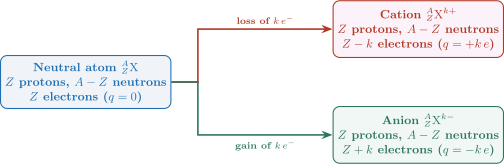
- Define a monoatomic ion, distinguish a cation (positive ion formed by loss of electrons) from an anion (negative ion formed by gain of electrons).
- Determine the subatomic composition (protons, neutrons, electrons) and the electric charge of a monoatomic ion of symbol .
- Know the name and the formula of the usual monoatomic and polyatomic ions of the curriculum.
- Write the empirical formula and the name of a solid ionic compound by applying the law of electrical neutrality of matter.
- Calculate the molar mass of an ion or of an ionic compound and use the relation .
3.1 Existence and experimental evidence of ions
3.1.1 Electrical conduction in aqueous solutions: electrolytes
In a metal (such as a copper wire), electric current is carried by the movement of free electrons. To test whether a liquid or an aqueous solution conducts electric current, a series circuit is set up comprising a voltage generator, an ammeter, an indicator lamp and an electrolysis cell fitted with two graphite electrodes dipping into the liquid studied.
- In pure distilled water, in an aqueous solution of glucose () or of ethanol (), the lamp stays off (): these media contain only electrically neutral molecules and do not conduct electric current.
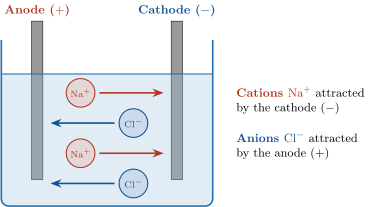
- In an aqueous solution of sodium chloride (salt water), of copper sulfate or of sodium hydroxide, the lamp glows and the ammeter indicates the passage of a current (). Now an aqueous solution contains no free electrons: the current is carried by the double movement, in opposite directions, of electrically charged and mobile chemical entities, called ions.
- An ion is an atom (or a group of atoms bonded covalently) that has lost or gained one or more electrons: it therefore carries a nonzero overall electric charge.
- A cation is an ion carrying a positive electric charge (it moves toward the negative electrode, called the cathode, when current flows).
- An anion is an ion carrying a negative electric charge (it moves toward the positive electrode, called the anode).
- A substance whose dissolution in water (or melting) releases mobile ions capable of conducting electric current is called an electrolyte.
3.1.2 Ions in ionic crystals
In the solid state, sodium chloride is already made of sodium ions and chloride ions regularly stacked in a crystal lattice. However, the solid crystal does not conduct electric current because these ions are held in fixed positions by strong electrostatic attractions and cannot move. It is melting (at high temperature) or dissolution in water that destroys the crystal stacking, releases the ions and makes the medium conducting.
3.2 Monoatomic ions
3.2.1 Formation, symbol and electric charge of a monoatomic ion
During chemical transformations, the nucleus of an atom remains strictly intact: the atomic number (number of protons) and the mass number (number of nucleons) never change. Only the electron cloud is modified by the loss or gain of one or more valence electrons.
- Formation of a monoatomic cation: When an atom (containing protons and electrons) loses electrons (), it keeps its protons in the nucleus but has only electrons left in its electron cloud. It becomes a monoatomic cation denoted (if , we simply write ) according to the formal half-equation:
Its total electric charge is positive and equals:
- Formation of a monoatomic anion: When an atom (containing protons and electrons) gains electrons, it keeps its protons in the nucleus but now has electrons in its electron cloud. It becomes a monoatomic anion denoted (if , we simply write ) according to:
Its total electric charge is negative and equals:
3.2.2 Nomenclature and list of the required monoatomic ions
- Name of a monoatomic cation: it bears the name of the corresponding chemical element. When the same metal (such as iron or copper) can form several cations of different charges, the number of positive charges is specified in Roman numerals in parentheses after the name of the metal.
- Name of a monoatomic anion: the suffix “-ide” is added to the root of the name of the element; oxygen thus forms the oxide ion .
Exercises of the chapter
- Formation and subatomic composition of monoatomic ions solved
- Identifying two monoatomic ions from their charges solved
- Polyatomic ions: electron counting and empirical formulas solved
- Molar and ionic balance in a sample of sodium phosphate solved
- Comparing two iron salts: iron(II) chloride and iron(III) sulfate solved
- Determining the degree of hydration of a sodium carbonate crystal solved