The chemical reaction and the molar balance
Course · Chemistry (Grade 10, Lebanon), chapter 4 · Lebanon, Grade 10 · the beginning of the chapter, the rest on Adloun
The blue flame of a gas stove burning methane or butane, the effervescence of an aspirin tablet dropped into water, the formation of rust on an iron gate or the photosynthesis carried out by green plants are all examples of chemical transformations. During these transformations, initial substances disappear while new substances with completely different properties appear. How does the chemist model a chemical transformation by a balanced equation that respects Antoine Lavoisier's conservation laws? And how can we predict, from the amounts of substance initially mixed, which of the reactants will be completely consumed first, as well as the mass or the volume of products actually obtained?
Curriculum: LB-2
Required skills
- Recognize experimentally the occurrence of a chemical transformation from its macroscopic signs (release of gas, formation of a precipitate, change of color, thermal effect) and identify the reactants and the products.
- State and apply the conservation laws (Lavoisier's law: conservation of mass and of chemical elements; conservation of the overall electric charge) to balance the stoichiometric coefficients of a chemical equation.
- Interpret a balanced equation at the microscopic scale (entities) and at the macroscopic scale (moles), and explain the role of valence electrons in the breaking and formation of chemical bonds.
- Know the factors that trigger a reaction and govern its progress (temperature, pressure, catalyst, radiation, amounts of substance) and distinguish an exothermic, endothermic or athermic reaction.
- Use the Avogadro-Ampère law and the molar volume of gases ().
- Establish the molar balance of a chemical reaction: recognize a stoichiometric mixture, identify the limiting reactant (in deficit) and the reactant in excess, and calculate the amounts of substance in the final state.
- Define and calculate the yield of a chemical reaction: .
4.1 Chemical transformation and balanced equation
4.1.1 Experimental signs, reactants and products
Unlike a physical transformation (such as the melting of ice or the vaporization of water) during which the nature of the chemical species does not change, a chemical transformation modifies the very nature of the species present.
A chemical reaction models a transformation during which initial chemical species, called reactants, are consumed (their amount of substance decreases) to give rise to new chemical species, called products (their amount of substance increases):
In the laboratory or in everyday life, the start of a chemical reaction shows up through one or more observable experimental signs:
- the appearance of effervescence (release of a gas, such as hydrogen when an acid acts on zinc, or carbon dioxide when it acts on limestone);
- the appearance of a solid precipitate within a clear solution (for example the blue precipitate of copper(II) hydroxide or the white precipitate of silver chloride );
- a change of color of the reaction mixture (for example the decolorization of a violet solution of potassium permanganate);
- a noticeable thermal effect (heating or cooling of the container) or an emission of light (flame, incandescence).
4.1.2 Conservation laws and balancing the chemical equation
At the end of the 18th century, Antoine Laurent de Lavoisier established, through rigorous weighings in a closed system, the fundamental principle of quantitative chemistry, summed up by the famous maxim: ``Nothing is lost, nothing is created, everything is transformed.''
During any chemical reaction:
- Conservation of mass: the total mass of the products formed is strictly equal to the total mass of the reactants consumed:
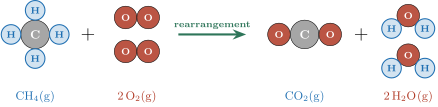
- Conservation of chemical elements (and of atoms): the nature and the number of atoms of each chemical element are identical before and after the reaction. Atoms are neither destroyed nor created: they are rearranged differently.
- Conservation of electric charge: the total electric charge of the reactants is equal to the total electric charge of the products.
The first two laws make up Lavoisier's law. The conservation of electric charge, which does not date back to Lavoisier (the electron was discovered only in 1897), completes them as soon as the equation involves ions.
To express these conservation laws symbolically, the balanced equation of the reaction is written by placing in front of the formulas of the reactants and of the products the smallest possible positive integers, called stoichiometric coefficients (the coefficient is never written), and by specifying the physical state of each species in parentheses: for solid, for liquid, for gas and for a species dissolved in aqueous solution.
Exercises of the chapter
- Balancing equations and conservation of mass (Lavoisier's law) solved
- Stoichiometric mixture in the thermite reaction solved
- Avogadro-Ampère law and combustion of a gas mixture solved
- Limiting reactant in the attack of aluminum by an acid solution solved
- Precipitation of silver chloride and complete balance in the final state solved
- Industrial synthesis of methanol under pressure and yield solved