Water and aqueous solutions
Course · Chemistry (Grade 10, Lebanon), chapter 5 · Lebanon, Grade 10 · the beginning of the chapter, the rest on Adloun
Water is the most abundant and the most remarkable solvent on our planet: the oceans, plant sap, blood plasma and most of the reagents used in the laboratory and in the pharmaceutical industry are aqueous solutions. Why does the water molecule manage to dissolve equally well a rigid ionic crystal such as sodium chloride, a molecular solid such as glucose or a gas such as hydrogen chloride? How can the mass concentration, the molar concentration of solute added and the effective molar concentration of each ion in solution be expressed and related? And what rigorous experimental procedures make it possible to prepare an aqueous solution of given concentration by dissolution or by dilution?
Curriculum: LB-2
Required skills
- Explain the dissolving power of water by the dipolar character of the molecule.
- Describe the three steps of the dissolution of an ionic compound in water (dissociation, hydration, dispersion) and write the corresponding dissolution equation.
- Distinguish the dissolution of a molecular compound without ionization (glucose, sucrose, ethanol) from one accompanied by a complete () or partial () ionization reaction with water, and recognize the thermal effect of a dissolution.
- Define the solubility , distinguish an unsaturated solution from a saturated solution and interpret the influence of temperature and pressure on the solubility of solids and gases.
- Calculate the mass concentration , the molar concentration of solute added (with ) and the effective molar concentrations of the ions present.
- Apply the law of conservation of the amount of substance during a dilution (), use the dilution factor and describe the experimental procedures of dissolution and dilution with the appropriate volumetric glassware.
5.1 Dissolving properties of water
5.1.1 Solvent, solute and role of the dipolar character of water
- A solution is a homogeneous liquid mixture obtained by dissolving one or more chemical species (solid, liquid or gaseous), called solutes (minority species), in a majority liquid called the solvent.
- When the solvent is water, the solution is called an aqueous solution.
As established in chapter 2, the water molecule has two polar covalent bonds and a bent geometry: it carries a partial negative pole on the side of the oxygen atom and two partial positive poles on the side of the hydrogen atoms. This permanent dipolar character gives water an exceptional dissolving power toward ionic compounds and polar molecules.
5.1.2 Dissolution of ionic compounds in water: the three steps
When a soluble ionic crystal (such as sodium chloride ) is placed in water, it goes into solution in three microscopic steps:
- Step 1 — Dissociation of the crystal lattice: the polar water molecules approach the surface of the crystal. Through ion-dipole electrostatic attraction, the negative poles () of the water molecules attract the cations of the crystal, while their positive poles () attract the anions; this weakens the cohesive forces of the crystal and tears the ions away from the solid lattice.
- Step 2 — Hydration (or solvation) of the ions: each released ion surrounds itself with a shell of several water molecules oriented around it (a hydration shield that prevents the cations and the anions from reassociating). These hydrated ions are denoted and .
- Step 3 — Dispersion: under the effect of thermal agitation (faster if the liquid is stirred with a stirrer), the hydrated ions spread uniformly throughout the volume of the liquid, forming a homogeneous and electrically conducting aqueous solution.
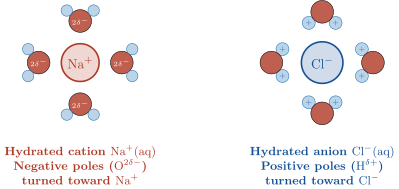
The dissolution in water of a solid ionic compound with the empirical formula is expressed by its dissolution equation (water, which acts as the solvent, is written above the arrow and not among the reactants):
This equation respects the conservation of elements and electrical neutrality ().
- Sodium chloride:
- Calcium chloride:
- Aluminum sulfate:
5.1.3 Dissolution of molecular compounds in water
When a molecular solute dissolves in water, two quite distinct behaviors can be observed:
- Molecular dissolution without ionization (non-electrolyte solutes): Polar molecules carrying hydroxyl groups , such as glucose , sucrose or ethanol , establish attractive interactions (hydrogen bonds) with the water molecules, become hydrated and disperse in water while remaining in the form of neutral molecules:
Exercises of the chapter
- Dissolution mechanism and effective concentrations of the ions solved
- Solubility, saturation and thermal recrystallization of copper sulfate solved
- Dissolution of a hydrated crystal: cobalt(II) chloride hexahydrate solved
- Preparing a color scale by dilutions from a stock solution solved
- Mixing electrolyte solutions without chemical reaction solved
- Using the label of a commercial ammonia solution solved