Acids and bases in aqueous solution
Course · Chemistry (Grade 10, Lebanon), chapter 6 · Lebanon, Grade 10 · the beginning of the chapter, the rest on Adloun
Lemon juice, vinegar and soft drinks have a characteristic sour taste due to their acidic character, while bleach, drain cleaners, household ammonia or soap feel slippery and have a basic character. In the laboratory as in the quality control of water, food or human blood, the acidity or basicity of an aqueous solution is located by a unitless quantity: the (potential of Hydrogen). How is the measured experimentally with color indicators or a meter? How do the historical theories of Svante Arrhenius, then of Johannes Brønsted and Thomas Lowry, make it possible to define rigorously what an acid or a base is at the microscopic scale?
Curriculum: LB-2
Required skills
- Classify an aqueous solution at as an acidic (), neutral () or basic () solution from the value of its .
- Describe and carry out the three experimental methods for estimating or measuring the : paper, acid-base color indicators (litmus, methyl orange, bromothymol blue, phenolphthalein) and meter.
- State the definitions of an acid and of a base according to the Arrhenius theory, specify its limits, then state the definitions according to the Brønsted-Lowry theory (transfer of a proton ) and justify the amphoteric character of water.
- Distinguish a monoprotic acid from a polyprotic acid, a strong acid (completely ionized in water, such as or ) from a weak acid (partially ionized, such as ), and write the equation of its reaction with water.
- Write the equation for the dissolution in water of an ionic hydroxide (, , ) and the equation for the ionization in water of a molecular base ().
- Know the safety rules for handling and diluting concentrated acids and bases in the laboratory.
6.1 Acidity, basicity and the scale
6.1.1 Acidic, neutral or basic character of an aqueous solution at
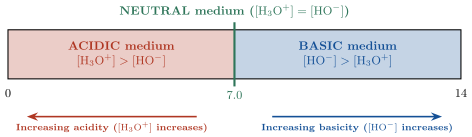
Every aqueous solution contains at the same time hydronium ions and hydroxide ions . It is the predominance of one of these two ions over the other that determines the acidic, neutral or basic character of the solution, located at on the scale graduated from to .
At a temperature of , an aqueous solution is:
- neutral if : it contains as many hydronium ions as hydroxide ions (); this is the case of pure water or of an aqueous solution of sodium chloride ;
- acidic if : the hydronium ions outnumber the hydroxide ions (). The lower the (close to ), the more acidic the solution and the higher ;
- basic if : the hydroxide ions outnumber the hydronium ions (). The higher the (close to ), the more basic the solution and the higher .
6.1.2 Experimental measurement of the : color indicators, paper and meter
In the laboratory, three complementary methods are available to estimate or measure the :
- Acid-base color indicators: a color indicator is an organic substance (in dilute solution) whose color changes with the of the medium on either side of a narrow interval called the transition range (in which the indicator takes its intermediate color, a mixture of the acidic and basic colors). It makes it possible to locate a range.
- paper: a strip of paper impregnated with a mixture of several color indicators (universal indicator). By placing a drop of the solution to be tested on a piece of paper with a glass stirring rod and comparing the color obtained with the color chart on the box, a quick estimate of the to within half a unit or one unit is obtained.
- The meter: an electronic device connected to a probe (combined glass electrode) which, after prior calibration with two buffer solutions (for example of and ), gives a precise digital measurement of the (to the tenth or hundredth of a unit).
{
| Color indicator | Color in | Transition range | Intermediate | Color in |
|---|---|---|---|---|
| acidic medium | () | color | basic medium | |
| Methyl orange | Red | Orange | Yellow | |
| Litmus | Red | Purple | Blue | |
| Bromothymol blue (BTB) | Yellow | Green | Blue | |
| Phenolphthalein | Colorless | Pale pink | Purplish pink |
Exercises of the chapter
- The scale at
25~^\circCand tests with color indicators solved - From the Arrhenius definitions to the Brønsted-Lowry proton transfer solved
- Study of polyprotic acids and amphoteric species: the phosphoric acid system solved
- Solutions of strong acids: a monoprotic acid (hydrochloric acid) and a diprotic acid (sulfuric acid) solved
- Basic solutions: comparing potassium hydroxide () and ammonia solution () solved
- Experimental procedure for characterization and dilution in the laboratory solved