Soaps
Course · Chemistry (Grade 11 Humanities, Lebanon), chapter 1 · Lebanon, Grade 11 Humanities · the beginning of the chapter, the rest on Adloun
In the old souks of Tripoli and Sidon, soap has been made for centuries: olive oil, caustic soda, a large cauldron, fire and a great deal of patience. The bars of soap, cut and then stacked in open-work towers, are then left to dry for months. The bar of soap sitting on the edge of the washbasin is the heir to this know-how. But what is it made of? Why does water alone not remove an oil stain, whereas soapy water succeeds? And why does soap lather so poorly with the water of some mountain springs?
Curriculum: LB-1H
Required skills
- List the raw materials of soap and describe, in words, the steps of its manufacture (saponification, salting out).
- Distinguish a hard soap (sodium soap) from a soft soap (potassium soap).
- Describe the composition of a soap and represent its active ion by a hydrophilic head and a hydrophobic tail.
- Explain why soap dissolves and lathers well in soft water, poorly in hard water and in salt water.
- Describe the steps in washing out a greasy stain and draw a micelle.
- List some varieties of soap and their characteristics.
1.1 Making soap
1.1.1 Two raw materials
To make a soap, two kinds of products must be brought together.
- A fat: a vegetable oil (olive, laurel, palm or coconut oil) or an animal fat (beef or mutton tallow). A fat does not mix with water: a drop of oil added to a glass of water stays at the surface.
- A strong base dissolved in water: caustic soda (sodium hydroxide) or caustic potash (potassium hydroxide). These products are corrosive: they attack the skin and the eyes, and are handled with gloves and goggles.
Before industry supplied caustic soda, the base needed was obtained from the ashes of certain plants: water was run over these ashes and a basic “lye” was collected. The word “potash” recalls this origin: it comes from words meaning “pot ashes”.
1.1.2 Saponification, then salting out
Mixing the oil and the caustic soda is not enough: when cold, almost nothing happens. The mixture must be heated and stirred for a long time. Little by little, the fat and the caustic soda disappear and two new products appear: soap and glycerol (also called glycerin). It is a chemical transformation: the products obtained are no longer those of the start.
Saponification is the chemical transformation, slow and carried out hot, of a fat by caustic soda or caustic potash. It can be summed up as follows:
fat \; + \; caustic soda (or potash) \; \; soap \; + \; glycerol.
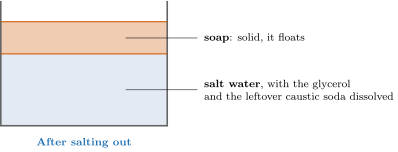
At the end of the boiling, the soap is still mixed with water, glycerol and the leftover caustic soda. To separate it, the whole mixture is poured into very salty water. Soap hardly dissolves at all in salt water: it gathers into a solid mass. As it is less dense than salt water, it floats. The glycerol and the leftover caustic soda remain dissolved in the salt water, underneath.
Salting out is the operation that separates the soap from the rest of the mixture: the mixture is poured into salt water, where the soap, only very slightly soluble, gathers and floats.

The collected soap is washed, poured into molds or spread out, cut into bars, then dried. The glycerol is not lost: it is a liquid that is gentle on the skin, found in creams and in some toilet soaps.
1.1.3 Hard soaps and soft soaps
The base used determines the consistency of the soap.
- With caustic soda, a sodium soap is obtained: it is a hard soap, cut into bars or cakes.
- With caustic potash, a potassium soap is obtained: it is a soft soap, pasty or liquid, like black soap.
The handmade soap of Lebanon and neighboring Syria is a hard soap. Olive oil is boiled for a long time with caustic soda; Aleppo soap also receives laurel berry oil. The hot paste is spread on the workshop floor, smoothed, then cut into cubes that are marked with a seal. The cubes then dry in the air for several months: they lose water, harden, and their surface turns from green to beige.
1.2 What is a soap made of?
1.2.1 Ions of two kinds
A soap is not made of molecules, but of ions, that is, particles that carry an electric charge. It contains two kinds of them, in equal numbers:
Exercises of the chapter
- In the workshop of a soap factory solved
- The quantities in a recipe solved
- The head and the tail solved
- Which water is the hardest? solved
- The steps of washing and the micelle solved
- A soap for every use solved