Detergents
Course · Chemistry (Grade 11 Humanities, Lebanon), chapter 2 · Lebanon, Grade 11 Humanities · the beginning of the chapter, the rest on Adloun
At the supermarket, the aisle of cleaning products takes up an entire row: washing powders or liquids, dishwashing liquids, shampoos, floor and window cleaners. Almost none of these products contains soap. They all owe their cleaning power to substances made by the chemical industry, which appeared during the 20th century and became indispensable with the washing machine. What do these products contain? In what way are they better than soap? And how should their label be read to choose them and measure them out correctly?
Curriculum: LB-1H
Required skills
- State what a synthetic detergent is and where its active ingredient comes from.
- List the three families of components of a detergent (surfactants, builders, additives) and the role of each.
- Compare the properties of a detergent with those of a soap, in particular in hard water.
- Describe the characteristics of the main commercial detergents (laundry detergents, dishwashing liquid, shampoo, household detergents).
- Read the label of a detergent and calculate a dose, a number of washes, a cost.
2.1 What is a detergent?
2.1.1 The limitations of soap
Soap washes well, but it has drawbacks. In hard water, part of the soap forms a precipitate with calcium ions and magnesium ions : this soap is lost, and the deposit makes the laundry dull. In a washing machine, this deposit also clogs the drum and the pipes. Finally, making soap uses up oils and fats, which also serve as food.
Chemists therefore looked for products that wash like soap, without its drawbacks. They made them from an abundant raw material: petroleum.
2.1.2 The synthetic detergent
A synthetic detergent is a cleaning product whose active ingredient is a synthetic surfactant, that is, one made by the chemical industry, most often from petroleum. In everyday language, it is simply called a “detergent”.
The synthetic surfactant closely resembles the active ion of soap. It too has a hydrophilic head, which likes water, and a long hydrophobic and lipophilic tail, which avoids water and slips into fats. It therefore washes in the same way: it helps the water to wet the fabric, it surrounds the grease, forms micelles and keeps them dispersed in the water until rinsing.
The difference lies in the head: that of the synthetic surfactant does not form a precipitate with calcium and magnesium ions.
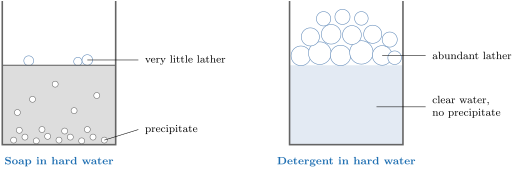
- Both wash thanks to a surfactant, made of a hydrophilic head and a lipophilic tail.
- The surfactant of soap comes from a fat, vegetable or animal; that of a synthetic detergent most often comes from petroleum.
- Soap precipitates in hard water; a synthetic detergent stays dissolved and active in it.
2.2 The composition of a detergent
A box of washing powder does not contain only surfactant. It is a carefully measured mixture, in which each component has a role. They are grouped into three families.
2.2.1 Surfactants
Surfactants are the active ingredient of the detergent: they are the ones that wash. They allow the water to wet the laundry, detach greasy dirt and keep it dispersed in the water in the form of micelles. The same product often contains several of them, which complement one another.
2.2.2 Builders
A builder is a component that helps the surfactant to act. Its first role is to soften the water: it captures the calcium ions and magnesium ions of hard water.
Even though the synthetic surfactant does not precipitate, calcium and magnesium ions hinder it, and they form scale in the machine. The builder neutralizes them. It also makes the washing water slightly basic, which helps to loosen dirt. The main builders are:
- phosphates, very effective, for a long time the most widely used, but harmful to lakes and rivers: many countries have restricted or banned them in laundry detergents;
- zeolites, insoluble mineral powders that hold on to calcium ions, and which today often replace phosphates;
- carbonates and citrates.
Exercises of the chapter
- From soap to detergent solved
- The composition of a washing powder solved
- To each stain its component solved
- The two-beaker experiment solved
- The right dose solved
- The right product in the right place solved