General characteristics of synthetic polymers
Course · Chemistry (Grade 11 Humanities, Lebanon), chapter 4 · Lebanon, Grade 11 Humanities · the beginning of the chapter, the rest on Adloun
A water bottle, a shopping bag, the case of a phone, a garden hose, a garden chair, the sole of a sports shoe: all these objects are made of “plastic”. A little over a century ago, none of them existed in this form: people used glass, wood, metal, leather or cotton. What, then, do these new materials, so different in appearance, have in common? Why do some melt in the heat while others resist it? And what does the small numbered triangle engraved under packaging mean?
Curriculum: LB-1H
Required skills
- Distinguish a natural polymer from a synthetic polymer and give examples of each.
- Use the words monomer, repeating unit, polymer and macromolecule correctly, and represent a polymer chain as a string of beads.
- Distinguish the three main families of synthetic polymers: thermoplastics, thermosets, elastomers.
- List the general properties of plastics and relate them to their uses.
- Recognize the common plastics (polyethylene, polypropylene, PVC, polystyrene, PET), their uses and their identification code.
4.1 Giant molecules
4.1.1 Natural polymers and synthetic polymers
Matter is made of molecules. Those of water, sugar or alcohol are tiny: a few atoms, a few dozen at most. But there are also giant molecules, made of thousands of atoms linked one after another in a very long chain. They are called macromolecules, and the materials they form are polymers.
Polymers were not invented by industry: nature has always made them.
- A natural polymer is made by a living thing, plant or animal.
- A synthetic polymer is made by the chemical industry, most often from petroleum or natural gas.
| Natural polymer | Where it comes from | Where it is found |
|---|---|---|
| Cellulose | wall of plant cells | wood, paper, cotton, linen |
| Starch | reserve of seeds and tubers | wheat, rice, corn, potato |
| Proteins | animals | wool, silk, hair, leather |
| Natural rubber | sap (latex) of a tree, the rubber tree | erasers, first tires |
Synthetic polymers, for their part, have names that almost all begin with “poly”: polyethylene, polypropylene, polystyrene, polyvinyl chloride. They are what are commonly called plastics.
A plastic material is not a pure polymer. To the base polymer, industry adds small quantities of other products, the additives: dyes, products that make the material more flexible, others that protect it from sunlight. This is how the same polymer can give a rigid pipe or a flexible pipe.
4.1.2 Monomer, repeating unit, polymer
The word “polymer” comes from Greek: poly means “many” and meros, “part”. A macromolecule is indeed built like a string of beads: the same small piece is repeated a very large number of times in it.
- A monomer is a small molecule able to link to other identical molecules.
- A polymer is a material made of macromolecules, that is, very long chains obtained by linking end to end a very large number of monomers.
- The repeating unit is the group of atoms that is repeated all along the chain: it is one “bead” of the string.
The chemical transformation that links the monomers to one another is called polymerization.
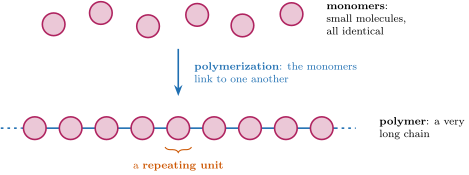
In a real macromolecule, the string does not have nine beads, but thousands, sometimes hundreds of thousands. It is this extraordinary length that gives polymers their properties: the long chains become tangled like spaghetti on a plate, and the material becomes solid and strong.
The name of a synthetic polymer is formed by placing “poly” in front of the name of its monomer.
| Monomer | Polymer | Abbreviation |
|---|---|---|
| ethylene | polyethylene | PE |
| propylene | polypropylene | PP |
| styrene | polystyrene | PS |
| vinyl chloride | polyvinyl chloride | PVC |