Synthetic polymers and the environment
Course · Chemistry (Grade 11 Humanities, Lebanon), chapter 5 · Lebanon, Grade 11 Humanities · the beginning of the chapter, the rest on Adloun
A plastic bag is often used just long enough to bring the shopping home: a few dozen minutes. Thrown away by the side of a road, carried by the wind into a ravine, then by a river to the sea, it will stay there far longer than the person who used it. The qualities that make plastics so successful, their strength and their resistance to water, become a drawback the day the object is thrown away. What becomes of abandoned plastics? Why must they never be burned on a vacant lot? And what can be done with them?
Curriculum: LB-1H
Required skills
- Explain why common plastics are not biodegradable and give the order of magnitude of the lifetime of a piece of plastic waste.
- Describe the pollution of soils and of the sea by plastics, and say what microplastics are.
- Explain the dangers of burning plastics in the open air.
- Describe the treatments of plastic waste: sorting, recycling, energy recovery, landfilling.
- Say what a biodegradable plastic is and give its limits.
- State and apply the 3R rule: reduce, reuse, recycle.
5.1 Waste that does not disappear
5.1.1 A short use, a long life
A large share of plastic objects are packaging: bags, films, bottles, trays, drinking cups. Many are used only once, sometimes for a few minutes, before becoming waste. Yet the material they are made of is designed to last.
5.1.2 Non-biodegradable materials
A peel, a dead leaf or a piece of bread left on the ground disappears in a few weeks: the microorganisms of the soil (bacteria, fungi) feed on it and decompose it. We saw, with detergents, that such a product is said to be biodegradable.
Common plastics, however, are synthetic polymers: their very long chains do not exist in nature, and microorganisms cannot cut them up.
Polyethylene, polypropylene, PVC, polystyrene and PET are non-biodegradable: microorganisms do not decompose them. Left in nature, they persist there for a very long time and accumulate.
5.1.3 How long?
No one has been able to observe a plastic bag for several centuries: the lifetimes of waste are estimates. They vary a great deal depending on the place (in the sun, underground, in water) and on the thickness of the object. They must therefore be read as orders of magnitude.
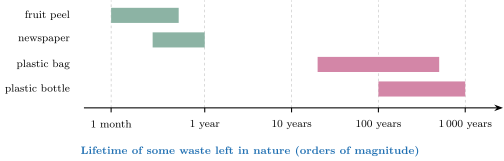
On this diagram, from one year onward, each graduation is worth ten times the previous one. A peel disappears in a few weeks or a few months; a newspaper, in less than a year. A plastic bag lasts dozens, even hundreds, of years; a bottle, which is thicker, several hundred years.
Even after this time, the plastic has not really disappeared. Under the effect of the sun, it becomes brittle and breaks into smaller and smaller pieces, which can no longer be seen, but which are still there.
5.2 Pollution by plastics
5.2.1 On land
Being light, bags and packaging are carried away by the wind and by rainwater. They are found everywhere: by the roadside, caught in trees and fences, in fields, in riverbeds.
- It spoils the look of landscapes, beaches and the outskirts of towns.
- It clogs gutters and sewers: at the first heavy rain, the water no longer drains away and the streets are flooded.
- It injures or kills animals: sheep, goats or cows swallow bags along with their food.
- In fields, pieces of film and bags mix into the soil and hinder roots and the movement of water.
5.2.2 In the sea
Most of the plastic found at sea comes from the land: the wind, rivers and sewers carry it there. The rest is thrown away or lost at sea, like fishing nets.
The Mediterranean Sea communicates with the ocean only through a narrow passage, in the west. Its waters are renewed very slowly, and its coasts are densely populated. The waste that reaches it hardly ever leaves: it floats, washes up on beaches or sinks to the bottom. That is why the Mediterranean is among the seas most affected by plastic pollution.
At sea, plastic waste is a danger to animals. A turtle mistakes a floating bag for a jellyfish and swallows it: its digestive tract becomes blocked. Seabirds feed pieces of plastic to their young. Dolphins, seals and turtles get trapped in abandoned nets.