Pesticides: classification and toxicity
Course · Chemistry (Grade 11 Humanities, Lebanon), chapter 6 · Lebanon, Grade 11 Humanities · the beginning of the chapter, the rest on Adloun
In spring, in an apple orchard in the mountains, a person in coveralls, face covered by a mask, moves a spray lance from which a fine mist comes out. On the can placed near the tractor, one reads a complicated name, a few figures and a small red diamond. The same day, in a kitchen, someone sprays a product against mosquitoes, without a mask and without giving it a thought. In both cases, a pesticide is being used: a product made to kill. What does it target? Is it dangerous for the person using it? And how can one know before using it?
Curriculum: LB-1H
Required skills
- Say what a pesticide is and why pesticides are used.
- Classify a pesticide according to the organism targeted: herbicide, insecticide, fungicide.
- Name the three routes by which a pesticide enters the human body.
- Distinguish acute toxicity from chronic toxicity.
- Define the , compare the toxicity of two products from their and calculate a dangerous dose for a given body mass.
- Read the label of a pesticide (toxicity class, pictograms) and list the precautions for use.
6.1 What is a pesticide?
6.1.1 The enemies of crops
A wheat field, an orchard or a tomato greenhouse is, for many living things, a food supply.
- Insects eat the leaves, sting the fruit or lay their eggs in it: aphids, caterpillars, the olive fruit fly, the codling moth.
- Microscopic fungi grow on leaves and fruit, especially in damp weather: they cause diseases such as downy mildew of grapevines and tomatoes, or apple scab, and make fruit rot.
- Weeds grow between the cultivated plants and take water, light and soil nutrients away from them.
Other animals add to these: rats and mice in grain stores, slugs in vegetable gardens. Without protection, a large part of the harvest is lost.
6.1.2 Products made to kill
A pesticide is a product intended to kill, repel or prevent the growth of living things considered harmful: insects, fungi, weeds, rodents.
The word comes from the English pest, “harmful animal or plant”, and from the ending “-cide”, from the Latin caedere, “to kill”. This ending is found in the name of each family of pesticides.
A commercial pesticide is a mixture. The active ingredient is the substance that acts on the targeted living thing; it often makes up only part of the product. The rest serves to dilute it and to make the droplets stick to the leaves. The label gives the name of the active ingredient and its quantity.
6.1.3 In the fields, but also at home
The largest quantities of pesticides are used by agriculture. But they are also found in everyday life: spray cans against flies and mosquitoes, anti-moth tablets in the wardrobe, bait against ants or cockroaches, rat poison, lotion against lice, products against the weeds of a path. Health services also use them, to destroy the mosquitoes that transmit diseases.
A pesticide acts on living things. Nothing guarantees that it has no effect on other living things, and in particular on human beings: every pesticide must be considered a dangerous product.
6.2 Classifying pesticides according to the organism targeted
6.2.1 The three main families
Pesticides are first classified according to the enemy they fight.
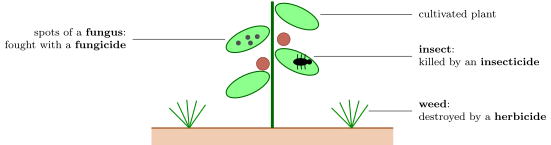
- Herbicides destroy weeds.
- Insecticides kill insects.
- Fungicides destroy the microscopic fungi that make plants sick.
6.2.2 Herbicides
Herbicides are “weed killers”. Two kinds are distinguished.
- A total herbicide destroys every plant it touches. It is used to clear a plot before sowing, the side of a road or a railway track.
- A selective herbicide destroys weeds without harming the cultivated plant: it can be sprayed on a wheat field that has already come up.
6.2.3 Insecticides
Insecticides protect crops against the insects that devour them (aphids, caterpillars, the olive fruit fly) and grain stores against weevils. They are also used to fight the insects that transmit diseases to human beings, such as mosquitoes, and those that invade houses.
6.2.4 Fungicides
The word comes from the Latin fungus, “mushroom”. Fungicides fight plant diseases caused by microscopic fungi: downy mildew, powdery mildew, scab, fruit rot. Some have been known for a very long time: sulfur and Bordeaux mixture, a blue copper-based preparation, have protected grapevines since the 19th century.
6.2.5 Other pesticides
Each kind of enemy has its pesticide, whose name is built in the same way.
| Pesticide | Organism targeted | Example of use |
|---|---|---|
| Herbicide | weeds | weeding a wheat field |
| Insecticide | insects | protecting an orchard from aphids |
| Fungicide | microscopic fungi | protecting grapevines from downy mildew |
| Acaricide | mites (tiny animals related to spiders) | protecting citrus trees |
| Rodenticide (or rat poison) | rodents: rats, mice | protecting a grain store |
| Molluscicide | slugs and snails | protecting the lettuces of a vegetable garden |
Method : Finding the family of a pesticide
- Look for what the product is used against: it is always written on the label.
- Deduce its family from this: against plants, a herbicide; against insects, an insecticide; against a disease caused by a fungus, a fungicide.
Exercises of the chapter
- An orchard's treatment log solved
- Three entry doors solved
- A laboratory test solved
- Comparing, classifying, calculating solved
- Four pictograms solved
- The mistakes of a morning of treatment solved