Pesticides and the environment
Course · Chemistry (Grade 11 Humanities, Lebanon), chapter 7 · Lebanon, Grade 11 Humanities · the beginning of the chapter, the rest on Adloun
In the 1940s, a new insecticide, DDT, was regarded as a miracle product: cheap, effective for a very long time, it protected harvests and pushed back diseases transmitted by insects, such as malaria and typhus. Twenty years later, the picture had changed. In many regions, mosquitoes and flies no longer died. Birds of prey, which no one had ever targeted, were disappearing. The product was found where it had never been sprayed. What had happened? What becomes of a pesticide once the treatment is over? And can harvests be protected in another way?
Curriculum: LB-1H
Required skills
- Explain how insects become resistant to an insecticide.
- Say what becomes of pesticides after a treatment: degradation, persistence, dispersal.
- Describe the contamination of soils, water and food, and the effects on non-target living things.
- Explain bioaccumulation and biomagnification along a food chain, using the example of DDT.
- Present the advantages and disadvantages of using pesticides.
- Name solutions that make it possible to use fewer pesticides.
7.1 The resistance of insects
7.1.1 An insecticide that “no longer works”
The first time an insecticide is used in a region, it kills almost all the targeted insects. But if the same product is used year after year, it becomes less and less effective. After a few years, it may hardly kill anything anymore. The insects have not “gotten used” to the product: it is the insect population that has changed.
An insect is resistant to an insecticide when it survives a dose of this product that kills the other insects of its species.
7.1.2 How resistance appears
In a population of millions of insects, not all individuals are exactly alike. By chance, a few, very rare ones withstand the insecticide. This particularity exists before the treatment, and it is passed on to their offspring.
- Before the treatment. The population consists of a huge majority of sensitive insects and a few rare resistant insects.
- The treatment. The insecticide kills the sensitive insects. The resistant ones survive.
- Reproduction. The survivors reproduce. They have all the food to themselves, and their offspring are resistant like them.
- A few generations later. After repeated treatments, the population is made up almost entirely of resistant insects: the insecticide has become ineffective.
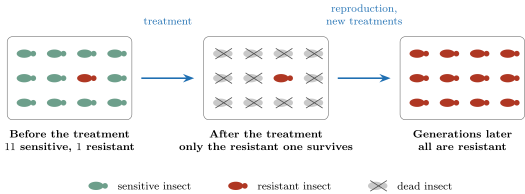
The insecticide does not transform the insects: it sorts them. It eliminates the sensitive insects and makes room for the resistant ones, which already existed. The treatment is said to select the resistant insects.
7.1.3 The consequences
Insects reproduce quickly: many species have several generations a year. Resistance can therefore become established in only a few years. Flies resistant to DDT were observed a few years after this product was first used.
Faced with an insecticide that no longer works, one is tempted to increase the doses, to treat more often or to switch to a more toxic product. Each of these responses pollutes more, costs more, and in turn selects new resistant insects.
To delay resistance, one must treat as rarely as possible and not always use the same product. Resistance does not concern only insects: weeds become resistant to herbicides, fungi to fungicides.
7.2 What becomes of a pesticide after the treatment?
7.2.1 Degradation
Once sprayed, a pesticide does not remain intact indefinitely. It is gradually transformed into other substances, most often less dangerous ones: this is degradation. Three agents contribute to it:
- light from the sun;
- the water of rain and of the soil;
- the microorganisms of the soil (bacteria, fungi), which break down the product: this is biodegradation, already met in connection with detergents and plastics.
Degradation is faster when it is hot and humid, and in a soil rich in microorganisms.
7.2.2 Persistence
The persistence of a pesticide is the length of time it remains present in the environment before being degraded. A persistent pesticide degrades very slowly.
Exercises of the chapter
- Flies that no longer die solved
- Two insecticides in the soil solved
- The journey of a pesticide solved
- DDT along a food chain solved
- Weighing the pros and cons solved
- Ladybugs in the greenhouse solved