Oxidation, reduction and redox couples
Course · Chemistry (Grade 11, Lebanon), chapter 1 · Lebanon, Grade 11 · the beginning of the chapter, the rest on Adloun
When a zinc gutter remains in prolonged contact with runoff water loaded with metal ions, or when an iron nail is dipped into a blue copper(II) sulfate solution, a spontaneous chemical transformation takes place: the metal surface becomes coated with a reddish deposit of copper while the blue color gradually fades. Likewise, the attack of a magnesium ribbon by hydrochloric acid produces a vigorous release of hydrogen gas. These phenomena, ubiquitous in the corrosion of infrastructure, in extractive metallurgy and in the electrochemical storage of energy, rest on one and the same fundamental mechanism: the transfer of electrons between chemical species, called an oxidation-reduction reaction. This first chapter establishes the concepts of oxidizing agent, reducing agent and redox couple, formalizes the writing of half-equations and builds a qualitative electrochemical classification that makes it possible to predict the spontaneous direction of redox reactions.
Curriculum: LB-1S
Required skills
- Interpret experimentally the reaction between a metal ion and a metal in terms of electron transfer.
- Define an oxidation, a reduction, an oxidizing agent and a reducing agent.
- Identify a redox couple and write the associated half-equation .
- Establish the balanced equation of an oxidation-reduction reaction by a linear combination of two half-equations, ensuring the conservation of elements and of electric charge.
- Build and use the qualitative electrochemical classification of the couples with the help of the gamma () rule.
- Place the couple in the electrochemical classification and predict the action of solutions of non-oxidizing acids on common metals.
1.1 Qualitative study of oxidation-reduction
1.1.1 Experimental evidence of electron transfer
To understand the microscopic nature of an oxidation-reduction transformation, let us study in the laboratory two classic experiments involving metals and aqueous ionic solutions.
Experiment 1: Action of a copper(II) sulfate solution on zinc metal.
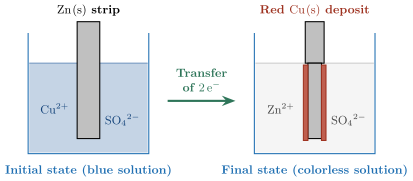
A freshly cleaned zinc strip is dipped into a beaker containing a blue aqueous solution of copper(II) sulfate, . After a few minutes of observation at room temperature, three major experimental facts are noted:
- The immersed part of the zinc strip becomes coated with a reddish, spongy metallic deposit: it is solid copper metal .
- The characteristic blue color of the hydrated copper(II) ions gradually fades until it disappears completely if the zinc is introduced in excess.
- If the final mixture is filtered and a few drops of a sodium hydroxide solution are added to the colorless filtrate, a white gelatinous precipitate of zinc hydroxide forms (soluble in excess ammonia), which proves the appearance of zinc(II) ions in solution.
The sulfate ions undergo no chemical transformation: a test with barium chloride gives, before as well as after the reaction, the same amount of white precipitate of barium sulfate . They are spectator ions.
The overall chemical transformation is therefore written, showing only the species that actually react:
Let us analyze the electron balance of this transformation at the microscopic scale:
- Each atom of zinc metal of the strip gives up two electrons and passes into solution as a zinc(II) ion :
- Each copper(II) ion present in solution gains two electrons at the surface of the strip and is deposited as an atom of copper metal :
Since electrons cannot exist in the free state for any length of time in aqueous solution, the two electrons given up by a atom are transferred directly to a ion at the moment the ion collides with the metal surface.
Experiment 2: Action of a silver nitrate solution on copper metal.
Let us dip a cleaned copper wire into a colorless aqueous solution of silver nitrate . The copper wire quickly becomes covered with fine shiny needles of silver metal (a branching growth called “Diana's tree”), while the solution takes on a blue tint, characteristic of the formation of copper(II) ions . The nitrate ions remain spectators.
Here, each copper atom gives up two electrons according to , while each silver(I) ion can gain only one electron according to . For all the electrons released by one copper atom to be gained, two ions are therefore needed per copper atom oxidized. The balanced equation of the reaction is written:
1.1.2 Fundamental definitions: oxidation, reduction, oxidizing agent, reducing agent
These two experiments reveal a direct transfer of electrons from a donor chemical species to an acceptor chemical species. The following general definitions are deduced from them.
- An oxidation is a chemical transformation during which a chemical species loses (or gives up) one or more electrons.
- A reduction is a chemical transformation during which a chemical species gains (or captures) one or more electrons.
- An oxidizing agent (denoted ) is a chemical species (atom, molecule or ion) able to gain one or more electrons during a chemical transformation. By gaining electrons, the oxidizing agent undergoes a reduction: it is said to be reduced.
- A reducing agent (denoted ) is a chemical species able to give up one or more electrons during a chemical transformation. By giving up electrons, the reducing agent undergoes an oxidation: it is said to be oxidized.
To never confuse the respective roles of the partners in an electron transfer, remember the vowel/consonant association:
- Oxidizing agent = electron Acceptor (two vowels); Reducing agent = electron Donor (two consonants), or again: “the Reducing agent Releases electrons”;
- An oxidizing agent oxidizes another species but is itself reduced; a reducing agent reduces another species but is itself oxidized.
In the reaction with balanced equation :
- Copper metal loses electrons: it undergoes an oxidation, so it is the reducing agent.
- The silver ion gains electrons: it undergoes a reduction, so it is the oxidizing agent.
1.2 The redox couple ()
1.2.1 Definition and half-equation
In the first experiment, zinc metal was transformed into the ion while the ion was transformed into copper metal . Yet, in the second experiment, this same copper metal played the role of reducing agent by being transformed into the ion. Thus, to each oxidizing agent corresponds a conjugate reducing agent, and conversely: together they form a redox couple.
Exercises of the chapter
- Reaction between copper metal and a silver nitrate solution (Diana's tree) solved
- Reduction of iron(III) ions by aluminum metal solved
- Gravimetric monitoring of a lead strip dipped into a copper(II) solution solved
- Experimental determination of an electrochemical scale with four metals solved
- Selective action of dilute sulfuric acid on a mixture of metal powders solved
- Comparative attack of two zinc-aluminum alloys by an acid solved