Electrochemical cells and redox potential
Course · Chemistry (Grade 11, Lebanon), chapter 2 · Lebanon, Grade 11 · the beginning of the chapter, the rest on Adloun
When a zinc strip is dipped directly into a copper(II) sulfate solution, the transfer of electrons from zinc to the copper(II) ions takes place by direct contact at the metal-solution interface: all the chemical energy released by the reaction is dissipated as thermal energy (heat) within the beaker. How can these electrons be forced to flow through an external electric circuit in order to power a motor, a lamp or a cell phone? In 1836, the British chemist John Frederic Daniell solved this problem by physically separating the two redox couples into two distinct compartments connected by an ionic conductor: the modern electrochemical cell was born. This chapter studies the structure and operation of electrochemical cells, introduces the standard hydrogen electrode as the universal reference for redox potentials, and establishes the quantitative scale of standard redox potentials.
Curriculum: LB-1S
Required skills
- Sketch and describe an electrochemical cell (Daniell cell and cells of the type ), specifying the role of the salt bridge.
- Determine the polarity of the electrodes, identify the anode (site of oxidation) and the cathode (site of reduction), and represent the direction of flow of the current, of the electrons and of the ions.
- Write the cell notation of a cell, the half-equations at the electrodes and the overall balanced equation of its operation.
- Define the standard hydrogen electrode (SHE) and the standard redox potential of a couple.
- Calculate the standard electromotive force (emf) of a cell and relate the quantity of electricity delivered to the wear of the electrodes.
- Use the quantitative scale of standard potentials to predict the spontaneous direction of an oxidation-reduction reaction.
2.1 Electrochemical cells: study of the Daniell cell and generalization
2.1.1 From direct to indirect electron transfer: structure of the Daniell cell
To convert the chemical energy of the spontaneous reaction into electrical energy, it is essential to prevent direct contact between the reducing agent and the oxidizing agent . To do this, the two couples and are separated into two distinct beakers, called half-cells (or compartments):
- First half-cell ( couple): a cleaned zinc strip (zinc electrode) dips into a beaker containing an aqueous solution of zinc(II) sulfate of concentration .
- Second half-cell ( couple): a cleaned copper strip (copper electrode) dips into a beaker containing an aqueous solution of copper(II) sulfate of concentration .
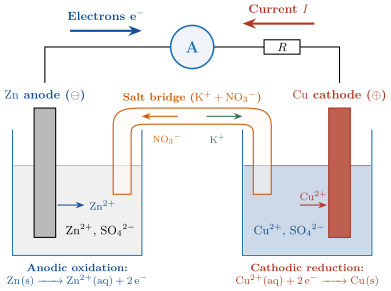
- Electrolytic junction (salt bridge): the two solutions are connected by a salt bridge (or electrolytic bridge), made of a U-tube filled with a gelled solution (with agar-agar) or of a strip of filter paper soaked in a concentrated strong electrolyte whose ions are electrochemically inert, such as potassium nitrate , potassium chloride or ammonium nitrate . In the historical Daniell cell, the salt bridge is replaced by a porous wall of unglazed earthenware separating the two solutions.
2.1.2 Polarity, reactions at the electrodes and motion of the charge carriers
When the two electrodes of the Daniell cell are connected to a digital voltmeter of very high input resistance (whose terminal is connected to the zinc strip and whose terminal is connected to the copper strip), a positive voltage is measured. If the voltmeter is replaced by an ohmic conductor of resistance in series with an ammeter, a direct electric current flows spontaneously.
In any electrochemical cell delivering a spontaneous electric current:
- The negative terminal () is the electrode made of the stronger reducing metal (here zinc ). It is the site of an oxidation reaction that releases electrons into the external circuit: it is called the anode.
- The positive terminal () is the electrode of the half-cell that contains the stronger oxidizing agent (here the copper electrode , dipped into the solution of ions). It is the site of a reduction reaction that consumes the electrons arriving from the external circuit: it is called the cathode.
The association between the nature of the electrochemical reaction and the name of the electrode never depends on the device:
- Anode = Oxidation (two vowels: A and O);
- Cathode = Reduction (two consonants: C and R).
Exercises of the chapter
- Functional and gravimetric study of a Daniell cell solved
- Asymmetric aluminum-copper cell ( electrons against electrons) solved
- Limiting reactant and maximum electric capacity of a silver-iron cell solved
- Measurements against the SHE and use of the scale of standard potentials solved
- Quantitative prediction of spontaneous reactions in solution solved
- Combining three half-cells and identifying an unknown couple solved