Oxidation number and balancing of redox reactions
Course · Chemistry (Grade 11, Lebanon), chapter 3 · Lebanon, Grade 11 · the beginning of the chapter, the rest on Adloun
In the first two chapters, we studied oxidation-reduction reactions in aqueous solution in which the transfer of electrons between a metal and a metal cation was obvious. Yet when a magnesium ribbon burns with a blinding glare in the oxygen of the air to form solid magnesium oxide, or when hydrogen reacts explosively with chlorine gas to give covalent hydrogen chloride, no ionic solution is involved. Moreover, in aqueous solution, very powerful oxidizing agents such as the permanganate ion , the dichromate ion or the hypochlorite ion of bleach exchange electrons, oxygen atoms and hydrogen ions with the solvent at the same time. To unify the study of all these transformations, chemists introduced a powerful formal tool: the oxidation number (or oxidation state). This chapter defines the oxidation number, shows how it makes it possible to identify any redox reaction (including disproportionations), and sets out the systematic method of half-equations for balancing oxidation-reduction reactions in acidic or basic medium.
Curriculum: LB-1S
Required skills
- Interpret dry redox reactions (formation of an ionic compound or of a polar molecular compound) in terms of complete or partial transfer of electrons.
- Determine the oxidation number (, written in Roman numerals) of a chemical element in a free element (elementary substance), a monatomic ion, a molecule or a polyatomic ion.
- Recognize an oxidation-reduction reaction, an oxidation and a reduction by the change in oxidation numbers, and distinguish it from an acid-base or precipitation reaction.
- Identify and interpret a disproportionation reaction and a comproportionation reaction.
- Write the half-equations of complex redox couples (oxygen-containing ions such as , , , , ) and balance the overall equation of a redox reaction in aqueous solution by the half-equation method.
3.1 Dry redox reactions
3.1.1 Reaction leading to an ionic crystal: complete electron transfer
Let us heat the end of a magnesium ribbon to incandescence in the flame of a Bunsen burner, then plunge it into a flask of oxygen gas : the combustion is very vigorous, strongly exothermic, and produces white smoke that settles as a white powder of magnesium oxide :
Although this reaction takes place in the complete absence of water (dry process), crystallographic analysis shows that the solid is a purely ionic compound, made of a regular arrangement of magnesium cations and oxide anions . During the combustion:
- Each magnesium atom has given up its two valence electrons:
- Each oxygen molecule has gained four electrons to form two oxide ions:
There has therefore been a complete transfer of electrons from the metal magnesium to the nonmetal oxygen. A strictly analogous phenomenon is observed in the combustion of sodium metal in chlorine gas (, ionic crystal ).
3.1.2 Reaction leading to a polar covalent molecule: partial electron transfer
Let us now react two nonmetallic gases by the dry process: hydrogen and chlorine . Under the effect of a flash of light (photochemical reaction), the mixture explodes to form hydrogen chloride gas according to:
Unlike or , hydrogen chloride is not an ionic solid but a covalent molecule. No electron has been completely removed! Why, then, is this synthesis nevertheless classified among oxidation-reduction reactions?
In the homonuclear molecules of the reactants and , the electron pair of the covalent bond is shared in a perfectly symmetrical way between two identical atoms.
On the other hand, in the product molecule , the chlorine atom is much more electronegative ( on the Pauling scale) than the hydrogen atom (). The bonding electron pair is therefore strongly attracted toward the chlorine atom, which acquires a partial negative charge , while the hydrogen atom acquires a partial positive charge :
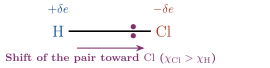
It is therefore as if hydrogen had partially lost its electron to chlorine: has been oxidized and has been reduced.
3.2 The oxidation number (O.N.) of a chemical element
3.2.1 Definition and conventional notation
To handle with a single rule both complete electron transfers (ionic species) and partial electron transfers (polar covalent species), all the electrons of each covalent bond are fictitiously assigned to the more electronegative atom.
The oxidation number (denoted , or oxidation state) of a chemical element in a chemical entity (atom, ion or molecule) is an algebraic integer (positive, negative or zero), traditionally written in Roman numerals preceded by its sign (, , , , , etc.), which characterizes the oxidation state of this element:
- in a purely ionic species, it represents the actual charge carried by the ion (in units of the elementary charge );
- in a covalent species, it represents the fictitious charge that the atom would carry if all the bonding pairs were given entirely to the more electronegative atom of each bond.
Thus, in the molecule, if the bonding pair is fictitiously assigned to chlorine (more electronegative), hydrogen fictitiously becomes and chlorine fictitiously becomes : we therefore have and .
3.2.2 General rules for determining the oxidation number
In practice, there is no need to draw the Lewis structure of each species to find the oxidation numbers: five working rules are enough in almost all cases.
Exercises of the chapter
- Diagram of the oxidation states of chlorine and disproportionation reactions solved
- Distinguishing oxidation-reduction reactions from non-redox reactions solved
- Reduction of the permanganate ion by oxalic acid and by sulfur dioxide solved
- Reactions of dichromate ions with iron(II) ions and with hydrogen sulfide solved
- Attack of silver by concentrated or dilute nitric acid solved
- Balancing a redox reaction in basic medium (synthesis of the ferrate ion) solved