Alkenes and polymerization reactions
Course · Chemistry (Grade 11, Lebanon), chapter 7 · Lebanon, Grade 11 · the beginning of the chapter, the rest on Adloun
In the citrus orchards and banana plantations of the Lebanese coast, between Sidon and Tyre, fruits ripen under the action of a gaseous plant hormone of remarkable simplicity: ethene (or ethylene), of formula . This same molecule is today the most produced raw material of the entire world organic chemical industry. Whereas alkanes, studied in the previous chapter, are saturated hydrocarbons of low reactivity whose chemistry requires vigorous conditions, alkenes have a carbon-carbon double bond that gives them a rich and selective reactivity.
This chapter studies the geometric and electronic structure of the double bond , the IUPAC nomenclature rules and the origin of geometric stereoisomerism. It then details electrophilic or catalytic addition reactions (hydrogenation, halogenation with bromine, regioselective hydrohalogenation according to Markovnikov's rule, hydration into alcohols), oxidation reactions, as well as the addition polymerization reaction that turns light alkenes into polymer materials found everywhere in everyday life (polyethylene, polypropylene, polyvinyl chloride, polystyrene, Teflon).
Curriculum: LB-1S
Required skills
- Define an acyclic alkene, write its general molecular formula () and describe the electronic () and geometric (trigonal planar, angles of ) structure of the double bond .
- Name a linear or branched alkene according to the IUPAC rules and write its condensed structural formula from its name.
- Identify the different types of isomerism of alkenes: structural isomerism (chain, position, functional group isomerism with cycloalkanes) and (or cis/trans) geometric stereoisomerism.
- Write the balanced equations of the addition reactions on the double bond : catalytic hydrogenation, halogenation (bromine water test), hydrohalogenation and hydration.
- State and apply Markovnikov's rule for the addition of an unsymmetrical reagent ( or ) to an unsymmetrical alkene in order to identify the major and minor products.
- Write the equation of the addition polymerization of an alkene, identify the monomer and the repeating unit, and calculate the average degree of polymerization .
7.1 Structure and nomenclature of alkenes
7.1.1 Definition and general formula of acyclic alkenes
An alkene (formerly called an olefin) is an unsaturated hydrocarbon with an open (acyclic), linear or branched carbon chain, whose molecule contains exactly one carbon-carbon covalent double bond and only single bonds and everywhere else.
The general molecular formula of an acyclic alkene with carbon atoms is:
Compared with the corresponding acyclic alkane of formula , the presence of the double bond leads to a deficit of two hydrogen atoms: the alkene molecule is said to have one degree of unsaturation. The first member of the family necessarily corresponds to : it is ethene (commonly called ethylene), of molecular formula and condensed structural formula .
7.1.2 Electronic structure and geometry of the double bond
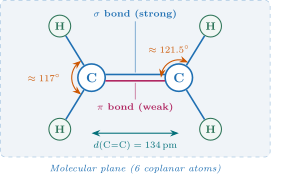
In the ethene molecule , each of the two carbon atoms is bonded to three neighbors (the other carbon atom and two hydrogen atoms). Each carbon atom involved in the double bond is said to be trigonal.
- Electronic nature: The carbon-carbon double bond is not made of two identical bonds. It results from the superposition of:
- a (sigma) bond, formed by axial overlap, very strong (bond energy );
- a (pi) bond, formed by lateral overlap of the electrons, weaker and more exposed to chemical reagents ().
The total energy of the double bond is about (less than twice that of a single bond ).
- Planar geometry: The two trigonal carbon atoms and the four atoms directly bonded to them are coplanar (located in the same plane). Around each trigonal carbon, the bond angles are close to . The interatomic distance is shorter than that of a single bond .
- Restricted rotation: Unlike the single bond , around which rotation is free, the presence of the lateral bond prevents any free rotation about the axis at ordinary temperature (rotating one group relative to the other would require breaking the bond).
7.1.3 Systematic (IUPAC) nomenclature of alkenes
Method : Naming an alkene according to the IUPAC rules
To determine the systematic name of an acyclic alkene:
- Main chain: Choose the longest carbon chain that necessarily contains both carbon atoms of the double bond . The number of carbon atoms of this chain determines the Greek or Latin prefix (eth-, prop-, but-, pent-, hex-, hept-, oct-…).
- Numbering: Number the main chain from one end to the other so as to give the two carbons of the double bond the lowest possible locants. The position of the double bond is indicated by the smaller of these two locants, placed between hyphens just before the ending -ene (e.g. -1-ene, -2-ene).
- Substituent groups (alkyl branches): If both directions of numbering give the same locant to the double bond, choose the direction that gives the lowest locant to the first alkyl substituent encountered. The alkyl groups (methyl , ethyl , propyl ) are placed as prefixes in alphabetical order, preceded by their position locant and possibly by the multiplying prefixes di-, tri-, tetra- (which do not count in the alphabetical order).
- : chain of carbons with a double bond necessarily in position propene (the locant is omitted for ethene and propene since there is no ambiguity).
- : chain of carbons; numbering from right to left, the double bond is between and but-1-ene.
- : the chain containing has carbons. Numbering from right to left, the double bond gets locant (versus from left to right) and the methyl group is in position 5-methylhex-2-ene (the double bond has priority over the alkyl groups for choosing the direction of numbering).
- : the longest chain containing has carbons (and not , because the -carbon chain would not contain the double bond!). Carbon carries an ethyl group 2-ethylbut-1-ene.
Exercises of the chapter
- Naming branched alkenes and avoiding the traps in choosing the main chain solved
- Counting all the alkenes and identifying their stereoisomers solved
- Regioselective hydrohalogenation and hydration: applying Markovnikov's rule solved
- Quantitative analysis of an ethane-propene gas mixture by bromination and combustion solved
- Identifying an alkene by analysis of its monohalogenated derivative or of its alcohol solved
- Industrial addition polymerization: from the monomer to the degree of polymerization and the mass balance solved