Alkanes and cycloalkanes
Course · Chemistry (Grade 11, Lebanon), chapter 6 · Lebanon, Grade 11 · the beginning of the chapter, the rest on Adloun
Major constituents of natural gas and of petroleum fractions, alkanes and cycloalkanes are the main source of thermal and mechanical energy in the modern world (methane-propane-butane domestic gas, motor gasoline, aviation kerosene, diesel fuel, fuel oil and paraffin waxes) as well as the basic raw material of the whole petrochemical industry. From a structural point of view, alkanes are the reference framework of organic chemistry: the whole international (IUPAC) nomenclature of organic molecules is based on the names of the straight-chain alkanes. This sixth chapter studies the tetrahedral geometric structure of alkanes, their systematic naming rules, the trends in their physical properties and their main chemical reactions: combustions, photochemical substitutions by halogens and industrial petrochemical transformations.
Curriculum: LB-1S
Required skills
- Write the general molecular formula of an acyclic alkane and () of a cycloalkane, and describe the tetrahedral geometry of the carbon atom ().
- Know the names of the first ten straight-chain alkanes and of the main alkyl groups (), and apply the IUPAC naming rules to branched alkanes and to cycloalkanes.
- Relate the physical state and the boiling point of an alkane to the length of its carbon chain and to its degree of branching.
- Write and use the balanced equations of the complete and incomplete combustion of alkanes.
- Interpret and write the equations of the photochemical substitution (halogenation) of methane and of higher alkanes, and present the industrial cracking and reforming processes.
6.1 Acyclic alkanes: structure and molecular geometry
6.1.1 Natural occurrence and general molecular formula
In nature, alkanes are abundant in fossil deposits: natural gas contains from to methane along with ethane , propane and butane , while crude oil is a complex mixture containing a wide variety of liquid and solid alkanes (paraffins) as well as cycloalkanes (naphthenes).
Acyclic alkanes are hydrocarbons (compounds made up only of the elements carbon and hydrogen ) with an open carbon chain (straight or branched) in which all the carbon atoms are bonded to one another only by single covalent bonds .
The general molecular formula of any acyclic alkane with carbon atoms () is:
Proof
In an open carbon chain (with no ring), straight or branched, of carbon atoms joined by single bonds:
- the tetravalent carbon atoms offer a total of bonds;
- an open chain of atoms has exactly bonds, and each of them takes up two of these bonds (one on each of its two carbons), that is, ;
- all the remaining bonds are bonds: there are of them.
The molecule therefore contains hydrogen atoms, whatever the branching of the chain (for example, for straight-chain butane: two units and two units, that is, hydrogen atoms).
6.1.2 Tetrahedral geometric structure of methane and ethane
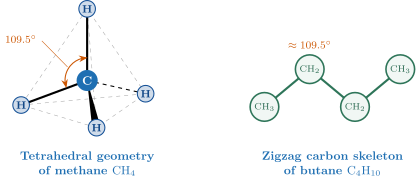
In any alkane, each carbon atom forms four single covalent bonds (called bonds, with cylindrical symmetry) with four neighboring atoms. The four bonding electron pairs repel one another and point in space so as to be as far apart as possible:
- In methane : the carbon atom is at the center of a regular tetrahedron whose four vertices are occupied by the four hydrogen atoms. The length of the bonds is () and all the bond angles are equal to the tetrahedral angle:
- In ethane () and the higher alkanes: each carbon atom keeps a tetrahedral environment (, length ). As a result, the carbon skeleton of a straight-chain alkane is not a straight line but forms a zigzag line in space.
- Free rotation about single bonds: since the single bond has rotational symmetry about the internuclear axis, the two groups of ethane can rotate almost freely relative to each other at room temperature (continuous change between the staggered conformation, the more stable, and the eclipsed conformation).
6.2 IUPAC nomenclature of alkanes and cycloalkanes
6.2.1 The first ten straight-chain alkanes and the alkyl groups
An alkane with an unbranched carbon chain is said to be straight-chain (or normal, sometimes written -alkane). The first four have names established by usage (methane, ethane, propane, butane); from onward, their name is formed from a Greek prefix indicating the number of carbon atoms followed by the characteristic ending -ane:
Exercises of the chapter
- Systematic IUPAC nomenclature and the traps of the longest main chain solved
- Determining the molecular formula of an alkane or a cycloalkane from mass criteria solved
- Complete combustion of a motor gasoline modeled by octane solved
- Combustion of a binary mixture of two homologous gaseous alkanes solved
- Regioselective halogenation and identification of alkanes by the number of monochlorinated isomers solved
- Stoichiometric balance of a photochemical bromination and determination of the acid formed solved