Elemental analysis, formulas and isomerism
Course · Chemistry (Grade 11, Lebanon), chapter 5 · Lebanon, Grade 11 · the beginning of the chapter, the rest on Adloun
From the carbohydrates, lipids and proteins that make up living matter to petroleum fuels, the active ingredients of medicines and the synthetic polymers of our everyday lives, more than twenty million known chemical compounds share a unique structural feature: their molecular skeleton is built around the element carbon (). When a chemist isolates a new substance — whether it is extracted from a medicinal plant or synthesized in the laboratory — the first step is to identify the chemical elements it contains (qualitative elemental analysis), to measure their exact proportions by mass in order to establish its molecular formula (quantitative elemental analysis), then to work out the three-dimensional arrangement of its atoms. This chapter lays the foundations of organic chemistry by presenting the methods of elemental analysis, the different structural representations of molecules and the fundamental phenomenon of isomerism.
Curriculum: LB-1S
Required skills
- Define organic chemistry and describe the experimental tests of qualitative elemental analysis (detection of the elements , , and halogens).
- Use the results of a quantitative elemental analysis (percentage composition by mass, or masses of water and carbon dioxide formed by complete combustion) and the vapor density to determine the molecular formula of an organic compound.
- Use the valence (covalence) of the elements , , , and (halogen) to write the full structural, condensed structural and skeletal formulas of an organic molecule.
- Define isomerism and distinguish the three types of structural isomerism: chain isomerism, position isomerism and functional group isomerism.
5.1 Qualitative elemental analysis of an organic substance
5.1.1 Definition and constituent elements of organic compounds
Historically, in the 18th century, the substances coming from living organisms (plants or animals) were called “organic”, as opposed to the “mineral” (or inorganic) substances coming from rocks and ores. In 1828, the German chemist Friedrich Wöhler synthesized urea in the laboratory from a mineral salt (ammonium cyanate ), doing away for good with the boundary of the so-called “vital force”.
Organic chemistry is the branch of chemistry that studies the compounds of the element carbon (), of natural or synthetic origin, with the exception of a few simple, purely mineral species: elemental carbon (diamond, graphite, fullerenes), the carbon oxides ( and ), carbonic acid and the carbonate (), hydrogen carbonate () and cyanide () ions.
Almost all organic compounds also contain the element hydrogen () — those that contain only and are called hydrocarbons — and very often the elements oxygen (), nitrogen (), halogens (), sulfur () or phosphorus (), called heteroatoms.
5.1.2 Experimental detection of the elements , , and halogens
Method : Procedures of qualitative elemental analysis
- Testing for the elements carbon () and hydrogen ():
- By pyrolysis (thermolysis away from air): by strongly heating sucrose (sugar, ) or starch at the bottom of a dry test tube, we observe a black residue of solid carbon (charcoal) and droplets of water on the cold walls of the tube.
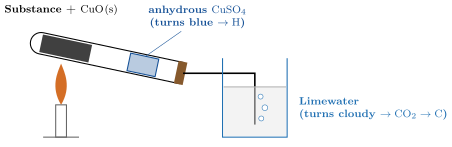
- By complete oxidation with copper(II) oxide (Liebig's general method): an intimate mixture of the organic substance and excess black copper(II) oxide is heated. The carbon is completely oxidized to carbon dioxide and the hydrogen to water vapor (while is reduced to red copper ):
- Passing the gases over white anhydrous copper(II) sulfate turns it blue (), which proves that water has formed and therefore that the element hydrogen is present.
- Bubbling the gases through clear limewater produces a white cloudiness of calcium carbonate , which proves that is given off and therefore that the element carbon is present.
- Testing for the element nitrogen (): by heating a nitrogen-containing organic substance (such as urea or glycine) with soda lime , the organic nitrogen is converted into ammonia gas , recognizable by its pungent smell, by turning moist pH paper blue and by the white fumes of in contact with a glass rod dipped in concentrated hydrochloric acid.
- Testing for halogens () — Beilstein test: a cleaned copper wire is heated red-hot in the flame of the Bunsen burner, brought into contact with the substance studied, then put back into the flame: the appearance of a green or blue-green flame (due to the vaporization of copper(II) halides) reveals the presence of a halogen element.
5.2 Quantitative elemental analysis and determination of the molecular formula
5.2.1 Percentage composition by mass and law of definite proportions
Let us consider a pure organic compound of molecular formula , where are natural whole numbers (). With the atomic molar masses , , and , the molecular molar mass (in ) of one mole of this compound is written:
In one mole of compound (of total mass ), there are grams of carbon, grams of hydrogen, grams of oxygen and grams of nitrogen.
Exercises of the chapter
- Determining the molecular formula of an oxygen-containing compound by complete combustion solved
- Elemental analysis of a nitrogen-containing solvent (DMF) solved
- Eudiometric analysis of a gaseous hydrocarbon by combustion solved
- Counting and classifying the isomers of molecular formula solved
- Isomerism of unsaturated or cyclic compounds of molecular formula and solved
- Analysis of a dibrominated derivative and structural identification by isomerism solved