Aldehydes and ketones
Course · Chemistry (Grade 12 Life Sciences, Lebanon), chapter 6 · Lebanon, Grade 12 Life Sciences · the beginning of the chapter, the rest on Adloun
From the delicate scent of benzaldehyde (bitter almond oil), cinnamaldehyde (cinnamon) and vanillin to camphor, menthone and propanone (acetone, the universal solvent of laboratories and industry), aldehydes and ketones form the two great families of carbonyl compounds. Their chemical unity comes from the presence of the same functional unit: the carbonyl group , whose strongly polarized double bond is the site of addition and condensation reactions common to both families — first among them the characteristic test with 2,4-dinitrophenylhydrazine (2,4-DNPH) and catalytic hydrogenation into alcohols. But the presence of a hydrogen atom directly bonded to the functional carbon in aldehydes () gives them a pronounced reducing character that ketones () do not have, which makes it possible to distinguish them by three classic tests of great visual elegance: Schiff's reagent, Fehling's solution and Tollens' reagent (silver mirror).
Curriculum: LB-SV
Required skills
- Describe the planar geometry and the electronic polarization of the carbonyl group .
- Write the general formula of saturated acyclic aldehydes () and ketones () (, ), name them according to IUPAC and identify their chain, position and functional isomers.
- Detect a carbonyl compound (aldehyde or ketone) by the 2,4-DNPH test and write the balanced equation of their reduction into alcohols by catalytic hydrogenation.
- Explain why only aldehydes undergo mild oxidation into carboxylic acids (or carboxylate ions in basic medium).
- Describe and interpret the three selective identification tests of aldehydes (Schiff's reagent, hot Fehling's solution, Tollens' reagent in a water bath) and write the corresponding redox half-equations and balanced equations.
6.1 Structure, general formula and nomenclature of carbonyl compounds
6.1.1 The carbonyl group: planar geometry and polarization
- A carbonyl compound is any organic compound whose molecule contains the carbonyl functional group , in which a trigonal carbon atom is bonded to an oxygen atom by a covalent double bond.
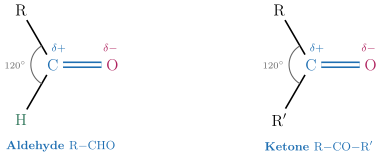
- If the functional carbon is bonded to at least one hydrogen atom (group , necessarily located at the end of the chain), the compound is an aldehyde, with general formula:
- If the functional carbon is bonded to two carbon atoms (group located inside the chain), the compound is a ketone, with general formula:
- Planar geometry: the trigonal carbon atom of the group and the three atoms to which it is directly bonded are coplanar, with bond angles close to and a bond length of about (shorter than the single bond of alcohols, which is ).
- Strong polarization: since oxygen is much more electronegative than carbon, the electron cloud of the double bond is attracted toward the oxygen atom, which carries a negative partial charge (electron-rich site), while the functional carbon carries a positive partial charge (electron-poor site):
Exercises of the chapter
- The seven carbonyl isomers with molecular formula and their tests solved
- Quantitative analysis of the 2,4-dinitrophenylhydrazone precipitate, and hydrogenation solved
- Redox balance and titration of a formalin solution with Tollens' reagent solved
- Reaction with Fehling's solution and the reducing character of glucose solved
- Reaction sequence: alkene alcohols aldehyde and ketone solved
- Catalytic oxidation of a mixture of alcohol vapors and titration of the products solved