Carboxylic acids and derivatives: the ester function
Course · Chemistry (Grade 12 Life Sciences, Lebanon), chapter 7 · Lebanon, Grade 12 Life Sciences · the beginning of the chapter, the rest on Adloun
From the fruity flavors of pineapple, banana or pear to active pharmaceutical ingredients such as aspirin and paracetamol, by way of fats and soaps, carboxylic acids and their derivatives hold a central place in organic chemistry and biochemistry. This chapter first studies the structure, nomenclature and reactivity of carboxylic acids and of their main derivatives (acyl chlorides, acid anhydrides, amides), then goes deeper into the ester function and the thermodynamic and kinetic control of the esterification-hydrolysis equilibrium, a pillar of the official exams of the Lebanese Baccalaureate.
Curriculum: LB-SV
Required skills
- Identify and name according to the IUPAC rules saturated-chain carboxylic acids and their main derivatives (acyl chlorides, acid anhydrides, esters, amides).
- Relate the structure of the carboxyl group to the physical properties (hydrogen bonds, dimerization, solubility) and to the acidic properties of carboxylic acids in aqueous solution.
- Write the balanced equations of the formation of acyl chlorides, acid anhydrides and amides, as well as the decarboxylation reaction.
- Identify the chain, position and functional isomers corresponding to the general molecular formula ().
- Write the balanced equation of the direct esterification reaction and of the reverse hydrolysis reaction of an ester, and state their experimental characteristics (slow, limited and athermic reactions).
- Express and use the equilibrium constant of the esterification-hydrolysis equilibrium to determine the composition of a mixture at equilibrium and the yield according to the class of the alcohol and the initial proportions of the reactants.
- Justify the choice of operating conditions (heating under reflux, acid catalyst, excess of one reactant, distillation of a product, use of an acid anhydride or an acyl chloride) that speed up the synthesis of an ester and increase its yield, and write the equation of the saponification of an ester.
7.1 Carboxylic acids: structure, nomenclature and properties
7.1.1 Carboxyl functional group and general formula
A carboxylic acid is an oxygen-containing organic compound whose molecule contains the carboxyl functional group (or ), made up of a carbonyl group directly bonded to a hydroxyl group on the same functional carbon atom:

When the group is a saturated non-cyclic alkyl group (or a hydrogen atom for ), the saturated-chain carboxylic acid has the general condensed structural formula and the general molecular formula:
Its molecular molar mass is expressed in terms of the number of carbon atoms by:
The functional carbon atom of the carboxyl group is involved in one double bond and two single bonds ( and ): it has a trigonal planar geometry (bond angles close to ). The high electronegativity of the two oxygen atoms strongly polarizes the , and bonds (), which gives the hydroxyl hydrogen atom a marked acidic character.
7.1.2 IUPAC nomenclature and common names
Method : Naming a carboxylic acid according to IUPAC
- The name of a carboxylic acid is obtained by replacing the ending -e of the corresponding alkane by the suffix -oic and adding the word acid: alkanoic acid.
- The main carbon chain is the longest chain that necessarily contains the functional carbon of the group.
- The carbon atom of the carboxyl group always bears the number ; its position number is omitted from the name.
| Molecular formula |
|
|
| ||||||
|---|---|---|---|---|---|---|---|---|---|
| () | methanoic acid | formic acid | |||||||
| () | ethanoic acid | acetic acid | |||||||
| () | propanoic acid | propionic acid | |||||||
| () | butanoic acid | butyric acid | |||||||
| () | 2-methylpropanoic acid | isobutyric acid | |||||||
| (aromatic) | benzoic acid | benzoic acid |
Let us name the following two carboxylic acids:

- First molecule: the main chain has carbon atoms, with on the group and a methyl group in position . It is 3-methylbutanoic acid.
- Second molecule: choosing the longest carbon chain containing means going through the group (), giving a -carbon chain (pentanoic acid) carrying two methyl groups in positions and . It is 2,3-dimethylpentanoic acid.
7.1.3 Physical properties and hydrogen bonds
Thanks to the simultaneous presence of a hydrogen-bond donor site () and a strong acceptor site (), carboxylic acid molecules associate in pairs through two intermolecular hydrogen bonds to form cyclic dimers that are very stable in the liquid state and even in the vapor phase:
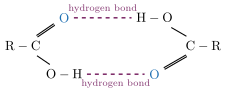
Physical consequences:
- Carboxylic acids have markedly higher boiling points than alkanes, aldehydes, ketones and even alcohols of similar molar mass (for example, compared with for propan-1-ol of the same molar mass ).
- The first four members (, from methanoic acid to butanoic acid) are completely miscible with water thanks to the hydrogen bonds formed with water molecules. Beyond , the hydrophobic character of the alkyl chain wins out and the solubility in water decreases rapidly.
7.1.4 Acid-base properties and decarboxylation reaction
- Partial ionization in water (weak acid): In aqueous solution, a carboxylic acid reacts partially with water by giving up a proton to form its conjugate base, the carboxylate ion (alkanoate ion):
The pH of an aqueous solution of a carboxylic acid is less than (bromothymol blue BTB turns yellow).
- Neutralization by a strong base: The reaction of a carboxylic acid with hydroxide ions (sodium hydroxide solution ) is fast, complete and exothermic:
It is used for the acid-base titration of a carboxylic acid with a standard sodium hydroxide solution in the presence of phenolphthalein: at equivalence, .
- Characteristic test with hydrogen carbonate ions: Carboxylic acids react with sodium hydrogen carbonate (or calcium carbonate ), producing an effervescence of carbon dioxide (which turns limewater cloudy):
- Decarboxylation: When strongly heated in the presence of a suitable catalyst (or of soda lime ), a carboxylic acid undergoes an elimination of carbon dioxide leading to a hydrocarbon :
Exercises of the chapter
- Identification of a carboxylic acid by titration and synthesis of its derivatives solved
- Constitutional isomerism around the molecular formula and identification tests solved
- Kinetic monitoring of an esterification by titration and determination of the class of the alcohol solved
- Complete study of the esterification-hydrolysis equilibrium and shifting of equilibrium solved
- Comparison between direct esterification and acylation by an anhydride or an acyl chloride solved
- Saponification of an ester and making a soap from palmitin solved