Chirality, asymmetric carbon and enantiomerism
Course · Chemistry (Grade 12 Life Sciences, Lebanon), chapter 8 · Lebanon, Grade 12 Life Sciences · the beginning of the chapter, the rest on Adloun
The lactic acid produced by the muscles during intense exercise and the lactic acid obtained from the fermentation of milk (in laban or yogurt) have exactly the same molecular formula and the same sequence of atoms : they are nevertheless two distinct molecules, which do not interact in the same way with the enzymes of our body. Likewise, the limonene molecule responsible for the smell of oranges and the one responsible for the smell of lemons have the same planar formula, but differ in the three-dimensional spatial arrangement of their atoms. This fundamental property, called chirality, plays a central role in biochemistry and pharmacology: almost all the -amino acids that make up proteins, as well as many active pharmaceutical ingredients, exist in two forms that are mirror images of each other, called enantiomers.
This chapter introduces the Cram spatial representation of organic molecules around a tetrahedral carbon, defines the chirality of an object and of a molecule, establishes the link between the presence of an asymmetric carbon atom () and molecular chirality, and presents the construction and the biological properties of a pair of enantiomers and of a racemic mixture.
Curriculum: LB-SV
Required skills
- Know the tetrahedral geometry of a carbon atom involved in four single covalent bonds and use the conventional Cram representation (lines in the plane, solid wedge pointing forward, hashed wedge pointing backward).
- Define the chirality of an object or of a molecule from the fact that it cannot be superimposed on its image in a plane mirror; distinguish a chiral molecule from an achiral molecule.
- Define and identify an asymmetric carbon atom () in a condensed structural formula or a skeletal formula (alcohols, carboxylic acids, -amino acids).
- Know that a molecule with a single asymmetric carbon atom is necessarily chiral.
- Define a pair of enantiomers and a racemic mixture; draw, in Cram perspective, the two enantiomers of a chiral molecule on either side of a plane mirror.
- Explain the biological and therapeutic importance of chirality (stereochemical specificity of biological receptors and of enzymes).
8.1 Tetrahedral geometry of carbon and Cram representation
8.1.1 The tetrahedral (tetragonal) carbon
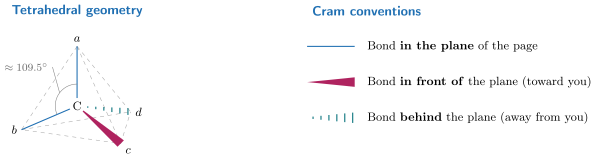
In saturated organic molecules (alkanes, alcohols, amines, carboxylic acids along their carbon chain), a carbon atom that forms four single covalent bonds with four neighboring atoms adopts a tetrahedral geometry (the carbon is said to be tetragonal). The carbon atom occupies the center of a regular (or nearly regular) tetrahedron whose four vertices are occupied by the four bonded atoms, with bond angles close to .
A planar structural or condensed structural formula does not show this three-dimensional arrangement: it flattens the four bonds into the plane of the page with apparent angles of . To represent faithfully the spatial arrangement of the four groups carried by a tetrahedral carbon atom, chemists use the conventional Cram representation (1953).
8.1.2 Conventions of the Cram representation
To represent a tetrahedral carbon atom and its four single bonds on a flat page:
- Two bonds lying in the plane of the page are drawn as ordinary solid lines making an angle of about with each other;
- A bond pointing in front of the plane (toward the observer) is drawn as a solid triangle (or solid wedge) that widens from the carbon toward the bonded group;
- A bond pointing behind the plane (away from the observer) is drawn as a hashed triangle (or dashed wedge) that widens from the carbon toward the bonded group.
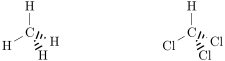
In the methane molecule , the carbon atom is bonded to four identical hydrogen atoms: we place, for example, two bonds in the plane, one bond in front and the fourth one behind. In trichloromethane (chloroform) , we place the bond and one bond in the plane, a second bond in front and the third one behind.
8.2 Chirality of an object and of a molecule
8.2.1 The notion of chirality: the example of the hand
The word chiral (introduced by Lord Kelvin in 1894) comes from the Greek kheir (), which means “hand”. If you place your right hand in front of a plane mirror, the reflected image observed in the mirror looks exactly like a left hand. Yet it is impossible to superimpose your right hand and your left hand perfectly: if the two palms are placed facing the same way, the thumbs point in opposite directions.
- An object or a molecule is said to be chiral if it is not superimposable on its image in a plane mirror.
- An object or a molecule is said to be achiral if it is superimposable on its image in a plane mirror.
In everyday life, a hand, a foot, a shoe, a glove, a snail shell or a corkscrew are chiral objects: there is a “right” model and a “left” model that cannot be superimposed. On the other hand, a sphere, an undecorated cube, a cylindrical cup with no side pattern, a symmetrical chair or an ordinary fork are achiral objects: their image in a plane mirror can be made to coincide perfectly with the initial object by simple translations and rotations in space.
Exercises of the chapter
- Systematic search for asymmetric carbons in alcohols and acids solved
- -amino acids and stereochemical recognition solved
- Molecules with one or two asymmetric carbons: 3-methylpentan-2-ol and threonine solved
- Identification of a chiral alcohol with formula by mild oxidation solved
- Dehydration of a chiral alcohol and hydrogenation of alkenes solved
- Synthesis of a chiral fruity ester from an acid and an alcohol solved