Memory and Childhood: Reading and Writing a Narrative
Course · English for Humanities (Grade 11, Lebanon), chapter 1 · Lebanon, Grade 11 · the beginning of the chapter, the rest on Adloun
Why do the places of our first years — a staircase, a fig tree, the road to school — stay so bright in the mind when so much of last year has already faded? Writers have always known that childhood is the first country anyone lives in, and that remembering it is a way of understanding who we have become. In this first unit, three great storytellers look back: George Eliot watches two children fishing by an English river, Mark Twain brings back the sleepy town of his boyhood on the Mississippi, and James Joyce lets a Dublin boy tell the evening on which his first dream broke. With them you will learn to discuss the four pillars of any story — theme, plot, characters and setting —, to read quickly for a purpose, to catch the main idea of a talk, to tell a story aloud and, finally, to write a narrative of your own, from the first notes to the revised copy.
Curriculum: LB-1H
Learning outcomes
- Reading: discuss the theme, plot, characters and setting of a literary narrative; skim a text for its general sense and scan it for a precise detail.
- Listening: identify the main idea of a talk and relate each supporting idea to it.
- Speaking: tell a personal story with an appropriate tone, intonation and body language.
- Writing: write a narrative essay by applying pre-writing, drafting and revising techniques, with correct narrative tenses.
- Thinking: respond to a writer's point of view with a reasoned answer of your own.
1.1 Key terms: the words of memory and the elements of a story
1.1.1 Talking about memory and childhood
English has several verbs for the act of remembering, and they are not interchangeable.
- To remember is the general verb: to have or keep something in the mind (I remember the house where I was born).
- To recall and to recollect mean to bring a memory back by an effort of the mind (She could not recall his name).
- To remind needs an object: something or someone reminds you of something else (The smell of thyme reminds me of my grandmother's kitchen). You do not remind a memory; a thing reminds you.
- To reminisce is to talk or think with pleasure about the past (The two old friends reminisced about their school days).
The nouns deserve the same care. A memory is what you remember (and memory, uncountable, is the power to remember); a memoir is a written account of a part of one's life; a souvenir or a memento is an object kept to remember a place or a person — in English, a souvenir is never a thought. Nostalgia is a longing, half sweet and half sad, for a time that is gone; hindsight is the understanding that comes only afterward (With hindsight, I see that my teacher was right).
| The age of childhood | The colors of memory | Growing up |
|---|---|---|
| infancy, boyhood, girlhood, upbringing, playmate, sibling, make-believe, mischief, innocence, wonder, a scolding, a treat. | vivid, faint, blurred, fond, bittersweet, haunting; to fade, to linger, to come back, to dwell on; a glimpse, a trace, a keepsake. | to outgrow, to come of age, to lose one's illusions; disappointment, awakening, maturity, self-knowledge; a turning point, a rite of passage. |
1.1.2 The four elements of a narrative
A narrative is a text that tells a story: a series of connected events lived by characters in a certain place and time. Whenever you discuss a story, four questions come first.
- The setting is the where and the when of the story: the place, the period, the season, the hour, and also the social world in which the characters live. A setting often creates a mood (the feeling the reader breathes in).
- The characters are the persons of the story. The protagonist is the central character; the antagonist is the person or force that opposes the protagonist. A round character has several sides and can surprise us; a flat character is built on a single trait. A dynamic character changes in the course of the story; a static character does not.
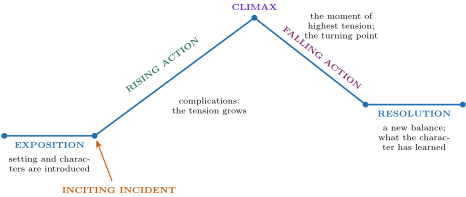
- The plot is the chain of events, linked by cause and effect: exposition, inciting incident, rising action, climax, falling action and resolution.
- The theme is the central idea about life that the story explores. A theme is not a single word (childhood is only a subject): it is a statement that the whole story supports (the places of childhood shape the way we love the world).
- Direct characterization: the narrator tells us what a character is like (Tom was a proud boy). Indirect characterization: the narrator shows us the character's speech, thoughts, actions, looks and effect on others, and lets us draw the conclusion.
- The narrator is the voice that tells the story — never to be confused with the author. A first-person narrator says I and takes part in the story; a third-person narrator stands outside it. A retrospective narrator is an adult who tells an experience of his or her youth: two points of view then meet in the same I, the child who lived the scene and the adult who understands it.
- An epiphany (a term the Irish writer James Joyce borrowed from religion) is a sudden moment of insight in which a character sees a truth about himself or herself.
1.2 Reading: three childhoods remembered
1.2.1 George Eliot: the river, the mill and the “mother-tongue of our imagination”
Author : George Eliot (1819–1880)
George Eliot is the pen name of Mary Ann Evans, one of the great English novelists of the nineteenth century. She grew up in the countryside of Warwickshire, and The Mill on the Floss (1860), the story of Maggie Tulliver and her brother Tom, draws on her own childhood. Her narrators do not only tell: they stop to reflect on what the story means.
Maggie, about nine years old, adores her older brother Tom, who has just come home from school. After a quarrel and a reconciliation, the two children go fishing at the Round Pool.
It was one of their happy mornings. They trotted along and sat down together, with no thought that life would ever change much for them; they would only get bigger and not go to school, and it would always be like the holidays; they would always live together and be fond of each other. And the mill with its booming; the great chestnut-tree under which they played at houses; their own little river, the Ripple, where the banks seemed like home, and Tom was always seeing the water-rats, while Maggie gathered the purple plumy tops of the reeds, which she forgot and dropped afterward; above all, the great Floss, along which they wandered with a sense of travel, to see the rushing spring-tide, the awful Eagre, come up like a hungry monster, or to see the Great Ash which had once wailed and groaned like a man, these things would always be just the same to them. Tom thought people were at a disadvantage who lived on any other spot of the globe; and Maggie, when she read about Christiana passing “the river over which there is no bridge,” always saw the Floss between the green pastures by the Great Ash.
Life did change for Tom and Maggie; and yet they were not wrong in believing that the thoughts and loves of these first years would always make part of their lives. We could never have loved the earth so well if we had had no childhood in it,—if it were not the earth where the same flowers come up again every spring that we used to gather with our tiny fingers as we sat lisping to ourselves on the grass; the same hips and haws on the autumn's hedgerows; the same redbreasts that we used to call “God's birds,” because they did no harm to the precious crops. What novelty is worth that sweet monotony where everything is known, and loved because it is known?
Exercises of the chapter
- The words of memory and the elements of a narrative solved
- Theme, characters and setting: George Eliot, The Mill on the Floss solved
- Skimming, scanning and close reading: Mark Twain, Life on the Mississippi solved
- Listening: main idea and supporting ideas solved
- Telling a story aloud: tone, intonation and body language solved
- From pre-writing to a revised paragraph solved