Love and Time: The Language of Poetry
Course · English for Humanities (Grade 11, Lebanon), chapter 2 · Lebanon, Grade 11 · the beginning of the chapter, the rest on Adloun
Lovers have always had one enemy that no courage can defeat: time. Beauty fades, the day ends, the beloved may leave or die — and so, for four hundred years, poets writing in English have answered time with words. Some say hurry: “Gather ye rosebuds while ye may”. Some say love more, because it will end. Some ask to be remembered, and one, more generous, asks to be forgotten. In this unit you will read a sonnet by William Shakespeare, a song by Robert Herrick, a seduction by Andrew Marvell and a farewell by Christina Rossetti. To read them well you need the tools of the trade: figurative language and the literary terms of poetry. You will also learn to follow the key terms and transitions of a talk, to comment on the way a person speaks, to choose your own words for a given reader, and to ask of any speaker: what does he want, and what does he take for granted?
Curriculum: LB-1H
Learning outcomes
- Reading: identify figurative language and explain the literary terms needed to analyze a poem (speaker, stanza, meter, rhyme scheme, sonnet, turn, tone).
- Listening: identify the key terms and the transitional words, phrases and sentences that organize a talk.
- Speaking: comment on the language used by a speaker — choice of words, intonation, accent — and read a poem aloud.
- Writing: choose grammatical constructions and diction appropriate for the audience, the purpose and the topic; write a paragraph of literary analysis.
- Thinking: figure out the motives and assumptions of a speaker.
2.1 Key terms: figurative language and the terms of poetry
2.1.1 Words for love and for passing time
| Love | Time that passes | Answers to time |
|---|---|---|
| the beloved, a suitor, courtship, to woo, to court, devotion, tenderness, passion, constancy, faithfulness; coy (pretending to be shy or unwilling). | fleeting, brief, transient; youth, prime, bloom; to fade, to wither, to decay; old age, mortality, the grave; mourning, grief. | to seize the day, to make the most of; to remember, to commemorate, to outlast; remembrance, oblivion, legacy, immortality through verse. |
Two Latin phrases name two attitudes that you will meet again and again. Carpe diem (“seize the day”, from the Roman poet Horace) is the invitation to enjoy the present because the future is uncertain. Memento mori (“remember that you must die”) is the reminder of death that makes every hour precious.
2.1.2 Figurative language
Literal language means exactly what it says. Figurative language says one thing in terms of another in order to make us see or feel more. Each device is called a figure of speech.
- A simile compares two different things with like or as: the youthful color “Sits on thy skin like morning dew” (Marvell).
- A metaphor identifies two things without a comparing word: the future is “Deserts of vast eternity” (Marvell). An extended metaphor is developed over several lines.
- Personification gives human actions or feelings to a thing or an idea: “Old Time is still a-flying”, a flower “smiles” (Herrick).
- Hyperbole is deliberate exaggeration: “I love thee to the depth and breadth and height / My soul can reach” (E. B. Browning). Its opposite, understatement, says less than is meant.
- A symbol is a concrete thing that stands for an idea: the rosebud for youth and beauty, the setting sun for the end of life.
- A paradox is a statement that seems to contradict itself and yet holds a truth: a fire “Consum'd with that which it was nourish'd by” (Shakespeare).
- Apostrophe is a direct address to an absent person, a thing or an idea.
Poetry is written for the ear. Alliteration repeats a consonant sound at the beginning of neighboring words (“seals up all in rest”); assonance repeats a vowel sound; anaphora repeats a word or group of words at the beginning of successive lines (“I love thee… / I love thee…”).
2.1.3 The literary terms of poetry
- The speaker is the voice that says I in a poem. As with the narrator of a story, do not confuse the speaker with the poet. The person spoken to is the addressee.
- A line is the unit of verse; a stanza is a group of lines set apart by a space. A couplet has two lines, a quatrain four, a sestet six, an octave eight.
- Rhyme is the repetition of the final sounds of lines (may / day). The rhyme scheme is the pattern of rhymes, written with letters: ABAB, ABBA, AABB.
- An end-stopped line ends with a pause marked by punctuation; in enjambment (a run-on line) the sentence runs over into the next line without a pause.
Meter is the regular pattern of stressed and unstressed syllables in a line. Its unit is the foot. The most common foot in English is the iamb: one unstressed syllable followed by one stressed syllable (da-DUM). A line of five iambs is an iambic pentameter:
That time of year thou mayst in me behold
A line of four iambs is an iambic tetrameter (“But at my back I always hear”, Marvell); a line of three is a trimeter.
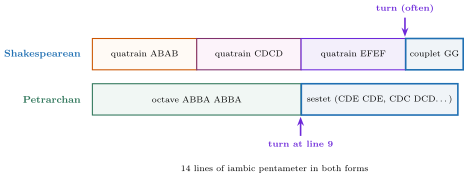
- A sonnet is a poem of fourteen lines, usually in iambic pentameter. The Shakespearean (English) sonnet has three quatrains and a final couplet (ABAB CDCD EFEF GG). The Petrarchan (Italian) sonnet has an octave (ABBA ABBA) and a sestet (for example CDE CDE or CDD ECE).
- The turn (or volta) is the point where the thought of the poem changes direction, often marked by But, Yet or Then: at line 9 in a Petrarchan sonnet, often at the couplet in a Shakespearean one.
- The tone is the speaker's attitude toward the subject or the addressee (tender, playful, urgent, resigned, ironic). The mood is the feeling created in the reader. Imagery is the language that appeals to the senses.
2.2 Reading: three poems against time
2.2.1 Shakespeare, Sonnet 73: three images of an ending
Author : William Shakespeare (1564–1616)
The greatest dramatist of the English language was also a poet. His 154 Sonnets, published in 1609, explore love, beauty, time and death. Many of them are addressed to a young man whom the speaker loves and admires.
That time of year thou mayst in me behold
When yellow leaves, or none, or few, do hang
Upon those boughs which shake against the cold,
Bare ruin'd choirs, where late the sweet birds sang.In me thou see'st the twilight of such day
As after sunset fadeth in the west;
Which by and by black night doth take away,
Death's second self, that seals up all in rest.In me thou see'st the glowing of such fire,
That on the ashes of his youth doth lie,
As the death-bed, whereon it must expire,
Consum'd with that which it was nourish'd by.This thou perceiv'st, which makes thy love more strong,
To love that well, which thou must leave ere long.
Exercises of the chapter
- Figures of speech, meter and rhyme solved
- Close reading of a sonnet: Shakespeare, Sonnet 73 solved
- Images that argue: Andrew Marvell, “To His Coy Mistress” solved
- Listening: key terms and transitions solved
- Commenting on the language of two speakers solved
- Choosing the right words: from a note to a literary paragraph solved