Escape and Happiness: Description, Cohesion and the Writer's Attitude
Course · English for Humanities (Grade 11, Lebanon), chapter 3 · Lebanon, Grade 11 · the beginning of the chapter, the rest on Adloun
Who has never dreamed, on a gray Monday, of being somewhere else — on a ship, on a mountain road, on a raft drifting down a river? The wish to escape is as old as the wish to be happy, and literature has always asked whether the two are the same. Herman Melville's Ishmael goes to sea whenever the land weighs on him; Samuel Johnson's prince owns a whole valley of pleasures and is miserable in it; Robert Louis Stevenson walks across cold hills with a donkey and declares himself content. Reading them, you will learn to see how a text holds together (its cohesion and coherence) and what the writer feels and wants behind the words (attitude, bias, intention). You will also learn to recognize how a speaker develops an idea, to defend an opinion of your own, to write a description that does not fall apart, and to separate facts from opinions.
Curriculum: LB-1H
Learning outcomes
- Reading: identify the elements of cohesion and coherence of a text (cohesive devices, transitional links); identify the author's attitude, bias and intention.
- Listening: specify the method of development of a talk (cause and effect, comparison and contrast, definition).
- Speaking: defend an opinion cogently and effectively.
- Writing: write a descriptive essay; maintain coherence and cohesion in an extended piece of writing.
- Thinking: discriminate between facts, opinions and bias.
3.1 Key terms: the words of escape and the fabric of a text
3.1.1 Words for restlessness, escape and happiness
| The wish to leave | The ways of escape | The shades of happiness |
|---|---|---|
| restless, weary, bored; boredom, tedium, monotony, routine, discontent, melancholy; to long for, to yearn for, to crave; wanderlust (a strong desire to travel). | to flee, to set out, to roam, to wander, to drift; a voyage, a journey, a refuge, a haven, a retreat; solitude, leisure, idleness, daydream, reverie. | contentment (quiet satisfaction), cheerfulness, delight, joy (strong and brief), bliss (perfect happiness), fulfillment (a life that has reached its aims), peace of mind. |
Do not confuse solitude, which is chosen and can be happy, with loneliness, which is suffered; nor leisure, free time well used, with idleness, doing nothing. Escapism is the habit of avoiding reality through dreams or entertainment: the word carries a reproach that escape does not.
3.1.2 Cohesion and coherence
The word text comes from the Latin textus, “woven”. A text is not a pile of sentences: its sentences are tied to one another like threads in a cloth.
- Cohesion is the set of visible links that tie the sentences of a text together: pronouns, repeated words, connectives. These links are called cohesive devices.
- Coherence is the logical unity of the text: all its ideas concern the same subject, follow a clear order and do not contradict one another.
A text can be cohesive without being coherent (I like tea. Tea grows in China. China is large. Large dogs frighten me: every sentence is tied to the one before, and the whole goes nowhere). A good text is both.
- Reference: a pronoun or a demonstrative points back to something already named (The prince… he… his; this complaint). The word pointed to is the antecedent.
- Substitution and ellipsis: a short word replaces a longer expression (I wanted a horse; he gave me one; they are happy, and so am I), or the expression is simply left out because it is understood (Some leaned on the rail; some [men] sat on the pier).
- Conjunction (transitional links): connectives state the logical relation between two sentences: addition (and, moreover), contrast (but, yet, however), cause and result (for, because, so, therefore), time (then, at length, meanwhile).
- Lexical cohesion: the same word is repeated, or replaced by a synonym, an opposite or a word of the same family (sea… ocean… ship… water).
- Parallelism: the same grammatical pattern is repeated (tied to counters, nailed to benches, clinched to desks).
3.1.3 Attitude, bias and intention
- The author's attitude is the way he or she feels about the subject: admiring, amused, critical, compassionate, ironic. It is heard in the tone.
- A bias is a leaning toward one side that prevents a writer from treating a question fairly. A biased text shows only what favors its side and uses loaded words, chosen for their emotional charge.
- The author's intention (or purpose) is what he or she wants to achieve: to inform, to persuade, to entertain, to express a feeling, to make us think. A text may have several intentions at once.
3.2 Reading: three ways out
3.2.1 Herman Melville: “I go as a simple sailor”
Author : Herman Melville (1819–1891)
Born in New York, Melville went to sea as a young man and served on a whaling ship in the Pacific. Moby-Dick; or, The Whale (1851) is told by a sailor, Ishmael, who explains on the first page that he goes to sea whenever life on land weighs on him. He now says how he travels. A salt is an experienced sailor; a Commodore commands several ships; to sail before the mast is to serve as a common sailor, lodged in the forecastle, at the front of the ship; a spar is a pole that carries a sail; barques, brigs and schooners are kinds of sailing ships.
Now, when I say that I am in the habit of going to sea whenever I begin to grow hazy about the eyes, and begin to be over conscious of my lungs, I do not mean to have it inferred that I ever go to sea as a passenger. For to go as a passenger you must needs have a purse, and a purse is but a rag unless you have something in it. Besides, passengers get sea-sick—grow quarrelsome—don't sleep of nights—do not enjoy themselves much, as a general thing;—no, I never go as a passenger; nor, though I am something of a salt, do I ever go to sea as a Commodore, or a Captain, or a Cook. I abandon the glory and distinction of such offices to those who like them. For my part, I abominate all honorable respectable toils, trials, and tribulations of every kind whatsoever. It is quite as much as I can do to take care of myself, without taking care of ships, barques, brigs, schooners, and what not. […]
No, when I go to sea, I go as a simple sailor, right before the mast, plumb down into the forecastle, aloft there to the royal mast-head. True, they rather order me about some, and make me jump from spar to spar, like a grasshopper in a May meadow. And at first, this sort of thing is unpleasant enough. […]
Again, I always go to sea as a sailor, because they make a point of paying me for my trouble, whereas they never pay passengers a single penny that I ever heard of. On the contrary, passengers themselves must pay. And there is all the difference in the world between paying and being paid. […]
Finally, I always go to sea as a sailor, because of the wholesome exercise and pure air of the fore-castle deck.
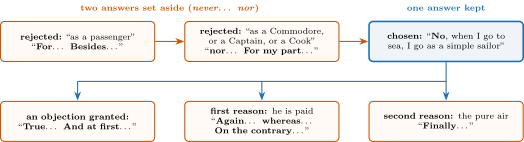
How the passage holds together. Ishmael answers one question — how does he go to sea? — and he answers it in order: two answers are rejected, a third is chosen, an objection is granted, and two reasons are added. Each step is announced by a transitional word placed at the head of a sentence.
Exercises of the chapter
- Naming the cohesive devices solved
- How a description holds together: Stevenson's “leaden business” solved
- Attitude and intention: the first and last words of Johnson's prince solved
- Listening: which method of development? solved
- Speaking: from a weak opinion to a cogent one solved
- Building a coherent descriptive paragraph solved