The Fantastic and the Gothic: Reading Between the Lines
Course · English for Humanities (Grade 11, Lebanon), chapter 4 · Lebanon, Grade 11 · the beginning of the chapter, the rest on Adloun
A dried monkey's paw that grants three wishes; a nobleman who casts no reflection in a mirror; a knock at the door in the middle of the night. Stories of fear have a special way of working: they never tell everything. The writer leaves clues, and the reader must put them together — must infer what is not said. This is why such stories are the best school of careful reading. With W. W. Jacobs, Bram Stoker and Edgar Allan Poe, you will learn to use the context to explain a word, to read between the lines, to notice what does not fit, and to judge the conclusions that characters — and readers — draw too quickly. You will also learn to predict the end of a talk or a tale, to follow the flow of an argument, and to organize a piece of writing so that it holds its reader.
Curriculum: LB-1H
Learning outcomes
- Reading: infer hidden messages; identify the contextual clues that explain meaning; discuss plot, characters and setting in a tale of suspense.
- Listening: predict plausible conclusions.
- Speaking: identify the elements that contribute to the flow of an argument.
- Writing: adopt proper organizational strategies.
- Thinking: show awareness of discrepancies, inconsistencies and gaps; assess conclusions and suggest alternative ones.
4.1 Key terms: the words of fear and the clues of meaning
4.1.1 Words for the strange and the frightening
| What is strange | What is felt | What appears |
|---|---|---|
| eerie (strange and frightening), uncanny (strange in a way that cannot be explained), weird, sinister, ominous (announcing something bad), supernatural, gloomy, dismal. | unease, dread (fear of what is coming), terror (fear before the danger), horror (fear mixed with disgust); to shudder, to shiver, to start, to shriek, to be appalled. | a ghost, a specter, an apparition, a phantom, a goblin; an omen (a sign of the future), a curse, a spell, a charm, a talisman; to haunt, to vanish. |
4.1.2 The literary terms of the tale of fear
- Gothic fiction, born in England in the eighteenth century, tells stories of terror and mystery in dark, isolated settings: castles, ruins, old houses, stormy nights. Its heroes are threatened by secrets, by crimes of the past or by supernatural beings.
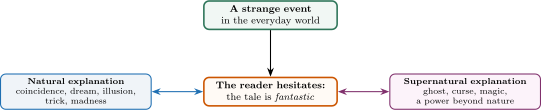
- A tale is called fantastic when a strange event breaks into the everyday world and the reader hesitates between two explanations: a natural one (a coincidence, a dream, a trick, madness) and a supernatural one. As long as the doubt lasts, the tale remains fantastic.
- Suspense is the anxious waiting of a reader who wants to know what will happen. The writer creates it by delaying the answer.
- Foreshadowing is a hint, given early in a story, of what will happen later.
- The atmosphere (or mood) is the feeling that the setting and the style create around the events.
- An unreliable narrator is a narrator whose account the reader cannot fully trust, because he is mad, naive, partial or dishonest.
- Dramatic irony arises when the reader understands more than a character does.
- An open ending leaves the main question unanswered; a twist is a sudden, unexpected turn of the plot.
4.1.3 Contextual clues
You do not need a dictionary for every unknown word. Very often, the sentences around the word — its context — explain it.
- Definition or restatement: the text explains the word, often between commas or dashes, or after that is, or, in other words. He kept a talisman, an object believed to bring luck.
- Synonym: a word of similar meaning stands nearby. The house was dismal; nobody could live long in so gloomy a place.
- Contrast (antonym): the word is opposed to a known one, after but, unlike, whereas, instead of. Unlike his credulous brother, he believed nothing without proof.
- Example: examples illustrate the word, after such as, like, for instance. She feared every omen, such as a black cat or a broken mirror.
- General sense (inference): no single word helps, but the whole situation does. He shuddered as the cold hand touched his neck.
Method : Explaining an unknown word from its context
- Do not stop reading. Finish the sentence, and the next one: the clue often comes after the word.
- Find the part of speech: is the word a noun, a verb, an adjective? What does it describe?
- Look for a clue of one of the five kinds: punctuation (commas, dashes), signal words (or, but, such as), nearby synonyms or opposites.
- Look inside the word: a prefix (un-, fore-, super-), a root you know (credulity, like incredible and credit, has to do with believing), a suffix.
- Try your guess in the sentence. If the sentence still makes sense, go on; check in a dictionary later.
4.2 Reading: what the text does not say
4.2.1 W. W. Jacobs: the first wish
Author : W. W. Jacobs (1863–1943)
The English writer William Wymark Jacobs was known in his time for humorous stories about sailors. He is remembered today for one tale of fear, “The Monkey's Paw” (1902). It opens in the home of an elderly couple, Mr. and Mrs. White, and their grown-up son Herbert:
Without, the night was cold and wet, but in the small parlour of Laburnam Villa the blinds were drawn and the fire burned brightly. Father and son were at chess, the former, who possessed ideas about the game involving radical changes, putting his king into such sharp and unnecessary perils that it even provoked comment from the white-haired old lady knitting placidly by the fire.
The setting is built on a contrast, announced by the first word: Without (outside), the night is “cold and wet”; within, “the fire burned brightly”. The home is a shelter. But a clue is already placed: the father plays chess by “putting his king into such sharp and unnecessary perils” that even his wife notices. A man who takes needless risks at a game may take them elsewhere: this is foreshadowing.
That evening a friend, Sergeant-Major Morris, back from twenty-one years in India, shows the family a dried monkey's paw.
“It had a spell put on it by an old fakir,” said the sergeant-major, “a very holy man. He wanted to show that fate ruled people's lives, and that those who interfered with it did so to their sorrow. He put a spell on it so that three separate men could each have three wishes from it.”
His manner was so impressive that his hearers were conscious that their light laughter jarred somewhat.
“Well, why don't you have three, sir?” said Herbert White, cleverly.
The soldier regarded him in the way that middle age is wont to regard presumptuous youth. “I have,” he said, quietly, and his blotchy face whitened.
Contextual clues. The word fakir is explained at once by a restatement between commas: “a very holy man”. The word presumptuous is explained by the general sense: Herbert has just asked a clever, slightly bold question, and “middle age” looks at “youth” with disapproval; presumptuous means “too confident, lacking respect”.
Reading between the lines. The soldier says only two words about his own wishes: “I have”. But the narrator adds two details: he speaks “quietly”, and “his blotchy face whitened”. The text does not say what happened to him. We infer that his wishes were granted and that the result was terrible — so terrible that the memory alone turns him pale. We infer, too, the hidden message of the fakir's spell, which the soldier himself states: “fate ruled people's lives, and … those who interfered with it did so to their sorrow”. The whole tale is announced in that sentence.
Exercises of the chapter
- Contextual clues and the terms of the tale of fear solved
- Inferring what is not shown: the end of “The Monkey's Paw” solved
- Gaps, clues and rival conclusions: Washington Irving, “The Legend of Sleepy Hollow” solved
- Listening: predicting plausible conclusions solved
- Speaking: what makes an argument flow solved
- Choosing and using an organizational strategy solved