Voices of Freedom: The Art of the Speech
Course · English for Humanities (Grade 11, Lebanon), chapter 6 · Lebanon, Grade 11 · the beginning of the chapter, the rest on Adloun
Some sentences have changed history because they were spoken. In a church in Virginia, in a hall in Rochester, in a theater in Hartford, a man or a woman stood up before a crowd and, with nothing but a voice, turned listeners into a people ready to act. Patrick Henry calls a hesitating assembly to arms; Frederick Douglass, once a slave, asks a free audience what their feast of liberty can mean to him; Emmeline Pankhurst, a “convict” in the eyes of the law, explains why women break windows. Studying them, you will learn how a speech persuades — by the character of the speaker, by the feelings of the audience, by reasoning — and how to resist a speech that persuades badly. You will learn to separate fact from opinion while you listen, to weigh the strengths and weaknesses of an argument, to recognize inductive and deductive reasoning, to choose relevant evidence, and to write and deliver a persuasive text of your own.
Curriculum: LB-1H
Learning outcomes
- Reading: identify the rhetorical devices of a speech and the speaker's attitude and intention.
- Listening: recognize a persuasive talk; distinguish between facts and opinion.
- Speaking: point out the strengths and weaknesses of arguments; defend an opinion with the right tone and delivery.
- Writing: develop a persuasive essay (appeals, evidence, call to action).
- Thinking: recognize inductive and deductive reasoning and the link between evidence and claim; present relevant evidence.
6.1 Key terms: the words of freedom and the tools of persuasion
6.1.1 Words for rights, oppression and struggle
| Rights and freedom | Oppression | Struggle |
|---|---|---|
| liberty, freedom, independence; a right, a citizen, citizenship; equality, justice; the vote, the ballot, suffrage (the right to vote), a voter; consent, to represent, representation; to emancipate, emancipation. | tyranny, a tyrant; slavery, a slave, a slaveholder, chains, bondage; oppression, to oppress; injustice, a grievance (a wrong one complains of); to submit, submission; to deny a right, to disfranchise (to take the vote away). | to resist, resistance; to protest, to petition (to ask the authorities in writing), to demand; a reform, a reformer; an abolitionist (who wants to abolish slavery), a suffragette; a cause, a movement; to struggle, to rebel, to overcome. |
Liberty and freedom mean nearly the same thing; liberty, of Latin origin, belongs rather to the language of law and politics (civil liberties), freedom, of Old English origin, to everyday speech (freedom of movement). Suffrage is not suffering: it is the right to vote. A grievance is a wrong for which one asks redress.
6.1.2 The three appeals
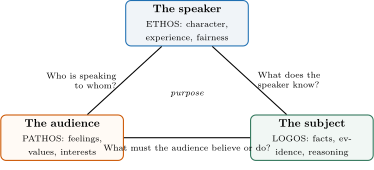
A speech is an act of persuasion: the speaker wants the audience to believe something or to do something. Since Aristotle, three means of persuasion have been distinguished; they keep their Greek names.
- Ethos is the appeal to the character of the speaker. We believe people who seem honest, competent and well disposed toward us. A speaker builds ethos by showing experience, fairness and courage: I have lived what I am telling you.
- Pathos is the appeal to the feelings of the audience: pity, fear, anger, pride, hope. It works through images, examples and strong words: The little children are freezing to death.
- Logos is the appeal to reason: facts, figures, examples and arguments linked by logic. Three millions of people, armed in the holy cause of liberty, are invincible.
A good speech uses the three together. A speech that has only pathos is a manipulation; a speech that has only logos is a lecture.
6.1.3 The devices of eloquence
The rhetorical devices studied in Unit 5 are the daily tools of the orator, because a listener, unlike a reader, cannot go back: what is repeated and balanced is remembered.
| Device | What it is | Example |
|---|---|---|
| Anaphora | the same words at the beginning of successive clauses | We have petitioned --- we have remonstrated --- we have supplicated |
| Parallelism | the same grammatical pattern repeated | to the vigilant, the active, the brave |
| Tricolon | a series of three parallel terms | the storm, the whirlwind, and the earthquake |
| Climax | terms arranged in rising force | petitioned… remonstrated… supplicated… prostrated ourselves |
| Antithesis | two opposite ideas in a balanced form | give me liberty, or give me death |
| Rhetorical question | a question whose answer is obvious | But when shall we be stronger? |
| Direct address | the speaker names the audience | Sir…; Fellow-citizens…; I ask American men… |
| Irony | saying the opposite of what one means, to mock or blame | a work of love and reconciliation (said of fleets and armies) |
A classical speech has four moments:
- the opening wins attention and good will: the speaker says who he or she is and why the subject matters now;
- the argument states the position (the claim) and proves it by reasons and evidence;
- the refutation answers the objections of the other side;
- the peroration is the conclusion: it gathers the argument into a few strong sentences and calls the audience to act.
6.2 Reading: three speakers and their audiences
6.2.1 Patrick Henry: “give me liberty, or give me death”
Author : Patrick Henry (1736–1799)
A lawyer of Virginia, Patrick Henry was the most famous orator of the American Revolution. On March 23, 1775, in St. John's Church in Richmond, the Second Virginia Convention was debating whether the colony should raise troops against the British government. Many delegates still hoped for peace. Henry rose to answer them. No one wrote the speech down: the text we read was reconstructed more than forty years later by his biographer William Wirt, from the memories of people who had heard it, and published in 1817. This is why the narrator's voice is sometimes heard inside it (continued Mr. Henry; cried he).
“They tell us, sir,” continued Mr. Henry, “that we are weak—unable to cope with so formidable an adversary. But when shall we be stronger? Will it be the next week, or the next year? Will it be when we are totally disarmed; and when a British guard shall be stationed in every house? Shall we gather strength by irresolution and inaction? Shall we acquire the means of effectual resistance, by lying supinely on our backs, and hugging the delusive phantom of hope, until our enemies shall have bound us, hand and foot? Sir, we are not weak, if we make a proper use of those means which the God of nature hath placed in our power. Three millions of people, armed in the holy cause of liberty, and in such a country as that which we possess, are invincible by any force which our enemy can send against us. Besides, sir, we shall not fight our battles alone. There is a just God who presides over the destinies of nations; and who will raise up friends to fight our battles for us. The battle, sir, is not to the strong alone; it is to the vigilant, the active, the brave. Besides, sir, we have no election. If we were base enough to desire it, it is now too late to retire from the contest. There is no retreat, but in submission and slavery! Our chains are forged. Their clanking may be heard on the plains of Boston! The war is inevitable—and let it come!! I repeat it, sir, let it come!!!
“It is in vain, sir, to extenuate the matter. Gentlemen may cry, peace, peace—but there is no peace. The war is actually begun! The next gale that sweeps from the north, will bring to our ears the clash of resounding arms! Our brethren are already in the field! Why stand we here idle? What is it that gentlemen wish? What would they have? Is life so dear, or peace so sweet, as to be purchased at the price of chains, and slavery? Forbid it, Almighty God!—I know not what course others may take; but as for me,” cried he, with both his arms extended aloft, his brows knit, every feature marked with the resolute purpose of his soul, and his voice swelled to its boldest note of exclamation—“give me liberty, or give me death!”
Sketches of the Life and Character of Patrick Henry* (1817)
Exercises of the chapter
- The appeals, the devices and the words of freedom solved
- Evidence and irony: Frederick Douglass, “we are called upon to prove that we are men!” solved
- Reasoning by comparison: Abraham Lincoln to the South (1861) solved
- Listening: facts and opinions in two speeches solved
- Speaking: pointing out the strengths and weaknesses of arguments solved
- From the syllogism to the peroration solved