Education and the Free Mind: Argument and Debate
Course · English for Humanities (Grade 11, Lebanon), chapter 7 · Lebanon, Grade 11 · the beginning of the chapter, the rest on Adloun
What is school for? To prepare us for a profession, or to form the mind? To fill the memory with facts, or to teach us to judge? The question is as old as schools, and every generation argues it again — you have probably argued it yourself, on a Monday morning. In the 19th century, when Britain and America were opening schools and universities to new classes of people, it was debated by some of the best minds of the age. Cardinal Newman defends an education that trains “good members of society”; the scientist T. H. Huxley compares life to a game of chess whose rules we must learn; the novelist Dickens mocks a schoolroom where nothing is wanted but Facts. Reading them, you will learn how a text of ideas holds together, how an author's attitude shows through, and how to answer a point of view. Then you will pass from the page to the floor: you will learn to take part in a debate and to chair one, to meet an objection with a counterargument, and to write an argumentative essay that weighs both sides before it concludes.
Curriculum: LB-1H
Learning outcomes
- Reading: identify the elements of cohesion and coherence of a text of ideas; identify the author's attitude, bias and intention.
- Listening: follow a discussion and distinguish the positions of the speakers.
- Speaking: participate in and lead a debate; identify what makes an argument flow; point out strengths and weaknesses.
- Writing: develop an argumentative essay; maintain coherence and cohesion.
- Thinking: present counterarguments; respond to a point of view; discriminate between facts, opinions and bias.
7.1 Key terms: the words of education, argument and debate
7.1.1 Words for learning and the mind
| Schooling | The mind | Aims of education |
|---|---|---|
| education, schooling, instruction, training; a curriculum (the subjects taught), a syllabus; a pupil, a scholar, a graduate; tuition (teaching, or its price); literate, illiterate; to enroll, to attend, to graduate. | intellect, reason, judgment, understanding, memory, imagination; knowledge, ignorance, wisdom; to reason, to grasp, to weigh, to question; curious, open-minded, narrow-minded; critical thinking. | a liberal education (general, forming the whole mind), a vocational education (preparing for a trade), a profession, a skill; to cultivate, to train, to fit for; useful, practical; self-reliance, citizenship, character. |
Beware of two false friends. A liberal education has nothing to do with politics: the adjective comes from the Latin liber, “free”, and names the education that befits a free person — broad, general, not tied to one trade. To train is to form by practice; a training may be of the body, of a skill, or, as in Newman, “of the intellect”.
7.1.2 The vocabulary of argument
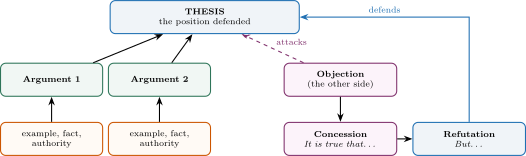
- The thesis (or claim) is the position that the writer defends: School should form the mind before it prepares for a job.
- An argument (or reason) is a statement given in support of the thesis: because jobs change, while a trained mind can learn any of them.
- An example is a particular case that illustrates or supports an argument.
- An objection is an argument against the thesis, raised by an opponent or foreseen by the writer.
- A concession admits that the objection is partly right: It is true that a diploma must lead to work.
- A refutation shows that the objection is false, or that it does not destroy the thesis: But the best preparation for work is the habit of thinking.
- A counterargument is any argument that answers another argument. Concession followed by refutation is its most persuasive form.
7.1.3 The vocabulary of debate
A debate is a formal discussion in which two sides argue for and against a statement before an audience, according to rules.
- The motion is the statement to be debated. It is affirmative and precise: This house believes that homework should be abolished.
- The proposition is the team that supports the motion; the opposition is the team that argues against it.
- The chair (or chairperson) leads the debate: introduces the motion, gives the floor, keeps time and order.
- To have the floor is to have the right to speak. The floor is also the audience, when it is invited to speak.
- A rebuttal is the part of a speech that answers the arguments of the other side.
- A point of information is a short question or remark offered to the speaker by an opponent, which the speaker may accept or decline.
- The summary speech closes a team's case: it adds no new argument but shows why the team has won the main points.
- The vote (or the decision of the judges) settles which side argued better — not which opinion is true.
7.2 Reading: three views of the schoolroom
7.2.1 John Henry Newman: “training good members of society”
Author : John Henry Newman (1801–1890)
A scholar of Oxford who became a Catholic in 1845, then a priest and later a cardinal, Newman was asked to found a Catholic university in Dublin. The lectures in which he explained his project became The Idea of a University. In the seventh, “Knowledge Viewed in Relation to Professional Skill”, he answers those who think that a university should above all prepare students for professions. He has quoted his opponents at length; he now concludes.
If then a practical end must be assigned to a University course, I say it is that of training good members of society. Its art is the art of social life, and its end is fitness for the world. It neither confines its views to particular professions on the one hand, nor creates heroes or inspires genius on the other. Works indeed of genius fall under no art; heroic minds come under no rule; a University is not a birthplace of poets or of immortal authors, of founders of schools, leaders of colonies, or conquerors of nations. It does not promise a generation of Aristotles or Newtons, of Napoleons or Washingtons, of Raphaels or Shakespeares, though such miracles of nature it has before now contained within its precincts. Nor is it content on the other hand with forming the critic or the experimentalist, the economist or the engineer, though such too it includes within its scope. But a University training is the great ordinary means to a great but ordinary end; it aims at raising the intellectual tone of society, at cultivating the public mind, at purifying the national taste, at supplying true principles to popular enthusiasm and fixed aims to popular aspiration, at giving enlargement and sobriety to the ideas of the age, at facilitating the exercise of political power, and refining the intercourse of private life.
The thesis is stated at once, and as a concession to the adversary: “If then a practical end must be assigned to a University course, I say it is that of training good members of society.” Newman accepts the opponent's demand — education must be useful — and changes the meaning of the word: the use of a university is not a trade but “fitness for the world”.
How the paragraph holds together. A text is coherent when its ideas follow a clear plan; it is cohesive when its sentences are tied to one another by visible links. Here the plan has three steps, and each is marked.
- What a university is not (too high): “It neither confines its views to particular professions on the one hand, nor creates heroes or inspires genius on the other.” The pair on the one hand… on the other announces two refusals. The second is developed first, by a series of negatives: “no art… no rule… not a birthplace… It does not promise”, and by three pairs of famous names (Aristotles or Newtons, Napoleons or Washingtons, Raphaels or Shakespeares).
- What it is not (too narrow): “Nor is it content on the other hand with forming the critic or the experimentalist, the economist or the engineer”. Each refusal ends with a concession introduced by though: such people a university may contain; they are not its aim.
- What it is: “But a University training is the great ordinary means to a great but ordinary end”. The connective But turns the paragraph from negation to affirmation; the long sentence that follows unfolds the “end” in seven parallel phrases built on at + a verb in -ing: “at raising…, at cultivating…, at purifying…, at supplying…, at giving…, at facilitating…, and refining…”.
Exercises of the chapter
- The words of argument and of debate solved
- A lesson told as a story: Booker T. Washington's “college examination” solved
- Why we must know the other side: John Stuart Mill solved
- Listening: who thinks what? Following a discussion solved
- Speaking: taking part in a debate and chairing it solved
- Counterarguments and the dialectical plan solved