Masks and Voices: Reading and Performing Drama
Course · English for Humanities (Grade 11, Lebanon), chapter 8 · Lebanon, Grade 11 · the beginning of the chapter, the rest on Adloun
A play is not a story that someone tells us: it is a story that happens in front of us, through voices. No narrator explains what the characters think; we have only what they say, how they say it, and what they do. That is why the theater is the best school of listening — and of suspicion. In Shakespeare's Julius Caesar, two men speak over the same dead body, and a crowd changes its mind twice in ten minutes. In Oscar Wilde's comedy, a great lady interviews a young man as if she were buying a horse. In Bernard Shaw's Pygmalion, a professor can tell where anyone was born from a single vowel. Reading them, you will learn the special terms of drama, how to read what a character does not say, how to comment on a speaker's accent and choice of words, how to give a text your own voice, and how to organize a literary essay on a scene.
Curriculum: LB-1H
Learning outcomes
- Reading: identify and explain the literary terms of drama; discuss plot, characters and conflict in a scene; infer what lies beneath the words.
- Listening: predict what will follow; identify key terms and transitional words.
- Speaking: comment on the language used by a speaker (accent, choice of words, intonation); adopt appropriate tone, intonation and body language.
- Writing: adopt proper organizational strategies in a literary essay on a scene.
- Thinking: figure out the motives and assumptions of a speaker; show awareness of discrepancies between words and acts.
8.1 Key terms: the language of the stage
8.1.1 Words for the theater
| People | The play | The performance |
|---|---|---|
| a playwright (or dramatist: the author of plays), an actor, an actress, the cast (all the actors), a director, the audience; a character, the hero or heroine, the protagonist (main character), a part or role. | a play, an act, a scene; the plot, the exposition, the conflict, the climax, the dénouement (or resolution); a line, a speech, a cue (the words after which an actor must speak or enter). | the stage, the set, the wings (the sides, out of sight), the curtain, a prop (an object used on stage), a costume; to stage a play, to rehearse, to perform; an entrance, an exit. |
A playwright is a maker of plays, as a shipwright is a maker of ships: the word is not spelled playwrite. Drama is the whole art of the theater; a drama is also a serious play.
8.1.2 The forms of dramatic speech
- Dialogue is the exchange of lines between characters. Repartee is a quick, witty reply.
- A monologue is a long speech by one character to others who listen. A soliloquy is a speech by a character alone on stage, who thinks aloud.
- An aside is a short remark that a character addresses to the audience or to himself, and that the other characters are supposed not to hear.
- Stage directions are the playwright's indications for the performance (movements, tone, set). They are printed in italics or in brackets, and are not spoken: [Shaking her head.]
- Dramatic irony occurs when the audience knows something that a character does not: the words then mean more for us than for the one who speaks or hears them.
- Mistaken identity is a situation in which one person is taken for another; many comedies are built on it.
- The subtext is what a character means or feels beneath what he or she says.
- An epigram is a short, brilliant sentence that expresses an idea in a surprising, often paradoxical way: Ignorance is like a delicate exotic fruit; touch it and the bloom is gone.
- A tragedy shows the fall of a great character and ends in death; a comedy ends happily and makes us laugh at human faults; a comedy of manners laughs at the habits and hypocrisies of a social class.
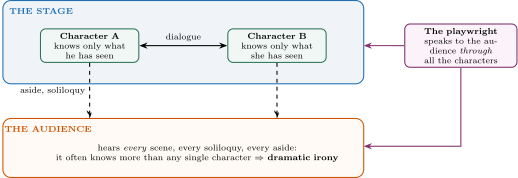
In the theater there are always two conversations at once: the characters speak to one another, and, through them, the playwright speaks to us. To read a scene is to listen to both.
8.2 Reading: two orators and a formidable lady
8.2.1 Shakespeare: Brutus and Antony over Caesar's body
Author : William Shakespeare (1564–1616), Julius Caesar
Shakespeare's tragedy, believed to have been written and first performed in 1599, shows the murder of the Roman general Julius Caesar by a group of senators who fear that he will make himself king. Their leader is Brutus, whom Caesar loved as a friend. In Act III, scene 2, the citizens of Rome, shocked, demand an explanation. Brutus speaks first, in prose. He has allowed Caesar's friend Mark Antony to speak after him, on condition that he will not blame the conspirators.
BRUTUS. Romans, countrymen, and lovers, hear me for my cause; and be silent, that you may hear. Believe me for mine honour, and have respect to mine honour, that you may believe. Censure me in your wisdom, and awake your senses, that you may the better judge. If there be any in this assembly, any dear friend of Caesar's, to him I say that Brutus’ love to Caesar was no less than his. If then that friend demand why Brutus rose against Caesar, this is my answer: Not that I loved Caesar less, but that I loved Rome more. Had you rather Caesar were living, and die all slaves, than that Caesar were dead, to live all free men? As Caesar loved me, I weep for him; as he was fortunate, I rejoice at it; as he was valiant, I honour him; but, as he was ambitious, I slew him. There is tears, for his love; joy for his fortune; honour for his valour; and death, for his ambition. Who is here so base, that would be a bondman? If any, speak; for him have I offended. Who is here so rude, that would not be a Roman? If any, speak; for him have I offended. Who is here so vile, that will not love his country? If any, speak; for him have I offended. I pause for a reply.
The citizens answer: “None, Brutus, none.” They are convinced; one of them even cries that Brutus should be the new Caesar. Then Antony comes forward with the body.
ANTONY.
Friends, Romans, countrymen, lend me your ears;
I come to bury Caesar, not to praise him.
The evil that men do lives after them,
The good is oft interred with their bones;
So let it be with Caesar. The noble Brutus
Hath told you Caesar was ambitious.
If it were so, it was a grievous fault,
And grievously hath Caesar answer'd it.
Here, under leave of Brutus and the rest,
For Brutus is an honourable man,
So are they all, all honourable men,
Come I to speak in Caesar's funeral.
He was my friend, faithful and just to me;
But Brutus says he was ambitious,
And Brutus is an honourable man.
He hath brought many captives home to Rome,
Whose ransoms did the general coffers fill:
Did this in Caesar seem ambitious?
When that the poor have cried, Caesar hath wept;
Ambition should be made of sterner stuff:
Yet Brutus says he was ambitious;
And Brutus is an honourable man.
You all did see that on the Lupercal
I thrice presented him a kingly crown,
Which he did thrice refuse. Was this ambition?
Yet Brutus says he was ambitious;
And sure he is an honourable man.
I speak not to disprove what Brutus spoke,
But here I am to speak what I do know.
You all did love him once, not without cause;
What cause withholds you then to mourn for him?
O judgement, thou art fled to brutish beasts,
And men have lost their reason. Bear with me.
My heart is in the coffin there with Caesar,
And I must pause till it come back to me.
Brutus speaks to reason. His speech is in prose, built like a proof, in balanced antitheses: “Not that I loved Caesar less, but that I loved Rome more”; “As Caesar loved me, I weep for him… but, as he was ambitious, I slew him.” He asks to be believed on his honour (ethos) and offers the crowd a choice between two terms only: “Had you rather Caesar were living, and die all slaves, than that Caesar were dead, to live all free men?” — a false dilemma (Unit 6), for nothing proves that Caesar alive meant slavery. Notice what the speech lacks: not one fact is given to show that Caesar was ambitious. Brutus assumes that his word is enough.