Lives in a Few Pages: Theme and Implied Meaning in the Short Story
Course · English for Literature and Humanities (Grade 12, Lebanon), chapter 1 · Lebanon, Grade 12 · the beginning of the chapter, the rest on Adloun
A short story has no time to explain. In ten pages it must make us know a person, feel a place, and understand something about life that we did not understand before — and the best stories do it without ever stating what they mean. Katherine Mansfield follows a lonely woman through one Sunday afternoon in a public garden, and never uses the word lonely. Charlotte Perkins Gilman lets a young wife describe her kind husband, and we slowly understand what she herself cannot say. In this first unit you will learn to read what a story implies: to collect its clues, to feel its mood, to move from its subject to its theme — and then to tell a story of your own in which every detail serves one idea.
Curriculum: LB-LH
Learning outcomes
- Reading: identify implied meaning in a text; extract themes and concepts; explain the mood of a passage.
- Listening: distinguish between main ideas and supporting details; infer, predict, and draw logical conclusions.
- Speaking: react verbally to oral or written texts; contribute to brainstorming activities.
- Writing: use narration as a rhetorical strategy; sustain thematic unity.
- Thinking: justify an inference by linking each conclusion to the clues that support it.
1.1 Key terms: the language of the short story
1.1.1 Words for stories and storytellers
| The story | The people | The telling |
|---|---|---|
| a short story, a tale, a collection (a book of stories); the plot, the setting (place and time), the conflict, the climax, the ending (closed, open, a twist ending); an episode, a scene. | the author, the narrator (the voice that tells), a character, the protagonist (main character), a minor character; a reader, to identify with a character, to sympathize with. | to narrate, to relate, to depict, to portray; to hint at, to suggest, to reveal, to conceal, to withhold (keep back) information; a flashback, suspense, a detail, a clue. |
The author is the real person who wrote the story; the narrator is the voice that tells it. Katherine Mansfield is not Miss Brill, and Charlotte Perkins Gilman is not the woman who writes in secret in “The Yellow Wallpaper”. Never write the author thinks when you mean the narrator says.
1.1.2 Ten terms for reading between the lines
- The implied meaning of a text is what it means without stating it. The writer implies (suggests); the reader infers (concludes from clues). An inference is a conclusion drawn from evidence.
- A clue is a detail of the text — an object, a gesture, a word that is repeated, a silence — from which the reader can infer something.
- The subject of a story is what it is about, in a word or two: loneliness. Its theme is what it shows about that subject, in a complete sentence: Lonely people build illusions that one careless word can destroy.
- The mood is the atmosphere of a passage: the feeling that it creates in the reader (cheerful, tense, gloomy). The tone is the attitude of the narrator or author toward the subject, heard in the choice of words (tender, ironic, bitter).
- The point of view is the position from which the story is told. A first-person narrator says I and is a character in the story. A third-person limited narrator says he or she but stays inside the mind of one character. An omniscient narrator knows the thoughts of all.
- Free indirect speech gives a character's thoughts in the third person and the past tense, but in the character's own words, without she thought that: Dear little thing! It was nice to feel it again.
- An unreliable narrator is a first-person narrator whose account the reader cannot fully trust, because he or she is too young, too ill, too interested or too mistaken to see the truth.
- A symbol is an object, a place or an action that stands for an idea beyond itself.
- An epiphany is a moment of sudden understanding in which a character sees his or her life as it is.
- A twist ending is an ending that surprises the reader and obliges him to reread the whole story differently. Situational irony is the contrast between what was expected and what happens.
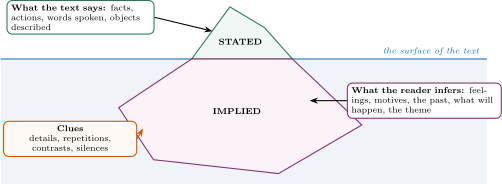
A story is like an iceberg: the part that is stated is small, and it is carried by a much larger part that the reader must infer. An inference is never a free guess. It must be tied to the text by clues, and a good reader can always answer the question What makes you say so?
1.2 Reading: a Sunday in the park, a summer in the country
1.2.1 Katherine Mansfield: “Miss Brill”
Author : Katherine Mansfield (1888–1923)
Born in Wellington, New Zealand, Katherine Mansfield lived in England and on the Continent, wrote almost nothing but short stories, and died of tuberculosis in France at thirty-four. “Miss Brill” was first published in a London review in November 1920 and collected in The Garden Party and Other Stories. Miss Brill, an Englishwoman who gives English lessons in a French seaside town, spends every Sunday afternoon on the same bench of the public gardens (the Jardins Publiques), listening to the band. Here is the beginning of the story.
Although it was so brilliantly fine—the blue sky powdered with gold and great spots of light like white wine splashed over the Jardins Publiques—Miss Brill was glad that she had decided on her fur. The air was motionless, but when you opened your mouth there was just a faint chill, like a chill from a glass of iced water before you sip, and now and again a leaf came drifting—from nowhere, from the sky. Miss Brill put up her hand and touched her fur. Dear little thing! It was nice to feel it again. She had taken it out of its box that afternoon, shaken out the moth-powder, given it a good brush, and rubbed the life back into the dim little eyes. “What has been happening to me?” said the sad little eyes. Oh, how sweet it was to see them snap at her again from the red eiderdown!... But the nose, which was of some black composition, wasn't at all firm. It must have had a knock, somehow. Never mind—a little dab of black sealing-wax when the time came—when it was absolutely necessary.... Little rogue! Yes, she really felt like that about it. Little rogue biting its tail just by her left ear. She could have taken it off and laid it on her lap and stroked it. She felt a tingling in her hands and arms, but that came from walking, she supposed. And when she breathed, something light and sad—no, not sad, exactly—something gentle seemed to move in her bosom.
What is stated. A woman has decided to wear her fur — a necklet made of a whole small animal, with eyes and a nose — because the fine autumn air has “just a faint chill”. She took it out of its box “that afternoon”, cleaned it, and now touches it.
What is implied. Nobody else has appeared, and yet we already know a great deal about her.
- She speaks to an object as to a pet or a child: “Dear little thing!”, “Little rogue!” She imagines that it speaks to her (“What has been happening to me?”) and that its eyes “snap at her”. A person who has someone to talk to does not need to make a fur talk: we infer that she lives alone.
- The fur is old and worn: its eyes are “dim”, its nose “wasn't at all firm”, and it has spent months in “moth-powder”. She will mend it herself with “a little dab of black sealing-wax”: we infer that she is poor, and careful. Later we may feel that the fur resembles its owner.
- She corrects her own feelings: “something light and sad—no, not sad, exactly—something gentle”. The word sad comes first, and is pushed away. The “tingling in her hands and arms” is explained at once — “that came from walking, she supposed”. She is a woman who does not allow herself to know what she feels.
The point of view is third-person limited: we see only what Miss Brill sees, and much of the passage is in free indirect speech (“Oh, how sweet it was to see them snap at her again”). The narrator never judges her and never explains: we look through her eyes and, at the same time, over her shoulder. The mood is bright (“brilliantly fine”, “powdered with gold”, “like white wine”), with one cold note under it: the “faint chill, like a chill from a glass of iced water”.
As the afternoon goes on, Miss Brill watches the crowd with growing delight, and makes a discovery.
Exercises of the chapter
- The terms of the short story solved
- “Even cupboards!”: the people on the benches solved
- A twist and its clues: “An Occurrence at Owl Creek Bridge” solved
- Listening: main idea, supporting details, inference and prediction solved
- Speaking: reacting to a text and brainstorming solved
- Showing, not telling: a paragraph with thematic unity solved