Faith, Doubt and Wonder: The Figures of Speech in Poetry
Course · English for Literature and Humanities (Grade 12, Lebanon), chapter 2 · Lebanon, Grade 12 · the beginning of the chapter, the rest on Adloun
A poet who writes that death is a slave, that faith is a sea, or that a child weeping over fallen leaves is weeping for herself, is not decorating an idea: he is thinking in images. Figurative language says one thing in terms of another, and by doing so says what plain words cannot. In this unit you will meet three poets who look at the same great questions — death, belief, the passing of time — with three different attitudes: John Donne defies, Matthew Arnold mourns, Gerard Manley Hopkins wonders and consoles. You will learn to name all the figures of speech, to explain what each one does, to weigh a word against its synonyms, to hear the difference between a statement and an image, and to make your own sentences richer and more varied.
Curriculum: LB-LH
Learning outcomes
- Reading: identify and explain figurative language in a text; show the effect of word choice by comparing synonyms and equivalent phrases.
- Listening: classify referential and figurative language; relate tone, stress and intonation to the purpose of what is said.
- Speaking: say a poem as a short speech; express ideas cogently.
- Writing: use a wide range of grammatical constructions and an extensive vocabulary, with a suitable variety of sentence lengths.
- Thinking: support a claim about the effect of a figure with evidence from the text.
2.1 Key terms: the figures of speech
2.1.1 Referential and figurative language
- Referential (or literal) language points to things as they are: its words keep their ordinary meaning, and the sentence can be checked. High tide at Tripoli will be at 6:40 p.m.
- Figurative language uses words outside their ordinary meaning in order to suggest, compare or strike: A tide of sadness rose in her. It cannot be checked; it must be interpreted.
- The denotation of a word is its dictionary meaning; its connotations are the ideas and feelings that it carries with it. Home and house denote the same building; only home connotes warmth and belonging.
- A figure of speech is a recognized way of departing from plain statement — in meaning, in sound or in construction — to produce an effect.
2.1.2 The figures, family by family
The curriculum requires all the figures of speech. Learn them by families: each family answers one question.
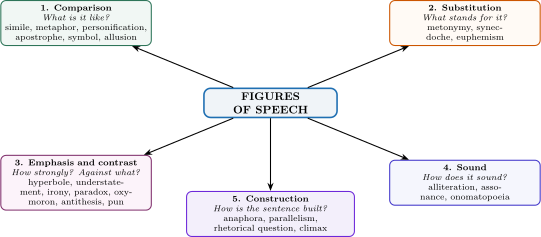
- A simile compares two different things with like, as or than: Her voice was as thin as a thread.
- A metaphor says that one thing is another, without a word of comparison: The classroom was a beehive. An extended metaphor is developed over several lines; when the comparison is surprising and worked out point by point like an argument, it is called a conceit.
- Personification gives human qualities or acts to an object, an animal or an idea: The wind knocked at every door.
- An apostrophe addresses directly someone absent or dead, or a thing, as if it could hear: O sea, give me back my brother!
- A symbol is a concrete thing that stands for an idea: a dove for peace, a falling leaf for the passing of life.
- An allusion is a brief reference to a person, a text or an event that the reader is expected to know: He met his Waterloo in the final examination.
- A metonymy names a thing by something closely linked with it: The whole village came to the wedding (its inhabitants); She reads Gibran (his books).
- A synecdoche names the whole by a part, or a part by the whole: There were forty sails in the bay (ships); We need more hands (workers).
- A euphemism replaces a harsh word by a mild one: He passed away (died); She is between jobs (unemployed).
- A hyperbole is a deliberate exaggeration: I have told you a thousand times.
- An understatement says less than is meant; litotes affirms by denying the opposite: He is not exactly a genius. The exam was no picnic.
- Irony says the opposite of what is meant (verbal irony): What lovely weather! — in a storm. (For situational and dramatic irony, see Units 1 and 3.)
- A paradox is a statement that seems to contradict itself and yet contains a truth: The more we learn, the less we know.
- An oxymoron joins two contradictory words: a deafening silence, bitter sweetness, a living death.
- An antithesis sets two opposite ideas in balanced terms: Many are called, but few are chosen.
- A pun plays on two meanings of a word, or on two words that sound alike: A bicycle cannot stand on its own because it is two-tired.
- Alliteration repeats a consonant sound at the beginning of neighboring words: wild and windy weather. Assonance repeats a vowel sound: the low moan of the cold road.
- Onomatopoeia is a word that imitates a sound: buzz, hiss, crash, murmur.
- Anaphora repeats the same word or words at the beginning of successive lines or sentences. Parallelism repeats the same grammatical pattern.
- A rhetorical question is asked for effect, not for an answer: Who has never been afraid?
- A climax arranges words or ideas in rising order of force: He lost his money, his friends, his honor.
2.1.3 The right word: synonyms and connotation
Two words are synonyms when they have nearly the same denotation. They almost never have the same connotations, the same strength or the same register: to choose among them is to choose a meaning.
| Neutral | Favorable | Unfavorable | Formal or literary |
|---|---|---|---|
| thin | slim, slender | skinny, scrawny | lean, gaunt |
| old | mature, venerable | worn-out, decrepit | aged, ancient |
| smell | scent, fragrance | stink, stench | odor |
| to walk | to stroll | to trudge | to tread |
| sad | wistful | miserable | sorrowful, melancholy |
An equivalent phrase says in several words what one word says: to pass away for to die, at the present time for now. A phrase is not better than a word because it is longer.
Exercises of the chapter
- The figures of speech and their families solved
- A conceit: the two feet of the compasses solved
- Praise in sounds and colors: “Pied Beauty” solved
- Listening: referential and figurative language; tone, stress and intonation solved
- Speaking: saying a poem, and expressing an idea cogently solved
- Constructions, vocabulary and sentence length solved