Trust and Betrayal on Stage: Tone, Attitude and Dramatic Irony
Course · English for Literature and Humanities (Grade 12, Lebanon), chapter 3 · Lebanon, Grade 12 · the beginning of the chapter, the rest on Adloun
On a stage there is no narrator to tell us that a character is lying. We have a voice, and we must decide how far to trust it. In Shakespeare's Othello, a great general is destroyed by a man whom everyone calls “honest”, and who never once states the lie that he makes his victim believe: he lets his tone do the work. In Henrik Ibsen's A Doll's House, a husband speaks to his wife in the most loving words, and the play teaches us to hear in them the voice of a master. In this unit you will learn to name a tone and to prove it, to recognize the attitude and the intent behind a speech, to hear several points of view on one event, to give a speech yourself — and to take apart an argument that only pretends to be one.
Curriculum: LB-LH
Learning outcomes
- Reading: explain tone, mood and attitude; identify the implied meaning of a line of dialogue.
- Listening: relate tone, stress and intonation to the purpose of what is said; recognize multiple points of view.
- Speaking: identify and explain bias, tone and intent; practice giving a speech.
- Writing: choose structures and word order appropriate for the task and the audience.
- Thinking: critique a speaker's argument.
3.1 Key terms: tone, attitude, intent
3.1.1 Four words that must not be confused
- The attitude of a speaker or writer is what he or she thinks and feels about the subject, or about the person addressed: respect, contempt, pity, suspicion, admiration.
- The tone is the attitude made audible: the way it shows in the choice of words, the kind of sentences, the forms of address and — on stage — the voice. We infer an attitude; we hear a tone.
- The mood is the atmosphere of a scene, the feeling created in the audience: tension, unease, gaiety, dread.
- The intent (or purpose) is what the speaker wants to obtain by speaking: to inform, to defend himself, to reassure, to flatter, to wound, to plant a doubt.
- A speaker shows bias when his view of a subject is one-sided: he leans, because of interest, feeling or habit, toward one conclusion, and selects words and facts accordingly.
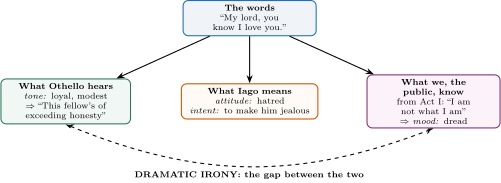
The four can pull in different directions, and drama lives on the difference: a character may adopt a friendly tone while his attitude is hatred and his intent destruction, and the mood of the scene, for the audience who knows it, is horror.
3.1.2 Words for tones
“The tone is good” or “the tone is negative” says nothing. A tone needs an exact adjective.
| Warm or favorable | Cold or hostile | Double or distant |
|---|---|---|
| affectionate, tender, admiring, respectful, earnest (serious and sincere), dignified, confident, hopeful, playful, soothing (calming). | contemptuous, scornful, bitter, resentful, indignant (angry at an injustice), threatening, harsh, curt (rudely brief), commanding. | ironic, sarcastic (ironic in order to wound), mocking, patronizing (kind in a way that treats the other as a child), detached, matter-of-fact, evasive, insinuating. |
3.1.3 Irony and its relatives on stage
- Verbal irony: a character says the opposite of what he means, and intends to be understood.
- Dramatic irony: the audience knows something that a character on stage does not; his words, or the words said to him, then carry a second meaning for us.
- Situational irony: what happens is the opposite of what was expected or intended.
- An insinuation is a suggestion made indirectly, so that the speaker can deny having made it. An innuendo is an insinuation against someone's character.
- A soliloquy is a speech by a character alone on stage; an aside is a remark that the other characters are supposed not to hear. Both tell the audience the truth that the dialogue hides.
- The subtext is what a character means or feels beneath what he says.
3.2 Reading: a general, a villain, a wife
3.2.1 Shakespeare: Othello defends himself
Author : William Shakespeare (1564–1616), Othello
Written about 1603, the tragedy is set in Venice and Cyprus. Othello, a Moor — an African — has risen by his courage to command the armies of Venice. He has secretly married Desdemona, the daughter of the senator Brabantio. In Act I, scene 3, Brabantio accuses him before the Duke and the Senate of having won her by drugs and witchcraft. Othello answers. He has just told how Brabantio used to invite him and ask for the story of his life, and how Desdemona would come to listen. (Passing: exceedingly. Hint: occasion.)
OTHELLO.
My story being done,
She gave me for my pains a world of sighs.
She swore, in faith, ’twas strange, ’twas passing strange;
’Twas pitiful, ’twas wondrous pitiful.
She wish'd she had not heard it, yet she wish'd
That heaven had made her such a man: she thank'd me,
And bade me, if I had a friend that lov'd her,
I should but teach him how to tell my story,
And that would woo her. Upon this hint I spake:
She lov'd me for the dangers I had pass'd,
And I lov'd her that she did pity them.
This only is the witchcraft I have us'd.
The task and the audience. A man accused of a crime speaks before judges, and his accuser is one of them. He does not attack Brabantio, does not protest, does not plead: he narrates. His proof is a story, and the story is a love story.
Tone. Calm, dignified, simple. The sentences are short and balanced; the vocabulary is plain (“She gave me for my pains a world of sighs”). He reports Desdemona's words in indirect speech, with their repetitions — “'twas strange, 'twas passing strange; / 'Twas pitiful, 'twas wondrous pitiful” — so that the judges hear her voice in his. Attitude: tenderness toward her, respect toward the court, and a quiet pride.