The Individual and Society: Reading the Novel, Writing the Literary Essay
Course · English for Literature and Humanities (Grade 12, Lebanon), chapter 4 · Lebanon, Grade 12 · the beginning of the chapter, the rest on Adloun
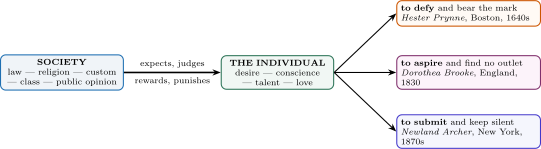
A short story shows a life in a moment; a novel has room for a whole world. It can set one person against a town, a class or a century, and follow the struggle for years. The three novels of this unit ask the same question in three societies. In Nathaniel Hawthorne's The Scarlet Letter, a Puritan town marks a woman with a letter. In George Eliot's Middlemarch, a provincial society offers a great soul nothing great to do. In Edith Wharton's The Age of Innocence, fashionable New York destroys a love without ever raising its voice. You will learn to extract the themes and the main issues of a text, to follow the development of an idea in a talk, to discuss the values that lie beneath a story — and to bring several texts together in one organized, coherent literary essay.
Curriculum: LB-LH
Learning outcomes
- Reading: extract themes and concepts from a text; identify its main ideas and the issues that it raises.
- Listening: identify the key terms of a talk and the manner in which its theme is developed.
- Speaking: trace the development of main ideas; comment on the relevance of supporting details; discuss underlying values.
- Writing: sustain thematic unity, maintain coherence and use proper organizational strategies in a literary essay.
- Thinking: synthesize information gathered from different sources.
4.1 Key terms: theme, issue, value
4.1.1 From the subject to the issue
- The subject (or topic) is what the text is about, in a word or a phrase: a public punishment.
- A main idea is what a passage states or shows about its subject, in a sentence: The punishment meant to shame Hester sets her apart and makes her visible.
- A theme is a general idea about life that the whole work develops, stated in a sentence that does not name the characters: A community that brands a person reveals itself as much as it reveals her.
- A concept is an abstract notion that helps us think about many cases: conformity, stigma, convention, vocation.
- An issue is a question raised by the text on which thoughtful people may disagree: Does a community have the right to punish private conduct?
- A value is what a person or a society holds to be good and worth defending: purity, order, freedom, reputation. The underlying values of a text are those that it takes for granted or defends without always naming them.
A subject is found by asking What is it about?; a theme, by asking What does it say about it?; an issue, by asking What question does it leave us to decide?
4.1.2 A vocabulary for the individual and society
| Term | Meaning |
|---|---|
| a norm | a rule of behavior that a group expects its members to follow, written or not |
| a convention | an accepted way of doing things, followed because “it is done” |
| conformity | behaving as the group expects; a conformist follows, a nonconformist refuses |
| a stigma | a mark of shame that a society attaches to a person |
| an outcast | a person rejected by the group |
| hypocrisy | professing in public values that one does not practice |
| a vocation | a strong inner call to a certain work or way of life |
| self-fulfillment | the full development of one's own abilities and character |
| public opinion | what “people” think and say; the court that has no judge and no appeal |
4.1.3 The novel and its narrator
A novel is a long prose narrative. It has a setting in time and place, which is often a society with its ranks and rules; a protagonist, whose desires meet obstacles; and a narrator. The great novelists of the nineteenth century often use an omniscient narrator, who knows every character's thoughts and who comments: Hawthorne's “we”, George Eliot's “you and me” speak to the reader directly and draw the lesson. Edith Wharton prefers a narrator who stays close to one character's mind and lets irony judge. To find the themes of a novel, listen to the narrator's comments, watch what happens to the protagonist — and look at the symbols.
4.2 Reading: a letter, a hidden life, a hieroglyphic world
4.2.1 Nathaniel Hawthorne: the letter on the scaffold
Author : Nathaniel Hawthorne (1804–1864), The Scarlet Letter
Born in Salem, Massachusetts, Hawthorne published in 1850 this novel set two centuries earlier, in the Puritan colony of Boston in the 1640s. Hester Prynne, whose husband is believed lost at sea, has borne a child. She refuses to name the father. Her judges condemn her to stand for three hours on the scaffold of the market-place and to wear for life, on her dress, the letter A — for adultery. In chapter II the women of the town, waiting at the prison door, have found the sentence too mild. The door opens. (Token: sign. Abashed: ashamed. Sumptuary regulations: laws limiting luxury in dress.)