Empire and Its Critics: Persuasion, Bias and Irony
Course · English for Literature and Humanities (Grade 12, Lebanon), chapter 5 · Lebanon, Grade 12 · the beginning of the chapter, the rest on Adloun
For three centuries the great powers of Europe, and later the United States, ruled a large part of the world, and they explained to themselves, at length, why they were right to do so. The debate about empire produced some of the most skillful persuasive prose in the English language — on both sides. In this unit you will read a minister of the British government in India proving that a whole people must be educated in English; a member of Parliament begging his country to keep its American colonies by affection, not by force; and an American humorist congratulating the “civilized” powers on their excellent business. You will learn to tell a text that informs from one that argues and one that persuades, to see how persuasion works on a reader, to detect bias and irony, to speak for a group — and to write a persuasive essay yourself.
Curriculum: LB-LH
Learning outcomes
- Reading: recognize the strategies of a persuasive text; explain bias, loaded words and irony.
- Listening: discriminate between informative, argumentative and persuasive discourse.
- Speaking: identify bias, tone and intent; advance and defend a point of view on behalf of a group; give a speech.
- Writing: produce a persuasive essay; use the rhetorical strategies of persuasion.
- Thinking: critique a writer's argument.
5.1 Key terms: the art of persuasion
5.1.1 Modes of writing and their purposes
- Narration tells what happened, in time.
- Description shows what a person, place or thing is like.
- Exposition explains or informs: it gives facts, defines, classifies, shows causes. Its purpose is that the reader should know and understand.
- Argumentation defends a claim by reasons and evidence, and examines the opposing view. Its purpose is that the reader should judge the claim to be true.
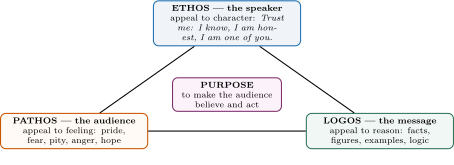
- Persuasion seeks to make the reader believe and, above all, act: vote, give, change. It uses reasons, and also the character of the writer and the feelings of the reader.
A real text mixes the modes: a persuasive speech narrates an anecdote, describes a scene, explains a fact. What defines it is its dominant purpose.
5.1.2 Three appeals
Since the Greek philosopher Aristotle, the means of persuasion have been sorted into three kinds, which still bear their Greek names.
5.1.3 The persuader's toolbox
| Device | What it does --- example |
|---|---|
| Rhetorical question | forces the answer on the listener: Would England have been what she now is? |
| Repetition, anaphora | hammers the idea: Not peace through…; not peace to be…; not peace to… |
| Antithesis | sets two things in sharp contrast: light as air… strong as links of iron |
| Triad (group of three) | gives a feeling of completeness: with reason, with morality, or even with that very neutrality |
| Hyperbole | enlarges: a single shelf… worth the whole literature |
| Direct address, “we” | draws the audience into the speaker's camp |
| Appeal to authority | borrows the credit of experts: the Orientalists themselves admit… |
| Concession | grants a point in order to seem fair, then turns: I admit… But… |
| Loaded words | judge while seeming to describe: dialects, mock-learning, lumber-rooms |
| Irony | pretends to praise in order to blame |
5.1.4 Loaded words and bias
Two words may have the same denotation and opposite connotations: a regime and a government; natives and inhabitants; to civilize and to conquer; a dialect and a language. A loaded word carries a judgment inside a description. A writer's bias shows in his loaded words and in his selection: the facts that he gives and those that he leaves out. The test is substitution: replace the word by a neutral synonym and see what the sentence loses.
Satire attacks a vice or a folly by making it ridiculous. Its favorite weapon is irony: the satirist pretends to adopt the point of view of those he attacks and pushes it until it condemns itself. The reader must detect the signals of irony: exaggeration, a clash between noble words and low ones, praise for what is plainly shameful.
5.2 Reading: three voices on empire
5.2.1 Macaulay: “a single shelf”
Author : Thomas Babington Macaulay (1800–1859), Minute on Indian Education
A historian, poet and politician, Macaulay sat from 1834 to 1838 on the Supreme Council that governed British India. The committee in charge of public education was divided: half wished to go on paying for teaching in Sanskrit and Arabic, the learned languages of India; half wished to teach in English. On February 2, 1835, Macaulay settled the question in a minute — an official memorandum — addressed to the Governor-General, who approved it. (Sanscrit is his spelling.)