The Machine and the Mind: Explaining Causes and Effects
Course · English for Literature and Humanities (Grade 12, Lebanon), chapter 6 · Lebanon, Grade 12 · the beginning of the chapter, the rest on Adloun
When the steam engine entered the workshops of Britain, some writers counted the yards of cloth; others asked a different question: what will the machine do to the people who live with it — to their work, their habits, their way of thinking and feeling? The question has not aged. In this unit a Scottish essayist names his century “the Mechanical Age”; a satirist proves, with a perfectly straight face, that machines may one day become conscious; and a philosopher brought up like a reasoning machine tells how he broke down, and what repaired him. From them you will learn to explain causes and effects: to follow a chain of reasoning in a text and in a talk, to test the link between a piece of evidence and the claim that it supports, to report what you have found out — and to write a cause-and-effect essay.
Curriculum: LB-LH
Learning outcomes
- Reading: identify the main ideas and the issues of an expository text; follow a chain of causes and effects.
- Listening: identify the method of development of a talk; list the expressions that mark its turning points.
- Speaking: report the findings of a researched project.
- Writing: organize a cause-and-effect essay; maintain coherence by logical sequencing and transitionals.
- Thinking: analyze the links between evidence and claim; distinguish inductive from deductive reasoning.
6.1 Key terms: causes, effects, and the words that link them
6.1.1 A vocabulary for explaining
- A cause is what makes something happen; an effect (or consequence, or result) is what happens because of it. A factor is one of several causes that work together.
- An immediate cause acts just before the effect; a remote (or underlying) cause acts further back. The immediate cause of the fire was a spark; the underlying cause was years of neglected wiring.
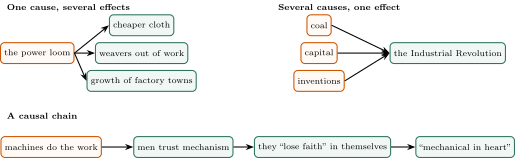
- A causal chain is a series in which each effect becomes the cause of the next.
- A necessary cause is one without which the effect cannot occur; a sufficient cause is one that is enough to produce it. Oxygen is necessary for a fire, but not sufficient.
- A correlation is the fact that two things vary together. It is not yet a proof of causation: both may depend on a third factor, or the link may be chance.
6.1.2 The language of cause and effect
| To introduce a cause | because, since, as, for; because of, owing to, due to, on account of; as a result of; thanks to (a good cause) |
| To introduce an effect | so, therefore, thus, hence, consequently, as a result, that is why; so… that, such… that |
| Verbs: cause effect | to cause, to produce, to bring about, to lead to, to result in, to give rise to, to trigger, to account for |
| Verbs: effect cause | to result from, to stem from, to arise from, to be due to, to be the outcome of |
| Nouns | cause, reason, source, root, origin, factor --- effect, result, consequence, outcome, impact |
| To be cautious | may, might, tends to, is likely to, partly, one reason is, contributes to |
Watch two pairs. To result in points forward to the effect (The strike resulted in a compromise); to result from points back to the cause (The compromise resulted from the strike). Affect is a verb (Machines affect our habits); effect is usually a noun (the effect of machines on our habits).
6.2 Reading: three diagnoses of a mechanical age
6.2.1 Thomas Carlyle: “the Age of Machinery”
Author : Thomas Carlyle (1795–1881), “Signs of the Times”
The Scottish essayist and historian published this article in the Edinburgh Review in 1829, when the first railways were being built. It is one of the earliest attempts to say what industry was doing to the mind of a whole society. (Epithet: descriptive word. Contrivance: clever device. Artisan: craftsman. To ply: to work with.)
Were we required to characterise this age of ours by any single epithet, we should be tempted to call it, not an Heroical, Devotional, Philosophical, or Moral Age, but, above all others, the Mechanical Age. It is the Age of Machinery, in every outward and inward sense of that word; the age which, with its whole undivided might, forwards, teaches and practises the great art of adapting means to ends. Nothing is now done directly, or by hand; all is by rule and calculated contrivance. For the simplest operation, some helps and accompaniments, some cunning abbreviating process is in readiness. Our old modes of exertion are all discredited, and thrown aside. On every hand, the living artisan is driven from his workshop, to make room for a speedier, inanimate one. The shuttle drops from the fingers of the weaver, and falls into iron fingers that ply it faster.
[…]
These things, which we state lightly enough here, are yet of deep import, and indicate a mighty change in our whole manner of existence. For the same habit regulates not our modes of action alone, but our modes of thought and feeling. Men are grown mechanical in head and in heart, as well as in hand. They have lost faith in individual endeavour, and in natural force, of any kind. Not for internal perfection, but for external combinations and arrangements, for institutions, constitutions, for Mechanism of one sort or other, do they hope and struggle. Their whole efforts, attachments, opinions, turn on mechanism, and are of a mechanical character.
Main idea of the first passage: a definition. Carlyle looks for the one word that characterizes his age, rejects four (“Heroical, Devotional, Philosophical, or Moral”) and keeps the fifth: “Mechanical”. He then defines it broadly: the age of machinery “in every outward and inward sense of that word”. The phrase announces the plan: first the outward facts, then the inward ones.