The Cry of the Children: From Problem to Solution
Course · English for Literature and Humanities (Grade 12, Lebanon), chapter 7 · Lebanon, Grade 12 · the beginning of the chapter, the rest on Adloun
In the 1840s, in the richest country of the world, young children worked long days in mines and mills, or sold watercress in the frozen streets of London. It took a poem, a journalist's notebook and a preacher's plan — among many other things — to make their country look at them and begin to act. The three texts of this unit show three ways of dealing with a social problem: Elizabeth Barrett Browning makes it felt; Henry Mayhew makes it known; William Booth proposes to solve it. With them you will learn to state a problem exactly, to look for its causes, to propose and evaluate solutions, to lead a group that is searching for one — and to write a problem-solution essay.
Curriculum: LB-LH
Learning outcomes
- Reading: extract the themes, the main ideas and the issues of texts of different kinds on one question.
- Listening: indicate how a theme is developed (examples, illustrations, facts); infer, predict and draw logical conclusions.
- Speaking: contribute to brainstorming; lead a discussion group; suggest alternatives and fill in information gaps; engage in critical discussion.
- Writing: choose structures suited to task and audience; use a wide range of constructions in a problem-solution essay.
- Thinking: synthesize information gathered from different sources.
7.1 Key terms: problems, causes, solutions
7.1.1 The anatomy of a problem
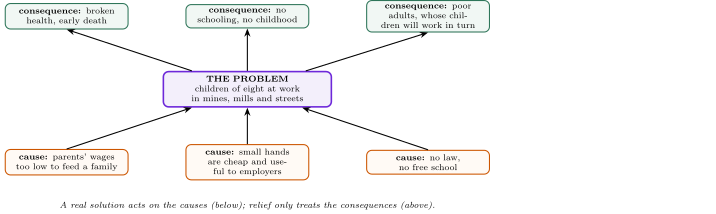
- A problem is a situation that harms someone and that could be otherwise. To state it, say who suffers, what, where, and how much.
- Its causes are what produces it; its consequences are what it produces in turn. (Symptoms are its visible signs: do not mistake them for the problem itself.)
- A solution is an action that removes the problem or reduces it. A measure is a particular action decided by an authority; a remedy cures; relief only eases the suffering for a time.
- The stakeholders are all those whom the problem or its solution concerns: those who suffer, those who profit, those who must pay or decide.
- A solution is feasible if it can really be carried out with the means available; effective if it acts on the causes; fair if its costs do not fall on the weakest.
- An obstacle is what stands in the way of a solution: cost, habit, interest, law.
- An alternative is another possible solution.
7.1.2 A vocabulary of poverty and reform
| Term | Meaning |
|---|---|
| child labor | the employment of children in work that harms their health or their schooling |
| wages | the money paid for work; a living wage is enough to live on |
| destitute | without the necessities of life: food, shelter, clothing |
| charity | help given freely to those in need; philanthropy: organized charity on a large scale |
| reform | a change made in order to improve a law or an institution; a reformer works for it |
| legislation | laws; to enforce a law is to make sure that it is obeyed |
| welfare | public help for those who cannot provide for themselves |
| to tackle, to address | to deal with (a problem); to alleviate: to make less severe; to eradicate: to remove completely |
7.1.3 The language of proposing
Landmark : Grammar in context: five ways of putting forward a solution
- Modals: The municipality should open the school yard in summer. We ought to begin with the youngest. This could be done in a month.
- Verbs of proposal + that + base form (the subjunctive): I propose that the hall be opened. We recommend that every employer keep a register. It is essential that the law be enforced.
- The second conditional, to imagine the result: If every child had a free meal at school, fewer would leave to work.
- Clauses of purpose: … so that no family need choose between bread and school; … in order to reach the villages.
- Ready-made frames: One way of tackling the problem would be to… — A more lasting solution lies in… — Rather than…, we might…
7.2 Reading: a poem, a report, a plan
7.2.1 Elizabeth Barrett Browning: the problem made felt
Author : Elizabeth Barrett Browning (1806–1861), “The Cry of the Children”
One of the most admired English poets of her century, Elizabeth Barrett published this poem in Blackwood's Magazine in 1843, after reading the report of a government commission — to which her friend R. H. Horne had contributed — on the work of children in mines and factories. The poem helped to win public support for the laws that limited that work. It is given here as she printed it in her Poems of 1844; she later changed a few lines. (Ere: before. Blowing: blossoming.)
Do ye hear the children weeping, O my brothers,
Ere the sorrow comes with years?
They are leaning their young heads against their mothers,
And that cannot stop their tears.
The young lambs are bleating in the meadows;
The young birds are chirping in the nest;
The young fawns are playing with the shadows;
The young flowers are blowing toward the west—
But the young, young children, O my brothers,
They are weeping bitterly!—
They are weeping in the playtime of the others,
In the country of the free.
In the middle of the poem, the children themselves speak:
“For, all day, the wheels are droning, turning,—
Their wind comes in our faces,—
Till our hearts turn,—our heads, with pulses burning,
And the walls turn in their places—
Turns the sky in the high window blank and reeling—
Turns the long light that droppeth down the wall—
Turn the black flies that crawl along the ceiling—
All are turning, all the day, and we with all!—
And all day, the iron wheels are droning;
And sometimes we could pray,
‘O ye wheels,' (breaking out in a mad moaning)
‘Stop! be silent for to-day!'”