What Is Literature For? The Argumentative Essay and the Debate
Course · English for Literature and Humanities (Grade 12, Lebanon), chapter 8 · Lebanon, Grade 12 · the beginning of the chapter, the rest on Adloun
You have spent a year reading stories, poems, plays and essays. Is it time well spent? The question is as old as philosophy. Plato sent the poets out of his ideal city and challenged their friends to defend them; in 1820 Thomas Love Peacock declared that an age of science had no more use for poetry than a grown man for a baby's rattle; his friend Shelley answered that without imagination all our knowledge is useless. This last unit sets these voices against one another, and asks you to join in. You will learn to build an argument, to state the other side at its strongest, to refute it, to debate — and to write the argumentative essay of the examination.
Curriculum: LB-LH
Learning outcomes
- Listening: recognize multiple points of view; discriminate between informative, persuasive and argumentative discourse.
- Speaking: participate in and lead a debate; express ideas cogently; defend a point of view on behalf of a group; engage in critical discussion.
- Writing: produce an argumentative essay that uses narration, exposition and persuasion where each is needed, with unity, coherence and organization.
- Thinking: present well-grounded counterarguments; formulate refutations and rebuttals.
- Thinking: critique a writer's or a speaker's argument.
8.1 Key terms: the anatomy of an argument
8.1.1 Thesis, argument, counterargument, refutation
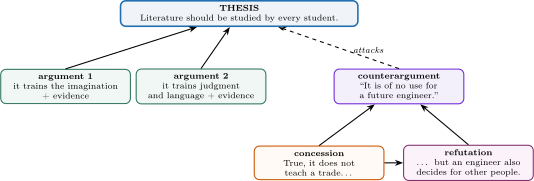
- An issue is a question on which reasonable people disagree: Should literature be compulsory for all students?
- A thesis is the position that a writer takes on the issue and undertakes to prove.
- An argument is a reason given in support of the thesis; it rests on evidence (facts, examples, testimony, quotations).
- A counterargument is a reason given against the thesis — the argument of the other side.
- A concession admits that part of the counterargument is true.
- A refutation shows that a counterargument is false, weak or beside the point.
- A rebuttal is the reply made, in a debate or in a later text, to the objections of an opponent: Shelley's essay is a rebuttal of Peacock's.
A persuasive text (Unit 5) seeks above all to win the reader, and may use every appeal to do so. An argumentative text has a stricter duty: it must give the other side its due. It states the opposing view fairly and answers it with reasons. That is why its characteristic move has three steps.
8.1.2 The language of concession and refutation
Landmark : Grammar in context: conceding, then answering
- To introduce the other side: It is often said that… — Some argue that… — Opponents of this view claim that… — At first sight…
- To concede: Admittedly… — Granted… — It is true that… — No doubt… — This may be so.
- To turn: However… — Nevertheless… — Yet… — Even so… — This does not mean that…
- To refute: This argument overlooks… — rests on a confusion between… — proves too much… — The evidence points the other way.
- In one sentence: Although poetry builds no bridges, it forms those who decide where bridges are needed. While it is true that reading takes time, it does not follow that the time is lost.
8.1.3 Faults of argument
In Unit 6 you met four faults of causal reasoning. Here are five that belong to dispute.
| Fault | What it does | Example |
|---|---|---|
| Straw man | attacks a weakened or distorted version of the opponent's view | “My opponent wants students to read novels instead of learning mathematics.” |
| Personal attack (ad hominem) | attacks the person, not the argument | “He defends poetry because he is a poet.” |
| False dilemma | pretends that there are only two choices | “Either we teach science or we teach literature.” |
| Circular reasoning | assumes what it should prove | “Great books are worth reading because they are great.” |
| Appeal to the crowd | treats popularity as proof | “Nobody reads poetry now; so it is worthless.” |
8.2 Reading: an ancient quarrel
8.2.1 Plato: the challenge
Author : Plato (about 428–347 BC), The Republic, Book X, translated by Benjamin Jowett
In this dialogue, the Athenian philosopher makes his teacher Socrates describe a just city. Poets, Socrates has argued, imitate appearances and feed the passions instead of reason; except for “hymns to the gods and praises of famous men”, poetry must be kept out. Here, speaking to Glaucon, he looks back on that judgment. Poetry is personified as a woman (“she”). The translation is that of the Oxford scholar Benjamin Jowett (1817--1893).
And now since we have reverted to the subject of poetry, let this our defence serve to show the reasonableness of our former judgment in sending away out of our State an art having the tendencies which we have described; for reason constrained us. But that she may not impute to us any harshness or want of politeness, let us tell her that there is an ancient quarrel between philosophy and poetry; of which there are many proofs, such as the saying of ‘the yelping hound howling at her lord,’ or of one ‘mighty in the vain talk of fools,’ and ‘the mob of sages circumventing Zeus,’ and the ‘subtle thinkers who are beggars after all’; and there are innumerable other signs of ancient enmity between them. Notwithstanding this, let us assure our sweet friend and the sister arts of imitation, that if she will only prove her title to exist in a well-ordered State we shall be delighted to receive her—we are very conscious of her charms; but we may not on that account betray the truth.
[…]
Shall I propose, then, that she be allowed to return from exile, but upon this condition only—that she make a defence of herself in lyrical or some other metre?
Certainly.
And we may further grant to those of her defenders who are lovers of poetry and yet not poets the permission to speak in prose on her behalf: let them show not only that she is pleasant but also useful to States and to human life, and we will listen in a kindly spirit; for if this can be proved we shall surely be the gainers—I mean, if there is a use in poetry as well as a delight?
Exercises of the chapter
- The anatomy of an argument solved
- “An ancient quarrel” solved
- Peacock against Shelley solved
- Listening: several points of view solved
- Speaking: the debate solved
- Counterargument, refutation, plan solved