Heredity and the Code of Life: The Special Language of Science
Course · English for Science (Grade 12, Lebanon), chapter 1 · Lebanon, Grade 12 · the beginning of the chapter, the rest on Adloun
Why do children resemble their parents, and why do they never resemble them completely? For thousands of years the question had only vague answers: “blood”, “likeness”, “the family nose”. It became a science when a few precise words were invented — dominant, recessive, gene, mutation — and when results began to be reported in numbers and not in impressions. This first unit is about that language. It teaches how to recognize and select the special terms of a science, how to identify the grammatical structures in which scientific discourse deviates from ordinary discourse, how to recognize the markers of objectivity, and how to hear, in an extended lecture, each specific detail as an example of a general topic.
Curriculum: LB-SG LB-SV
Learning objectives
- Identify the special terms used in a text or a lecture, and select the appropriate technical term when writing.
- Identify special linguistic structures (nominalization, dense noun phrases, impersonal passives, reduced clauses) and explain how they deviate from normal discourse.
- Identify objectivity markers in scientific discourse and distinguish them from markers of subjectivity.
- Recognize specific details as examples of general science topics when listening to extended discourse, and paraphrase parts of the information.
- Use an extensive technical lexis (heredity, genes, cells) and the grammar most pertinent to scientific discourse.
1.1 Special terms: the vocabulary of a science
1.1.1 Three layers of vocabulary
A page of a biology textbook does not contain one vocabulary but three, and a trained reader treats each differently.
- A technical term (or special term) is a word or group of words that has one exact meaning inside one field and is fixed by a definition: allele, chromosome, heterozygous, messenger RNA.
- A semi-technical word is an ordinary word to which a science gives a special, narrower meaning: cross, character, dominant, express, culture, code.
- A general academic word belongs to no science in particular but serves in all of them: factor, ratio, obtain, constant, occur, respectively.
Property : — What makes a word a term
- One term, one meaning. In ordinary speech dominant means “more powerful”; in genetics a dominant allele is simply the one whose effect is seen in a heterozygous individual. It is neither stronger nor better nor more frequent.
- No elegant variation. A novelist avoids repeating a word; a scientist repeats the same term twenty times, because a new word would suggest a new thing. Trait must not become feature, then property, then aspect.
- A definition stands behind it. A term can always be replaced by its definition, and the sentence remains true.
- It belongs to a family and a system. Gene, genetic, genetics, genome, genotype; homozygous is understood by contrast with heterozygous.
The most dangerous words for a reader are not the long Greek ones, which announce themselves, but the semi-technical ones, which look familiar.
| Word | Everyday meaning | Meaning in genetics |
|---|---|---|
| cross | angry; a mark (); to go over | to mate two individuals of different types (verb); the mating itself (noun) |
| character | a person in a story; someone's nature | an observable inherited feature, such as seed shape (today more often trait) |
| express | to say what one thinks | (of a gene) to produce its product and its visible effect |
| code | a secret system of signs | the rule by which sequences of bases correspond to amino acids |
| translation | putting a text into another language | the building of a protein from messenger RNA |
| culture | arts and customs | cells or microbes grown in the laboratory |
| generation | people of about the same age | all the offspring of one stage of a cross (P, F1, F2) |
| carrier | a company that transports goods | an individual with one copy of a recessive allele that is not expressed |
1.1.2 A scientist names what he sees: Mendel (1865)
Author : Gregor Mendel (1822–1884)
A monk of the Augustinian abbey of Brünn (today Brno, in the Czech Republic), Mendel crossed varieties of the garden pea for eight years and counted the offspring. He read his paper, Experiments in Plant Hybridization, to the local Natural History Society in February and March 1865; it was printed in 1866 and almost ignored. In 1900, sixteen years after his death, three botanists rediscovered it, and it became the foundation of genetics. The paper is quoted here in the English translation prepared for the Royal Horticultural Society (C. T. Druery and W. Bateson, 1901).
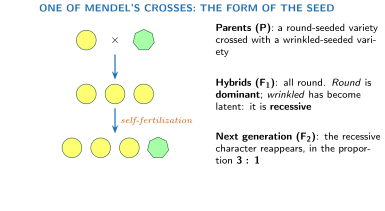
In each of his seven crosses Mendel observed that the hybrid plants looked like one of the two parents, as if the character of the other parent had vanished. He needed two words for this, and he created them in a single sentence:
Henceforth in this paper those characters which are transmitted entire, or almost unchanged in the hybridization, and therefore in themselves constitute the characters of the hybrid, are termed the dominant, and those which become latent in the process recessive. The expression “recessive” has been chosen because the characters thereby designated withdraw or entirely disappear in the hybrids, but nevertheless reappear unchanged in their progeny, as will be demonstrated later on.
The passage shows how a term is born. Are termed is the signal of naming; Henceforth in this paper fixes the meaning for the whole text; the definition comes before the name (those characters which… are termed the dominant); and the choice of the word is justified by its Latin sense (recedere, to withdraw). After this sentence the two adjectives are no longer ordinary words: every later use refers back to it.
1.1.3 Identifying and selecting terms
Method : — Identifying the special terms of a text or a lecture
- Look for naming signals: is called, is termed, is known as, is referred to as, that is, i.e., or followed by a second name; in speech, a short pause and a slower voice.
- Look at the typography: bold or italic type at the first occurrence; in a lecture, the word written on the board.
- Look at the form: Greek or Latin parts (hetero-, homo-, -zygous, chromo-, -some), abbreviations and symbols (DNA, F1, Aa).
- Look at repetition: the word that comes back unchanged, where a novelist would have used a synonym, is a term.
- Test: can you replace it with a definition? Does an ordinary synonym make the sentence vague or false? Then it is a term, and it must be kept as it is in your notes and in your summary.
Property : — The core lexis of heredity
| Term | Definition |
|---|---|
| gene | a segment of DNA that carries the information for one product, usually a protein |
| allele | one of the alternative versions of the same gene |
| locus (pl. loci) | the position of a gene on a chromosome |
| genotype | the set of alleles that an individual carries (AA, Aa or aa) |
| phenotype | the observable characteristics that result from the genotype and the environment |
| homozygous | having two identical alleles of a gene (AA or aa) |
| heterozygous | having two different alleles of a gene (Aa) |
| dominant | (of an allele) expressed in the phenotype of a heterozygous individual |
| recessive | (of an allele) expressed only when the individual is homozygous for it |
| mutation | a change in the sequence of DNA |
| genome | the whole of the genetic material of an organism |
Exercises of the chapter
- How a term is born: Mendel names what he sees (1865) solved
- From ordinary to scientific discourse: nominalization and noun phrases solved
- Objectivity markers in a report of results: Mendel's counts solved
- Saying what is not known: Darwin on inheritance (1859) solved
- Listening to a lecture: details as examples of general topics solved
- Selecting terminology and paraphrasing: correcting a paragraph solved