The Invisible World: Scientific Description, Figures of Speech and Tone
Course · English for Science (Grade 12, Lebanon), chapter 2 · Lebanon, Grade 12 · the beginning of the chapter, the rest on Adloun
In 1665 Robert Hooke put a flea under his microscope and found, where everyone else saw a disgusting insect, an animal “adorn'd with a curiously polish'd suit of sable Armour”. To make his readers see what only he had seen, he needed two things at once: the exactness of a scientific description, and the comparisons of a poet. This unit studies both. It teaches how to build an extended description, with its plan, its vocabulary and its grammar; how to read a textbook page and turn it into a table; how simile, metaphor and personification serve science, and where they mislead; and how to interpret the tone and the point of view of a writer who speaks of science, whether he is a scientist or a poet.
Curriculum: LB-SG LB-SV
Learning objectives
- Develop a scientific description: plan it, order it in space, and relate each structure to its function.
- Use the technical lexis of size, shape, position, composition and function, and the grammar of description.
- Derive relevant information from a textbook page and organize it in a table.
- Identify simile, metaphor and personification, explain what they contribute to scientific discourse, and test the limits of an analogy.
- Interpret tone and point of view in texts about science.
2.1 The scientific description
2.1.1 What a scientific description is
A scientific description is a text that makes an object known to a reader who cannot see it, by stating in an orderly way what it is, what it looks like, what it is made of and what each part does. It differs from a literary description in its aim: not to create an impression, but to allow the reader to recognize the object, to draw it, and to check every statement against the object itself.
A definition (studied in Grade 11) answers the question What is it? in one sentence. A description begins where the definition ends.
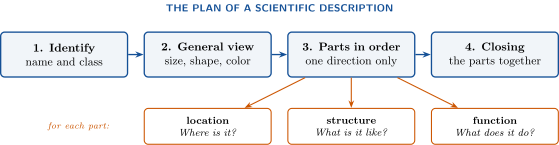
Method : — The plan of an extended description
- Identify: name the object and place it in its class (one sentence of definition).
- General appearance: size, shape, color, position in the larger whole. Give measurements with units.
- Parts, in a fixed order: announce how many parts there are, then take them one by one, always moving in the same direction (from the outside to the inside, from top to bottom, from front to back, or along the path that something follows).
- For each part: its location, its structure, its function.
- Closing: how the parts work together; a reference to the figure.
The reader must never have to jump. A description that goes from the head to the tail, back to the eye and then to the legs cannot be drawn.
Property : — Three orders of description
- Spatial order: the text follows the object in space. Markers: at the top, below, on either side, in the center, at the front, behind, between, around, inside.
- Order of the whole and its parts: the text goes from the whole to the parts, and from each part to its own parts. Markers: consists of, is divided into, each of which, the former, the latter.
- Functional order: the text follows something that moves through the object (light through the eye, blood through the heart, a signal along a nerve). Markers: enters, passes through, reaches, leaves.
2.1.2 A master of description: Hooke's flea (1665)
Author : Robert Hooke (1635–1703)
Curator of experiments of the Royal Society of London, Hooke published Micrographia in 1665: sixty “observations” of small things seen through the microscope, with large engraved plates drawn by the author. The Grade 11 book quoted the page in which he names the cells of cork. Observation LIII describes a flea; the letters in the text refer to the plate (“the 34. Scheme”). The spelling is Hooke's.
The strength and beauty of this small creature, had it no other relation at all to man, would deserve a description.
For its strength, the Microscope is able to make no greater discoveries of it then the naked eye, but onely the curious contrivance of its leggs and joints, for the exerting that strength, is very plainly manifested, such as no other creature, I have yet observ’d, has any thing like it; for the joints of it are so adapted, that he can, as ’twere, fold them short one within another, and suddenly stretch, or spring them out to their whole length […] these six leggs he clitches up altogether, and when he leaps, springs them all out, and thereby exerts his whole strength at once.
But, as for the beauty of it, the Microscope manifests it to be all over adorn’d with a curiously polish’d suit of sable Armour, neatly jointed, and beset with multitudes of sharp pinns, shap’d almost like Porcupine’s Quills, or bright conical Steel-bodkins; the head is on either side beautify’d with a quick and round black eye K, behind each of which also appears a small cavity, L, in which he seems to move to and fro a certain thin film beset with many small transparent hairs, which probably may be his ears;
(then = than; onely = only; clitches up = clutches, draws tightly together; sable = black; bodkin = a thick pointed needle.)
The page is three and a half centuries old, and its method is the one still taught. Hooke announces his plan in the first sentence (strength and beauty) and follows it (For its strength… But, as for the beauty of it…). He describes a structure together with its function: the joints are so adapted, that the flea can fold its legs and spring them out; the film behind the eye probably may be his ears. He locates each part (on either side, behind each of which, in which) and labels it with a letter that sends the reader to the plate. He grades his certainty: what he has seen is stated plainly (is very plainly manifested), what he supposes is marked (he seems to, probably may be). And where exact words do not yet exist, he compares: the spines are almost like Porcupine's Quills.
2.2 The words and grammar of description; reading a textbook page
2.2.1 An extensive lexis
Property : — The technical lexis of description
| Size | The cell is 8 micrometers in diameter. The axon is one meter long / has a length of one meter / measures one meter in length. The wall is 2 mm thick. Its diameter ranges from 1 to 20 micrometers. |
| Shape | spherical, cylindrical, oval, conical, cubic, flat, tubular, disk-shaped, rod-shaped, star-shaped, branched, coiled, folded, tapering (becoming narrower toward one end), concave, convex, biconcave |
| Position | is located / is situated in; lies between; surrounds; is surrounded by; encloses; lines (covers the inner surface of); is attached to; is embedded in; extends from… to; projects from; is adjacent to; runs along |
| Composition | consists of; is composed of; is made up of; comprises (the whole first); contains; includes (some of the parts); is divided into; is filled with; is covered with |
| Function | serves to; acts as; is responsible for; enables… to; allows… to; protects; supports; conducts; its function is to; plays a role in |
Exercises of the chapter
- The plan of a description: the head of Hooke's flea (1665) solved
- From notes to a description in functional order: the human eye solved
- Reading a textbook page: the mitochondrion solved
- Simile, metaphor, personification: from Hooke to the modern textbook solved
- A poet accuses science: Poe, “Sonnet — To Science” solved
- Listening to a poem: Whitman, “When I Heard the Learn'd Astronomer” solved