The Web of Life: Cause, Effect and Logical Relationships
Course · English for Science (Grade 12, Lebanon), chapter 3 · Lebanon, Grade 12 · the beginning of the chapter, the rest on Adloun
Can the number of cats in a village decide how many flowers grow in the fields around it? Charles Darwin thought so, and showed why in a single paragraph: cats eat mice, mice destroy the nests of bumblebees, and bumblebees fertilize the clover. In living systems a cause seldom has one effect, and an effect seldom has one cause; causes form chains, webs and loops. In Grade 11 you learned the simple language of cause and effect. This unit extends it. It teaches how to write and speak about multiple and indirect causes, how to assess a logical relationship (is the condition necessary? sufficient? is the reasoning valid?), how to build a complete cause/effect essay and presentation, and how to summarize an argument that you have read or heard.
Curriculum: LB-SG LB-SV
Learning objectives
- Develop cause/effect discourse about multiple causes, indirect causes and feedback loops, and organize them in a causal diagram.
- Assess logical relationships: necessary and sufficient conditions, correlation and causation, valid and invalid inferences.
- Write a cause/effect essay with a thesis, ordered body paragraphs and a conclusion.
- Summarize arguments and paraphrase parts of the information heard in a lecture.
- Deliver a cause/effect presentation on a complex system.
3.1 Extended cause/effect discourse: chains, webs and loops
3.1.1 Beyond the simple chain
- Causal chain: each effect is the cause of the next (). is an indirect (or remote) cause of ; is its direct (or immediate) cause.
- Multiple causes: several factors combine to produce one effect; each one contributes to it.
- Multiple effects: one cause has several consequences, some of them unexpected (side effects).
- Causal web: chains that cross and share links, as in an ecosystem.
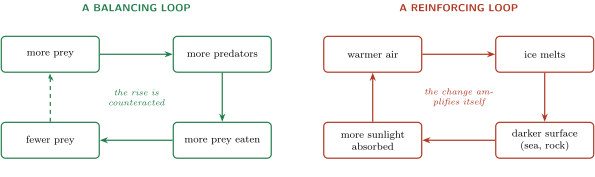
- Feedback loop: the effect acts back on its own cause. In a reinforcing (positive) loop the change amplifies itself; in a balancing (negative) loop the change is counteracted and the system returns toward its starting point.
3.1.2 A classic chain: Darwin's cats and clover (1859)
In the third chapter of On the Origin of Species, “Struggle for Existence”, Darwin wants to show “how plants and animals, most remote in the scale of nature, are bound together by a web of complex relations”. (Humble-bee is the old name of the bumblebee; the heartsease is the wild pansy.)
From experiments which I have tried, I have found that the visits of bees, if not indispensable, are at least highly beneficial to the fertilisation of our clovers; but humble-bees alone visit the common red clover (Trifolium pratense), as other bees cannot reach the nectar. Hence I have very little doubt, that if the whole genus of humble-bees became extinct or very rare in England, the heartsease and red clover would become very rare, or wholly disappear. The number of humble-bees in any district depends in a great degree on the number of field-mice, which destroy their combs and nests; […] Now the number of mice is largely dependent, as every one knows, on the number of cats; […] Hence it is quite credible that the presence of a feline animal in large numbers in a district might determine, through the intervention first of mice and then of bees, the frequency of certain flowers in that district!
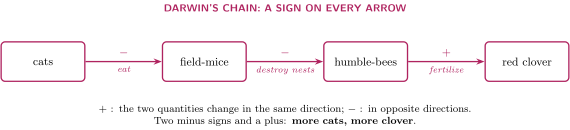
The paragraph is a model of extended causal discourse. Every link has its own expression, and no two are alike: are highly beneficial to, depends in a great degree on, is largely dependent on, might determine. The indirect causation is named as such: through the intervention first of mice and then of bees. The strength of each link is graded (if not indispensable, at least highly beneficial; in a great degree; largely), and so is the certainty of the whole (I have very little doubt; it is quite credible that… might). Finally, each link rests on a different kind of evidence, which Darwin names: his own experiments, the testimony of an observer (a Mr. Newman, in the lines omitted here), and common knowledge (as every one knows). The exclamation mark, rare in Darwin, shows that he knows how surprising the conclusion is.
Property : — The lexis of extended causation
| \raggedrightOne factor among several | contribute to; play a part (a role) in; be a factor in; be partly responsible for; account for 40 percent of; be attributed to; together with; combined with |
| Strength of the link | mainly, largely, chiefly, in a great degree; partly, to some extent; slightly; the main / major / minor cause |
| Indirect causation | indirectly; through; via; by way of; in turn; which in turn; through the intervention of; ultimately |
| Dependence | depend on; be dependent on; be determined by; be governed by; vary with; be related to; be proportional to; the more…, the more… |
| Feedback | reinforce, amplify, accelerate, intensify (reinforcing); counteract, offset, limit, check, stabilize, regulate (balancing); a vicious circle |
| \raggedrightStarting and enabling | trigger, set off, initiate (start suddenly); allow, enable, make possible, favor (create the conditions) |
Method : — Organizing causes in a diagram
- Write each variable as a noun phrase that can increase or decrease (number of mice, not mice eat).
- Draw an arrow from each cause to its direct effect, and only to its direct effect.
- Put a sign on each arrow: if the two change in the same direction, if they change in opposite directions.
- Look for loops: a path that returns to its starting point. An even number of signs (or none) gives a reinforcing loop; an odd number gives a balancing loop.
- Turn the diagram back into sentences, one arrow at a time, varying the expressions.
Exercises of the chapter
- An indirect cause in a classic text: Darwin's cats and clover (1859) solved
- From a text to a causal diagram: the death of a lake solved
- Necessary, sufficient, valid, invalid solved
- Correlation and causation: bees and fruit solved
- Summarizing an argument: Malthus on population (1798) solved
- Listening to a lecture: ocean acidification solved