Theories on Trial: Evidence, Warrant and Scientific Debate
Course · English for Science (Grade 12, Lebanon), chapter 5 · Lebanon, Grade 12 · the beginning of the chapter, the rest on Adloun
In 1628 an English physician claimed that the blood moves in a circle. For fourteen centuries the schools of medicine had taught otherwise, and he knew that he would be attacked. He did not ask to be believed: he multiplied two numbers, and left his opponents with a quantity of blood that no body could contain. In science a statement is worth the evidence that supports it, and the scientist must know how to bring that evidence forward, how to judge the evidence of others, and how to answer an objection without anger. This unit teaches how to substantiate a hypothesis, how to decide whether a theory is warranted, how to recognize defensive discourse and irony in a text, and how to write an argumentative essay.
Curriculum: LB-SG LB-SV
Learning objectives
- Substantiate a hypothesis: support a claim with evidence and reasoning.
- Discuss whether a theory is warranted, using explicit criteria.
- Recognize defensive discourse (objection, concession, rebuttal) and irony in a text read or heard.
- Assess the logical strength of an argument for or against a theory.
- Write an argumentative essay with a thesis, arguments, a counter-argument and a rebuttal.
5.1 Substantiating a hypothesis
5.1.1 Claim, evidence, reasoning
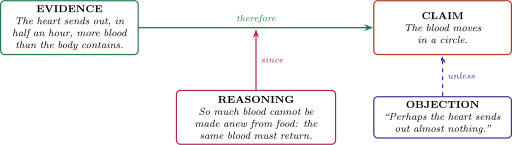
To substantiate a hypothesis is to give it substance: to support it with evidence and to show by reasoning why that evidence counts in its favor. A substantiated statement has three parts:
- the claim: what is asserted;
- the evidence: the observations, measurements or established facts that support it;
- the reasoning (or warrant): the link that explains why the evidence supports the claim.
Property : — Kinds of evidence, from the strongest to the weakest
- A controlled experiment that has been repeated (Unit 4).
- A measurement or systematic observation, with figures.
- A calculation from accepted values.
- An observation made once; an example; an analogy.
- The opinion of an authority (“Galen says…”); common belief (“everyone knows…”).
The last kind is not evidence about nature: it is evidence about what people think. Much of the history of science consists in replacing kind 5 by kinds 1 to 3.
5.1.2 A model: Harvey counts the blood (1628)
Author : William Harvey (1578–1657)
Physician to two kings of England, Harvey published in Latin, in 1628, a short book known as De Motu Cordis (“On the Motion of the Heart”). Medicine then followed the Greek physician Galen: the blood was thought to be made continually from food, and consumed by the organs. The translation below is that of Robert Willis (1799--1878), in the revised text of the Harvard Classics (1910). (A drachm: one eighth of an ounce; a pound contained twelve ounces. Charge: contents.)
Let us assume, either arbitrarily or from experiment, the quantity of blood which the left ventricle of the heart will contain when distended, to be, say, two ounces, three ounces, or one ounce and a half — in the dead body I have found it to hold upwards of two ounces. […] and let us suppose as approaching the truth that the fourth, or fifth, or sixth, or even but the eighth part of its charge is thrown into the artery at each contraction; this would give either half an ounce, or three drachms, or one drachm of blood as propelled by the heart at each pulse into the aorta; […] Now, in the course of half an hour, the heart will have made more than one thousand beats, in some as many as two, three, and even four thousand. Multiplying the number of drachms propelled by the number of pulses, we shall have either one thousand half ounces, or one thousand times three drachms, or a like proportional quantity of blood, according to the amount which we assume as propelled with each stroke of the heart, sent from this organ into the artery — a larger quantity in every case than is contained in the whole body!
Harvey substantiates his hypothesis by a calculation from deliberately low values. He does not know exactly how much blood the heart sends out at each beat; so he takes several estimates, down to the smallest that anyone could accept (or even but the eighth part), and the smallest number of beats (more than one thousand). Even then the product is too large: a thousand drachms make 125 ounces, more than ten pounds of blood in half an hour. The strength of the argument lies in the words in every case: whatever figures the opponent prefers, the conclusion stands. This is how to argue from uncertain data: concede every doubtful point to the other side, and show that the result survives.
Property : — The lexis of evidence
| Evidence supports | support, substantiate, corroborate, bear out, confirm, be consistent with, lend weight to, point to |
| Evidence goes against | contradict, undermine, weaken, cast doubt on, be at odds with, refute, disprove, rule out |
| Quality of evidence | strong, compelling, conclusive, direct / weak, indirect, circumstantial, anecdotal, inconclusive |
| Nouns | a piece of evidence (uncountable: never an evidence, evidences); a finding; grounds for; proof (rare outside mathematics) |
| Frames | There is strong evidence that…; The evidence for X comes from…; This is borne out by…; On the evidence available,… |
Exercises of the chapter
- Substantiating a hypothesis: Harvey's calculation (1628) solved
- The language and the weight of evidence solved
- Is the theory warranted? The continents in 1926 solved
- Defensive discourse: Darwin and the eye (1859) solved
- Irony: Swift at the Academy of Lagado (1726) solved
- Listening to a debate: dissection or simulation? solved