Science and Society: Persuasion, Solutions and the Rules of Good Writing
Course · English for Science (Grade 12, Lebanon), chapter 6 · Lebanon, Grade 12 · the beginning of the chapter, the rest on Adloun
A discovery does not stay in the laboratory. Sooner or later someone must decide what to do with it: build the dam or keep the valley, share the new source of energy or lock it away. In these debates the scientist no longer writes only for colleagues who weigh evidence. The audience is a council, a public, an assembly; the aim is not only to show what is true but to move people to act. This last unit studies the language of science in society: how style and register change with the audience, how a persuasive essay and a problem-solution essay are built, how to use and evaluate other sources and to read a text for its point of view. It ends where every unit of this book has been leading: with the rules for writing coherently, grammatically and clearly.
Curriculum: LB-SG LB-SV
Learning objectives
- Recognize different discourse styles and registers, and choose the one that suits an audience.
- Write a persuasive essay and a problem-solution essay.
- Use other sources in your own writing and evaluate them; identify an author's point of view.
- Listen to a speech and identify its purpose and its means of persuasion.
- Write coherently, grammatically and clearly, and revise your own text.
6.1 Style and register
6.1.1 One fact, three voices
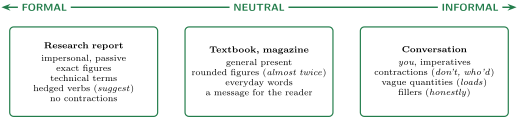
Register is the level of formality of a text, chosen according to the audience and the situation: formal, neutral or informal. Style is the particular way a writer or a kind of text uses the language: the style of a research report, of a textbook, of a newspaper, of a speech. A good writer has not one register but several, and moves between them on purpose.
A. Research report (formal). Participants who had slept for fewer than six hours made significantly more errors in the recall task than those who had slept for eight (mean 7.4 against 4.1). These findings suggest that sleep restriction impairs short-term memory.
B. School magazine (neutral). Students who sleep less than six hours remember less the next day. In a recent test, short sleepers made almost twice as many mistakes as classmates who had slept a full night. The lesson is simple: before an examination, an hour of sleep may be worth more than an hour of revision.
C. Conversation (informal). “Honestly, don't stay up all night before the exam. They tested it: people who'd barely slept got loads more wrong. You're better off going to bed.”
Property : — Markers of register
| Formal | Informal | |
|---|---|---|
| Vocabulary | obtain, demonstrate, sufficient, approximately, a considerable number of | get, show, enough, about, lots of |
| Verbs | one-word verbs: investigate, discover, eliminate, tolerate | phrasal verbs: look into, find out, get rid of, put up with |
| Grammar | passive, nominalization, full forms (do not, it is) | active with you / we, contractions (don't, it's) |
| Sentences | complete, subordinate clauses, no direct question to the reader | short, incomplete at times, questions and exclamations |
| Attitude | hedged, impersonal (it appears that) | personal, emphatic (I really think, honestly) |
The most common fault in a student's formal writing is not an error of grammar but a slip of register: “The results were kind of surprising”; “Lots of scientists think…”; “The experiment didn't work, so we had to do it again.” Each is correct English, and each is out of place in a report. Write: rather unexpected; many scientists; did not succeed and was therefore repeated. Conversely, a talk to younger students in the style of a research paper will lose them in a minute. Neither register is “better”: each fits an audience.
6.1.2 Recognizing a discourse style
Method : — Five questions for identifying a style
- Who is speaking, and to whom? A specialist to specialists, a teacher to learners, a citizen to the public?
- For what purpose? To inform, to explain, to persuade, to entertain?
- How does the writer appear? Absent (it was found), discreet (we), present (I believe)?
- How exact is the language? Figures with units and hedges, or round numbers and images?
- How does it try to hold the reader? By the logic of the evidence, by examples and stories, by emotion?
6.2 Persuading and proposing solutions
6.2.1 The persuasive essay
The argumentative essay of Unit 5 addressed a reader ready to weigh reasons. The persuasive essay or speech addresses an audience that must be moved: to vote, to give, to change a habit. It still needs reasons; it adds the means of touching those who listen.
Exercises of the chapter
- One subject, three registers solved
- A persuasive speech: “Atoms for Peace” (1953) solved
- Point of view and the evaluation of a source: Muir on Hetch Hetchy (1912) solved
- The problem-solution essay: evaluating solutions solved
- Using other sources: quotation, paraphrase, acknowledgment solved
- Listening to a persuasive speech: the fountain solved