Society and Its Customs: Theory, Style and Register
Course · English for Sociology and Economics (Grade 12, Lebanon), chapter 4 · Lebanon, Grade 12 · the beginning of the chapter, the rest on Adloun
Why do we shake hands, eat at certain hours, wear black or white for mourning — and find it strange that others do otherwise? In 1906 an American professor, William Graham Sumner, gave a name to the habits that a whole group follows without thinking about them: folkways. He also gave currency to a name for our tendency to judge every other group by our own: ethnocentrism. Seventy years before him, an Englishwoman, Harriet Martineau, had already warned travelers against that very fault; and a young Frenchman, Alexis de Tocqueville, had gone to observe the customs of a new society, the United States. The three write about the same thing — how human beings live together — and no two of them write alike. This unit is about what they say and about how they say it: you will explain a theory and compare it with another, recognize a style and a register on the page and in the voice, judge a presentation, write a critique, and learn to say one thing in several ways.
Curriculum: LB-SE
Learning outcomes
- Reading: identify different writing styles and explain how they change according to topic, writer and context; identify and explain the stylistic features of a text.
- Listening: identify features of style and register.
- Speaking: identify the strengths and weaknesses of presentations; speak coherently and clearly, with proper enunciation and intonation.
- Writing: comment on or critique what is heard or read; vary style to suit purpose, situation and audience; modify parts of a text to change its orientation, tone or style.
- Thinking: explain a theory; compare one theory with another.
4.1 Key terms: society, style, register
4.1.1 Words for society
| The group | The rules | The study of society |
|---|---|---|
| a society, a community; a group, a member; an insider an outsider; a generation; an institution (the family, the school, the State); a class; a role; status (one's position in a group). | a custom, a habit, a tradition; manners (ways of behaving in company); morals (rules of right and wrong); a norm (what a group expects); a value; a taboo (what must not be done); a sanction (a punishment or a reward). | sociology, a sociologist; to observe, an observer, observation; a survey; a prejudice (an opinion formed before knowing); a standard (a measure by which one judges); a theory, a concept, a hypothesis. |
- Folkways: the habits and customs common to a group, which arise from the repeated efforts of its members to satisfy their needs, and which the young learn from their elders.
- Mores (a Latin plural, pronounced MOR-ayz): the folkways that a group has come to regard as necessary to its welfare, and therefore as right.
- In-group (or we-group) and out-group (or others-group): ourselves, and everybody else.
- Ethnocentrism: the view of things in which one's own group is the center of everything, and all others are judged with reference to it.
4.1.2 Words for style and register
- The style of a text is the manner in which it is written: the writer's choice of words, the length and form of the sentences, the figures of speech, the place given to I and to you.
- The register is the level of language, chosen according to the situation and to the person addressed: formal (a report, a ceremony), neutral (a textbook, the news), informal (a conversation between friends).
- A stylistic feature is any choice that can be pointed to and named: short declarative sentences; a rhetorical question; a list of three; the passive voice; a technical term.
- Diction is the choice of words: concrete or abstract, plain or learned, neutral or loaded.
Style changes with three things: the topic (a law is not described like a festival), the writer (his or her period, training and temperament) and the context (the purpose, the audience, the kind of publication).
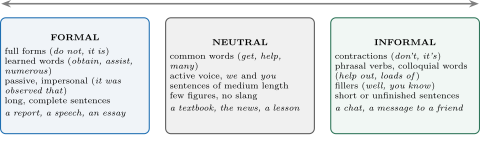
{ The scale of registers, with the main features of each.}
4.2 Reading: three observers of custom
4.2.1 Sumner: how folkways arise
Author : William Graham Sumner (1840–1910), Folkways
Sumner taught the social sciences at Yale University, where he held the first professorship of sociology in the United States. Folkways, published in 1906, is his study of customs. These extracts are from its opening section, “Definition and mode of origin of the folkways”. (Expedient means useful for a purpose; concurrence is agreement, a running together. The word primitive, usual in 1906, is one that social scientists now avoid.)
Men begin with acts, not with thoughts. Every moment brings necessities which must be satisfied at once. Need was the first experience, and it was followed at once by a blundering effort to satisfy it. […]
The method is that of trial and failure, which produces repeated pain, loss, and disappointments. Nevertheless, it is a method of rude experiment and selection. The earliest efforts of men were of this kind. Need was the impelling force. Pleasure and pain, on the one side and the other, were the rude constraints which defined the line on which efforts must proceed. The ability to distinguish between pleasure and pain is the only psychical power which is to be assumed. Thus ways of doing things were selected, which were expedient. They answered the purpose better than other ways, or with less toil and pain. […]
The struggle to maintain existence was carried on, not individually, but in groups. Each profited by the other's experience; hence there was concurrence towards that which proved to be most expedient. All at last adopted the same way for the same purpose; hence the ways turned into customs and became mass phenomena. Instincts were developed in connection with them. In this way folkways arise. The young learn them by tradition, imitation, and authority. The folkways, at a time, provide for all the needs of life then and there. They are uniform, universal in the group, imperative, and invariable. As time goes on, the folkways become more and more arbitrary, positive, and imperative. If asked why they act in a certain way in certain cases, primitive people always answer that it is because they and their ancestors always have done so.
Explaining the theory. In Unit 1 you learned to explain a theory: state it, define its terms, set out its mechanism step by step, give an example, mark its limits. Apply the method here. Sumner's thesis is in the first sentence quoted: “Men begin with acts, not with thoughts.” Customs are not invented by a lawgiver nor agreed in an assembly; they grow, unplanned, out of practice. The mechanism has six steps.
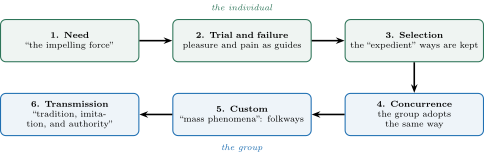
{ How folkways arise, according to Sumner: from the need of the individual to the custom of the group.}
An example of your own completes the explanation: nobody decided at what hour a village should eat, or on which side of a path people should pass one another; a way that worked was repeated, then copied, then expected, then taught. And the limit: Sumner writes that people asked for their reasons “always answer” that their ancestors did so. Always claims more than any observer can have verified.
The second concept. A few pages later, Sumner describes how each group regards the others.
Ethnocentrism is the technical name for this view of things in which one's own group is the center of everything, and all others are scaled and rated with reference to it. Folkways correspond to it to cover both the inner and the outer relation. Each group nourishes its own pride and vanity, boasts itself superior, exalts its own divinities, and looks with contempt on outsiders. Each group thinks its own folkways the only right ones, and if it observes that other groups have other folkways, these excite its scorn.
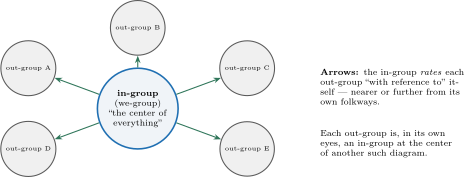
{ Ethnocentrism: one's own group as the center from which all others are measured.}
The style of the treatise. Look at how Sumner writes.
- Short declarative sentences, many of them under ten words: “Need was the impelling force.” “In this way folkways arise.” Each states one thing, like a law.
- The present tense of general truth (“Each group nourishes its own pride and vanity”) and words of universality: each, all, always.
- No I, no you, no anecdote. The subjects of the verbs are abstractions: need, the struggle, the folkways, ethnocentrism.
- Technical terms defined as they appear: “is the technical name for…”.
- Hardly a figure of speech, apart from the metaphor hidden in a verb: each group “nourishes” its pride.
It is the style of a scientific treatise: impersonal, general, assertive. It suits the topic (laws of society), the writer (a professor) and the context (a book for students and scholars).
4.2.2 Martineau: advice to a traveler
Author : Harriet Martineau (1802–1876), How to Observe Morals and Manners
The English writer Harriet Martineau published this small book in 1838, after a long journey in the United States. It is a guide for travelers who wish to understand the societies that they visit: an early treatise on the method of social observation. The traveler, she has just said, must judge what he sees by one standard only: how far it serves the happiness of the people who live there. (Blubber is the fat of whales and seals; Hindoo is the old spelling of Hindu.)
He is not to conclude unfavourably about the diet of the multitude because he sees them swallowing blubber, or scooping out water-melons, instead of regaling themselves with beef and beer. He is not to suppose their social meetings a failure because they eat with their fingers instead of with silver forks, or touch foreheads instead of making a bow. He is not to conclude against domestic morals, on account of a diversity of methods of entering upon marriage. He might as well judge of the minute transactions of manners all over the world by what he sees in his native village. There, to leave the door open or to shut it bears no relation to morals, and but little to manners; whereas, to shut the door is as cruel an act in a Hindoo hut as to leave it open in a Greenland cabin.
Exercises of the chapter
- Concepts, features and registers solved
- Explaining a theory: from the folkways to the mores solved
- Comparing two theories: Sumner and Tocqueville on the origin of a custom solved
- Listening: features of style and register solved
- Speaking: judging a presentation, speaking clearly solved
- Writing: one content, several styles solved