Wealth, Poverty and Justice: Argument, Persuasion and Debate
Course · English for Sociology and Economics (Grade 12, Lebanon), chapter 5 · Lebanon, Grade 12 · the beginning of the chapter, the rest on Adloun
Why are there poor people in rich countries? In 1879 an American journalist, Henry George, answered that progress itself produces poverty, and his book sold in enormous numbers. Four years later a Yale professor whom you already know, William Graham Sumner, replied that every plan to help the poor forgets one person: the quiet worker who pays for it. Half a century on, in the depth of the Great Depression, a new President of the United States, Franklin D. Roosevelt, had to convince a frightened nation that something could be done. The question has not been closed; it is debated in every country and in every generation. This unit will not tell you which side to take. It will show you how each side argues, how an orator persuades, how to weigh what you read and hear — and how to defend a position of your own, in an essay and in a debate, without ever losing your thread.
Curriculum: LB-SE
Learning outcomes
- Reading: identify the thesis, the arguments and the faults of reasoning of an argumentative text; explain how simile, metaphor, irony and personification serve an argument.
- Listening: identify the purpose, the role and the tone of an orator, and the devices by which a speech persuades.
- Speaking: develop main ideas fully while maintaining unity of theme; take part in problem-solving activities; take part in debates and lead them.
- Writing: write an argumentative essay and a persuasive essay; use different argumentative methods of development; maintain thematic unity.
- Thinking: present a critique of a text and of the work of others; compare one theory with another.
5.1 Key terms: wealth, argument, debate
5.1.1 Words for wealth and poverty
| Having and lacking | Earning and paying | Helping |
|---|---|---|
| wealth, wealthy; a fortune; poverty, the poor; want (the lack of what is necessary); the standard of living; inequality; the rich the poor; the well-off the needy; the unemployed. | income; wages (for labor); rent (for land or housing); profit (for capital); savings, to save; a tax, a taxpayer; to afford (to have enough money for); a debt. | charity; relief (help given to those in need); welfare (the well-being of people; also public assistance); a benefit, an allowance; a philanthropist; to redistribute; self-reliance (depending on oneself). |
Watch out: the poor, the rich, the unemployed are plural and take no -s: the poor are… One person is a poor man, a poor woman.
5.1.2 Words for argument
- The thesis (or claim) is the position defended. An argument is a reason given in support of it; evidence is the fact, figure, example or testimony that supports an argument.
- A counter-argument is a reason that can be given against the thesis. A concession admits the part of truth in it; a refutation (or rebuttal) shows why it does not overturn the thesis.
- To argue is to try to show by reasons that a position is true or right. To persuade is to try to bring someone to believe or to do something — by reasons, but also by trust and by feeling.
Since Aristotle, three means of persuasion have been distinguished.
- The appeal to reason (logos): facts, figures, logical arguments.
- The appeal to the character of the speaker (ethos): the audience believes someone who appears competent, honest and well-disposed.
- The appeal to emotion (pathos): fear, hope, pity, pride, indignation.
An argumentative essay relies above all on the first; a persuasive speech uses all three.
5.1.3 Words for debate
| Term | Meaning |
|---|---|
| the motion | the statement to be debated: This house believes that… |
| the proposition | the team that supports the motion |
| the opposition | the team that speaks against it |
| the chair | the person who leads the debate: gives the floor, keeps time and order |
| to have the floor | to have the right to speak |
| a rebuttal | the answer to the other side's arguments |
| a point of information | a brief question or remark offered to the speaker who has the floor |
| the vote | the decision of the audience (the house) at the end |
5.2 Reading: two theories of poverty
5.2.1 George: the wedge
Author : Henry George (1839–1897), Progress and Poverty
You met the American economist Henry George in Unit 3. Progress and Poverty (1879) starts from a fact that he calls an enigma: the nineteenth century has multiplied wealth as no century before it, and poverty has not disappeared. In the introduction, entitled “The Problem”, he states his thesis.
It is true that wealth has been greatly increased, and that the average of comfort, leisure, and refinement has been raised; but these gains are not general. In them the lowest class do not share. I do not mean that the condition of the lowest class has nowhere nor in anything been improved; but that there is nowhere any improvement which can be credited to increased productive power. I mean that the tendency of what we call material progress is in nowise to improve the condition of the lowest class in the essentials of healthy, happy human life. Nay, more, that it is still further to depress the condition of the lowest class. The new forces, elevating in their nature though they be, do not act upon the social fabric from underneath, as was for a long time hoped and believed, but strike it at a point intermediate between top and bottom. It is as though an immense wedge were being forced, not underneath society, but through society. Those who are above the point of separation are elevated, but those who are below are crushed down.
The structure of the argument. The paragraph is a model of argumentative order.
- A concession: “It is true that wealth has been greatly increased…”. George begins by granting what his opponents would say.
- The turn: “but these gains are not general.”
- A clarification of the thesis, in two steps, each introduced by a formula: “I do not mean that… but that…”; “I mean that…”. He rules out the claim that he does not make (nothing has improved anywhere) and fixes the one that he does make.
- A reinforcement: “Nay, more”: progress does not merely fail to help the lowest class; it tends “still further to depress” its condition.
- An image that makes the thesis visible.
Landmark : Figures of speech: the simile as argument
“It is as though an immense wedge were being forced, not underneath society, but through society.” A wedge is a piece of wood or metal, thick at one end and sharp at the other, driven in to split or to lift. The comparison is announced by as though: it is a simile. Driven under a block, a wedge lifts the whole of it; driven through it, the wedge lifts the upper part and presses the lower part down. In one image George gives his whole theory: progress raises “Those who are above the point of separation” and crushes those below. A simile makes an idea clear and memorable. It does not prove it: the reader still has to ask whether society really behaves like a block of wood.
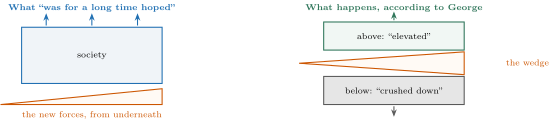
{ George's simile: a wedge driven under society would lift all of it; driven through it, the wedge lifts some and presses the others down.}
5.2.2 Sumner: the Forgotten Man
Author : William Graham Sumner (1840–1910), What Social Classes Owe to Each Other
Four years after George's book, the sociologist of Folkways (Unit 4) published a short and combative essay (1883) against the reformers of his time. Its ninth chapter is entitled “On the Case of a Certain Man Who Is Never Thought Of”.
Exercises of the chapter
- The parts and the methods of an argument solved
- Thesis, cohesion and figures: George's enigma solved
- Comparing two theories and critiquing an argument: Sumner's “social pets” solved
- Listening: “I see one-third of a nation” solved
- Speaking: a committee and a debate solved
- Writing: to argue, to persuade, to keep the thread solved